Hunting traditions – Hunting breaks

An important role in the lives of hunters.

Hunting breaks

Since time immemorial, fractures have played an important role in the lives of hunters. The knowledge and use of these signs gave resourceful hunters the opportunity to understand each other and interact without the uninitiated noticing. It was also a symbol of legal and proper hunting.

What is meant by “fracture”?
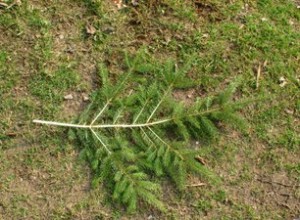
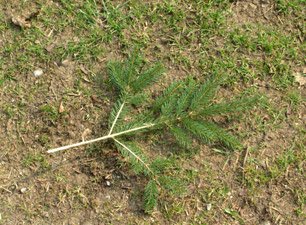
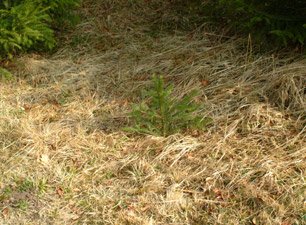
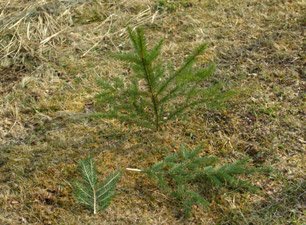
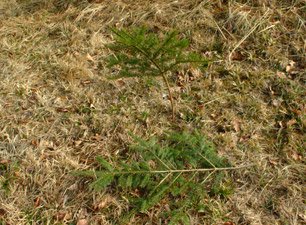
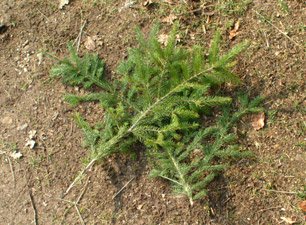
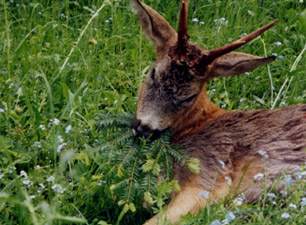
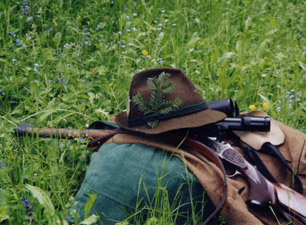
It is a broken green twig or branch, which allows the hunter to indicate the path or escape route of game or to decorate his hunting hat. The twig of oak, alder, Douglas fir and spruce are appropriate to serve as a hunter’s break.

There are two major types

  • Communication breaks
  • Hunting breaks

1. Communication breaks

These breaks were used in other times where communication and movement posed real problems; they now tend to be forgotten. They were used to indicate orientation, place settings, hurt animals or flight of game, mail to be taken, waiting times or warnings. These signs have lost their efficiency as a result of our current communication and movement capabilities.

a. Head break

A branch the length of an arm, the bark is removed from the main stem with the hunting knife, this to avoid confusion with a fallen branch. It is hung from a tree, fence or something similar or even simply laid on the ground. It meant “watch out”: in this area there is something to be noticed, from here the hunter should watch for further signs.

b. Lead break

This branch is the length of a forearm (half as short as a Head-break), and is also debarked, the growth edge indicating a direction to follow, either toward a killed game or to the place of flight.

c. Fleeing breach – Attack breach

This branch with a length of a forearm is planted vertically in the ground with the broken part. It indicates the place where the game was hit (shot) and can no longer be pursued e.g. at the end of the hunting day or at dusk with the risk of not being able to find the place of flight the next day.

d. Track break

When the flight tracks are clearly visible at the location of the flight break, lay an identical break as the previous one but not debarked: with the broken end, pointed, to indicate that it is a deer, roebuck, wild boar or fallow deer. In the case of a female game, the break will be laid with the growing edge in the direction of the flight.

e. Pitch break

Indicates the pitch of each Hunter during a (large) pressure hunt. Is composed of a break of one arm length, pricked into the ground, the lower part completely pruned, only the tip retains green and from a debarked head break of one arm length laid on the ground with the tip of the growing edge facing the direction of the path to be followed at the end of the hunt.

f. Guardbreak

Composed of two fractures of one arm length, not debarked, they lie on the ground in cross shape. If waiting time is given up, this break is pruned except for the tip and laid back crossed.

g. Warning breach

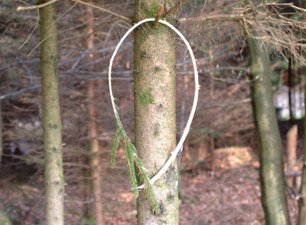
At the time, this break acquired great value because it represented danger. Composed of a fracture, completely debarked and pruned beyond the tip that remains green, folded circularly and suspended very visibly.

2. Hunting breaches

We distinguish the following fractures, which still exist today and are even more and more being restored to honor.

a. Breach of possession

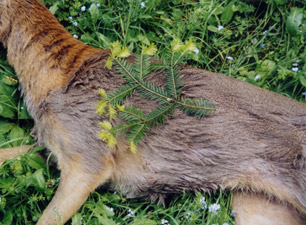
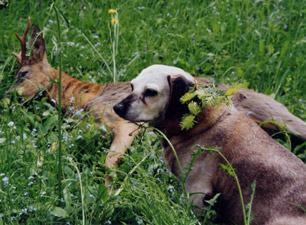
This snap has a length of a large hand. It signals to passing hunters that a hunter has taken possession of a piece of game. If necessary, he does this himself in the place of the hunting rights holder.

This is the practical meaning, but it also has a symbolic meaning: namely, a gesture of honor and reverence by the hunter in front of the shot game and its final decoration. Traditionally, a shot piece of game is always placed on the right flank the side of the heart facing up. The hunter places the snap on the left side of the body, after a final salute of honor to the game, (he takes off the hat for a moment for a minute of silence)

The break is placed as follows:

  • Male game, deer, fallow deer, roebuck, wild boar: the broken end facing the head;
  • Female game, doe, fallow doe, roe goat or sow: the broken end pointed backwards;
  • The predators such as fox, wolf, lynx, and others are put on the left side and do not get a break.

b. Last bite

The male game receives another break ” last bite ” called. This, traditionally applied break of a hand length, is placed between the teeth and had a symbolic meaning namely “the reconciliation with the stretched game”.

c. Archer break

This break of a hand length moistened with sweat (blood) of the shot game was originally handed to the hunter of a large deer or boar. He wore it on the right side of the hat. Today this break is handed to every hunter of a deer, fallow deer, roebuck or wild boar. Only one archer’s break is handed to the hunter even if he has stretched several pieces.

The lucky hunter with the hat in hand receives the break, presented on the naked blade of the hunter’s knife. Failing this, the break is placed on the hunter’s hat. The hunter immediately places the break on the right side of his hat. On this occasion, the hunting lord wishes a “Weidmans salute” to which the hunter replies with a “Weidmansdank” and a handshake.

d. After-search fracture

If the game was tracked by a sweat dog, the hunter hands part of the break to the dog’s handler. By this gesture, the hunter shows the importance of the dog’s intervention. The handler also places this part of the break on the right side of his hat.

He confirms, after the successful search, a small break on the dog’s collar. This does represent the survival of a very old custom. This handing over of the break is done in the hunt itself when no presentation of the hunting tableau is scheduled at the end of the day.

e. Hunter break

In some regions, the tradition is continued: a small break is attached to the left buttonhole of the vest, to participate in the dish drive. Tradition has it that in Bavaria but especially in Austria the hunter wears a small break on the hat just to indicate that he is part of the hunting world. This small break placed on the left side of the hat is called “party break” or “professional break” and is worn on the occasion of hunting events but also on the occasion of the funeral of a hunter friend.

Observing and passing on these ancient traditions is an integral part of our hunting experience, is specific to a grazing hunter and makes our sporting hobby passion so beautiful and rich.

Source: From the Hereheide and Berufsjäger Bayern.

No permit yet?

Jachtexamen.be is the online learning environment for hunting, providing optimal exam preparation.