
Small game – Hare

All about the hare.

Haas

Class: mammals
Order: lagomorpha
Family: leporidae
Species: lepus europaeus (field hare)

Biotope

The hare’s preferred environment is an open landscape between forest steppe and desert steppe. Because agriculture allows it to find sufficient food throughout the year, it can easily adapt and expand in new areas. Mark trials have shown that the hare is very loyal to its habitat. Eighty-five percent of all tagged young hares were recaptured within a three-kilometer radius.
Hares live on top of the ground and do not dig pipes like wild rabbits. They are content to scratch out a lying area (= army) with the hindlings, which is just the size of the hare’s body. In rainy weather, rainwater runs along the water-repellent fur just outside the army. Within its habitat, the hare establishes several armies. According to the calm and prevailing winds, it will show its preference for a particular army. They prefer to lie with their heads against the wind; this prevents the hairs that protect the body thermally from blowing up and at the same time allows them to catch the scent of possible predators.
Normally the hare lives within a habitat of 20 hectares. However, to find food, mate and escape, you can count on a total habitat of 300 hectares.
External Characteristics

The sexes are indistinguishable from a distance.

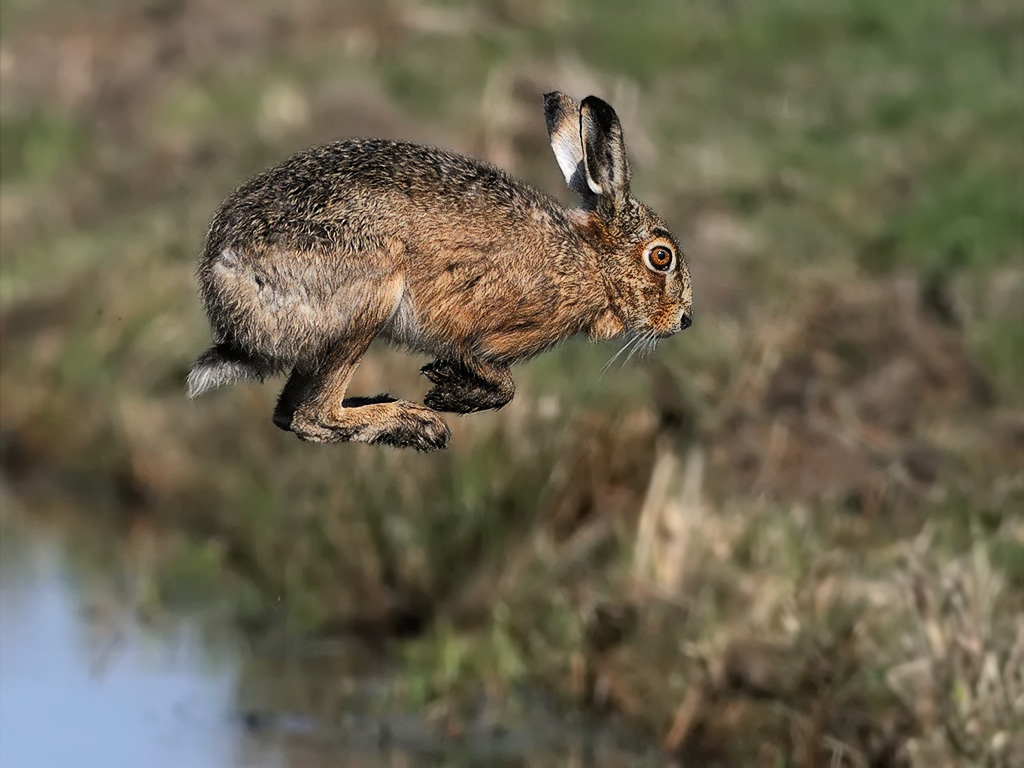
The hare has an elongated, muscular body with a broad but funnel-like narrow thorax tapering forward. Typically, it has slender precursors and very long, highly muscular hindlings. The body is well shielded from cold by a layer of fine, short and woolly underhairs, above which are stiffer and longer cover hairs that are light colored and end in dark spikes. Natural oil makes those hairs waterproof.
The hare changes its hair twice a year. It falls out zone by zone. Molting begins on the head and neck and runs down the back over the rest of the body. The white belly hair comes last.A hare is best recognized by its ears (= spoons). These are multifunctional: they not only serve to pick up any sound, they are also used to maintain the body temperature.
The eyes too are adapted to recognize any looming danger as quickly as possible. Their sideways bulging position allows them to see both sides. Because the hare is so active at night, it is equipped with tactile hairs and a very good sense of smell. In bright light, the eye pupils do not contract and the animal is defenselessly blinded. This is what poachers with light boxes take advantage of.

Propagation

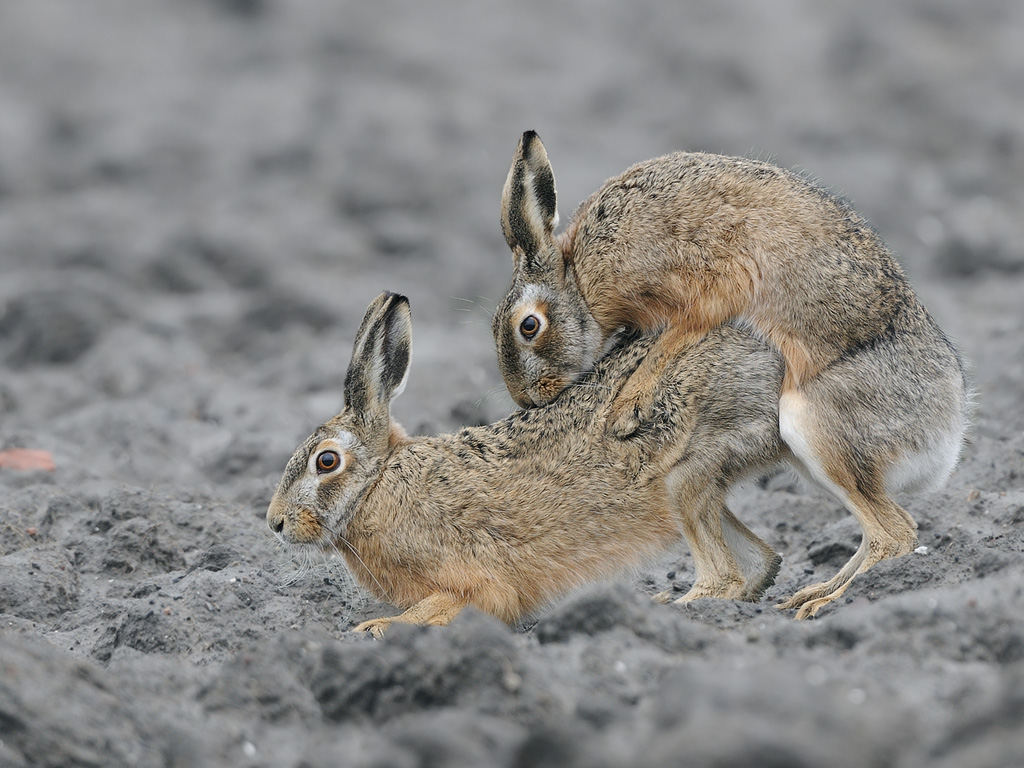
Day length is the natural factor regulating the reproductive period. The rutting odors of the lees trigger the reproductive ritual. In hares, the doe remains in heat until copulation takes place.
After a gestation period of 42 to 43 days, usually 2, exceptionally 6 young (= lampreys) are born. In normal winters, fertilized does can be found as early as December. On average, a mullein gives birth 3 to 4 times a year, resulting in 12 young per year per mullein. Of these newborns, 62% never reach the age of 1 year.
Sexual activities begin in the month of December to end in the month of September. The birth weight of hares is 90-150 grams depending on the number of young in the litter.

No permit yet?

Jachtexamen.be is the online learning environment for hunting, providing optimal exam preparation.