We already have a few things hanging on our bike. Especially now with the ongoing procedures of Vogelbescherming Vlaanderen.
On 8 August 2014, Vogelbescherming submitted a petition against the Flemish Government to have a number of provisions in the hunting decrees of this Flemish Government declared null and void.
– The complete Petition of 2014 – Petition Vogelbescherming Vlaanderen
And what do we learn from this:
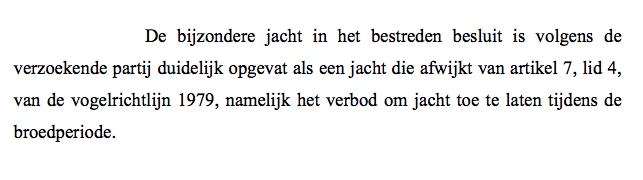
The biggest problems they have with the current hunting regulations are in the field of hunting in snow and frost, the special hunting of the fox, the use of bait in box traps, special hunting in general due to the lack of a legal basis, the special hunting of bird species because it is contrary to the European Birds Directive, etc. the hunting of the partridge, the hunting of the fox, the use of the pigeon carousel, the hatching and reintroduction of pheasant broods and the expansion of the winter hunting of greylag geese and wigeons.
In the last petition it addressed to the Council of State, Vogelbescherming Vlaanderen raised 8 pleas that are set out below.
1. Special hunting
Vogelbescherming Vlaanderen won a first blow on this point earlier this year when the regulation regarding special hunting in the Hunting Conditions Decree and the Hunting Opening Decree was annulled on the basis that there was no legal basis for special hunting in the Hunting Decree.
In the meantime, this point has been restored by providing a legal basis in the Hunting Decree (Hunting Decree 2015 07 20). Now it is only a matter of waiting for an amendment to the hunting opening decree that provides for new opening dates for special hunting.
2. The Snow and frost scheme
The next regulation that Vogelbescherming Vlaanderen wants to see annulled is the regulation of hunting in case of snow or frost. This regulation is currently contained in Article 7 of the Hunting Conditions Decree and reads as follows:
Ҥ 1. If it snows at the location where hunting is taking place and the snow layer reaches a thickness of five centimeters, the hunting is suspended. The suspension lasts up to 24 hours after the last snow falls. The suspension referred to in the first paragraph does not apply in the following cases:
- 1° for hunting in the woods and game that is pushed out of those woods and stretched in the open field, within 50 metres of the aforementioned forests;
- 2° for the hunting of the wood pigeon, the Canada goose and the rabbit;
- 3° for the hunting of waterfowl on or immediately along marshes, ponds and watercourses with due observance of paragraph 2 of this article;
- 4° for the hunting of big game.
§ 2. Hunting of waterfowl is prohibited at a distance of 150 metres or less along marshes, ponds and watercourses of which more than half of the surface and the associated reed beds along the banks are covered with ice.
§ 3. In the event of very hard and prolonged frosts, hunting may be temporarily suspended by the head of the agency. The suspension of hunting can be imposed per province and per category of game. The head of the agency shall take the decision to suspend hunting on the advice of the relevant provincial director of the agency.’
There is currently an advice from the auditor of the Council of State that supports the vision of Vogelbescherming Vlaanderen. The judgment on this issue is expected at the end of this year.
3. Use of vegetable and non-live animal bait
The next means that Vogelbescherming Vlaanderen is raising is the use of vegetable and non-living animal bait. The Dutch Society for the Protection of Birds wants to see this destroyed. This is currently permitted by art. 13 of the hunting conditions decree and reads as follows:
For hunting or control with box traps or cage traps, vegetable and non-live animal bait may be used as a lure.
The Council of State has not yet ruled on this.
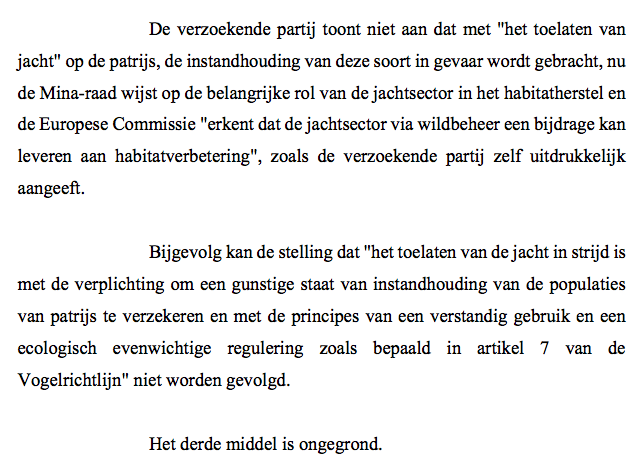
4. The hunt for the partridge
The Council of State explicitly acknowledged that the hunting industry makes a lot of effort to improve the population by purchasing and cultivating plots.
5. The Night Hunt
Since wild boars are nocturnal animals, the hunting conditions decree provided for the special hunting of this species also at night with the help of artificial light. The Society for the Protection of Birds argues that the use of these products is contrary to the Benelux provisions and Articles 6 and 19 of the Hunting Decree. The regulations regarding night hunting and the use of artificial light were provided for in Articles 9 and 33 and of the Hunting Conditions Decree.
In this area, too, the auditor spoke in favour of the view of Vogelbescherming Vlaanderen. There is no final judgment of the full Council of State yet, but will probably follow at the end of this year.
6. The use of the pigeon carousel
Articles 39 and 51 of the Hunting Conditions Decree allow the use of the pigeon carousel again in the case of special hunting and control. Here too, Vogelbescherming Vlaanderen has asked the Council of State to annul the relevant provisions so that the use of the pigeon carousel is banned again. According to Vogelbescherming Vlaanderen, these means would be in violation of the Benelux provisions and Article 19 of the Hunting Decree.
Here, too, the auditor spoke in favour of the vision of Vogelbescherming Vlaanderen.
7. Article 64 of the Hunting Conditions Decree
This article reads:
The Agency may grant specific derogations for the transport of live game or game eggs outside the opening hours of the species in question.
According to the Dutch Society for the Protection of Birds, this measure helps to reintroduce pheasants.
Here too, the request is followed by the auditor.
8. Breeding pheasant broods
Finally, the Society for the Protection of Birds requests the annulment of Article 65 of the Hunting Conditions Decree, which reads as follows:
If there is no other satisfactory solution to protect the nests of pheasants from threat from agricultural work, the eggs from those broods can be transferred for further hatching and rearing of the young. The person responsible for incubating the eggs and rearing the young shall notify the Agency of the number of nests, the number of eggs and the number of young reared by means of a paper or electronic notification form, the model of which shall be drawn up by the Agency and made available on the Agency’s website www.natuurenbos.be. The notification form shall be sent to the Agency by 1 July at the latest in one of the following ways:
1° by registered letter;
2° by e-mail;
3° by electronic submission.
By 31 July of the same calendar year at the latest, the reared young are released into the wild in the same hunting grounds where the eggs were collected.
According to Vogelbescherming Vlaanderen, this ensures that hunters have a back door to release pheasants and this provision is therefore contrary to the Birds Directive, the Hunting Decree and the principle of due care.
The auditor of the Council of State also follows them in this area.
It therefore goes without saying that the upcoming rulings of the Council of State could seriously shake up the hunting landscape if the judgment of the Council of State fully follows the pleas put forward. So we have to wait and see. In addition, if this is the case, restoring the annulled provisions may again take months of consultation and discussion, as this time we will not be lucky enough that an amendment to the hunting decree will be on the agenda of the Flemish Government anyway.