


Biotope
The wood pigeon is found almost everywhere. It is enormously adaptable.
The wood pigeon is found almost everywhere. It is enormously adaptable.
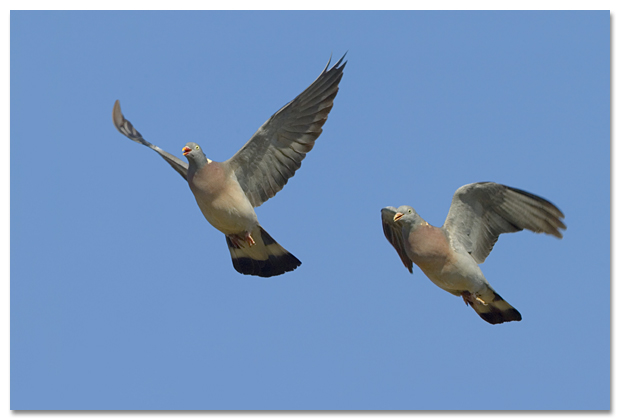
The upperparts are tinted blue-gray, slightly darker on the wings and black on the tail. The breast is wine-colored, a color that blends unobtrusively into the light gray of the belly, flanks and underside of the tail. Both the rump and head are bluer gray than the rest of the back, while iridescent blue-green colors the sides of the neck; large white spots run nearly together on the neck. A broad band runs across the black tail and several broad white bands cross the wing. The glow in the plumage lends the bird a bright appearance, but is lost in poor condition. The base of the bill is pink, the rest goes from yellow to the light brown of the bill tip. The bill widens at the base into a soft, white tubercle formed by the membranes above the nostrils. The coral-red legs are tinged light purple. A small pear-shaped iris stands out in the straw-colored eyes, giving the bird a very watchful appearance.
The courtship behavior looks like this: the pigeons bow the head, the tail is raised and spread. Meanwhile, the accompanying courtship song sounds. After a while, the female tolerates the male close to her and they form a pair. From then on, nest site selection and luring the female to that nest site begins. The male chooses a suitable place for the nest and sits there to courtship, but now the wings begin to twitch and the tail moves jerkily. Then the pigeons minnows each other: they rub the beak along each other and pass it through the feathers of the neck.
Its main function seems to be to initiate ovulation this way. Once a nest site is chosen, nest building begins. Even an old nest can be used, they just have to refurbish it.
The first nests are built from the beginning of May. Nest building stops at the end of September. Actual ovulation and copulation are closely related to nest-building activities and love-making.
Already a week before there are eggs, the female begins to brood. She sits on the nest, leaving everyone under the delusion that it is serious. Perhaps she does this to give the nest its proper fit despite all its shortcomings.
About a week later, eggs are laid in two days. Already after the first egg, incubation begins. The male incubates from about nine to sixteen hours, the rest of the day the female incubates. Relaying is done very precisely so that the eggs are hardly left unattended.
After an average of 17 days, the eggs hatch. During the first three days, the young are fed very regularly with milk, later they also receive the food collected by the parents. After about 10 days, the young are fed only at the changing of the guard.
The young remain in the nest for an average of 22 days. Even before they leave the nest, the parents are engaged in a new cycle of courtship, nest building, egg laying, etc. Even after the young have left the nest, the parents will still feed them for a while.
Jachtexamen.be is the online learning environment for hunting, providing optimal exam preparation.