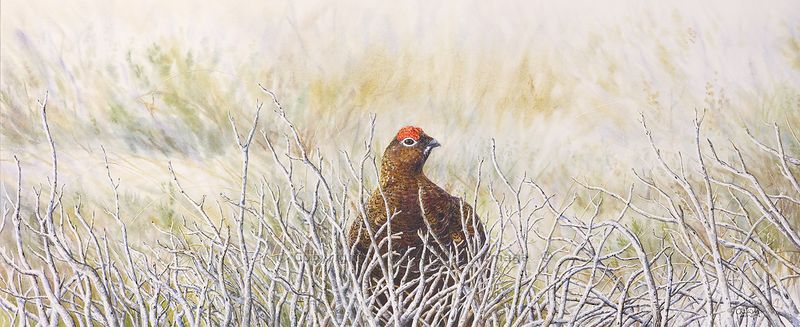
An almost magical word, this “king and queen” of small game. In Victorian times, railroads and roads were built and lodges specially constructed. And for centuries there have been generations of artists trying to capture this magical bird on canvas or photograph (drawing – Coling Woolf)
Each year on August 12 – Glourious Twelfth (unless this falls on a Sunday, then the day after) the hunting season for this unique game bird begins.
But years of preparation preceded this.
In a number of short chapters and paragraphs, we want to try to unveil this mysterious event.
Moorland
Everything starts with the Moorlands. Mostly peaty soil that acts as a big sponge and holds a lot of water, slowly releasing it to fill streams and rivers.
Count optimally on a good 8,000 to 15,000 hectares. Smaller Moors are easily a few hundred hectares. And almost always in full ownership. Because a Moor does not yield more than Grouse, and you have to start with only one objective: Heath and Grouse.
At a last count there were 600 Moors in use, 450 in Scotland and 150 in the north of England.
Heather
Second most important part is the Heaths. Since late last century, seeding and cultivation techniques have been found to bring heath back to the peatlands.
And bizarrely, if there is heath then it is regularly removed. Usually by fire or “disturbance” of the ground by ploughing off. The seed, which remains germinable for years, sprouts up again fairly quickly. And precisely these young shoots are the Grouse’s main food. The other parts of heather that grow in gradations higher up are then excellent for nesting or to provide shelter and cover for the Grouse and chicks.
Maintenance
When you get to that point the maintenance begins. Especially the control of predators with goose on top Fox Crow and Stone marten. On one Moor at start up almost 1 fox per 3 hectares. Other predators to combat are: forest and heathland fires, ticks, disease, incorrect grazing, disturbance and even sabotage. Added to this is any freezing temperatures where eggs can freeze to pieces until early May.
Wildlife and nature
But you get something in return, especially in terms of biodiversity. With an increase in the number of birds, especially ground-breeding birds such as lapwing, skylark, wheatear, golden plover, curlew, ringed thrush, and especially birds of prey such as raven, kestrel, peregrine falcon, blue and marsh harrier, hawk. Who do like the occasional Grouse chick, but mostly eliminate the worse predators.
Grouse
And then the game. The famous Grouse. Hunting game in England and Scotland is even a separate subfamily “Lagopus scoticus.” Beautiful birds that resemble partridges, but are rather related to pheasants. Males are polygamous. The hens lay 6 to 9 eggs in April-May.
The rise, for a few years now, of the Grouse is due to (see above) advances in sowing and cultivation techniques of the heather, as well as the reduction of the parasitic worm (Trichostrongylus tenuis) through the use of medicinal gravel. True game, because Grouse cannot be bred, even feeding them is almost impossible.
Fantastic hunting game, if you know that the Grouse can reach speeds of up to 140Km/h.
Also, Grouse are counted by Brace, being two.
People
And when you get that far you need people, lots of people. Besides the owner, you have the Moorland manager, the Headkeeper, the beatkeepers (trackers), pickers up who pick up the birds, and flankers. We have this here on well-organized yachts as well. But specifically on the Grouse are the loaders.
Equipment
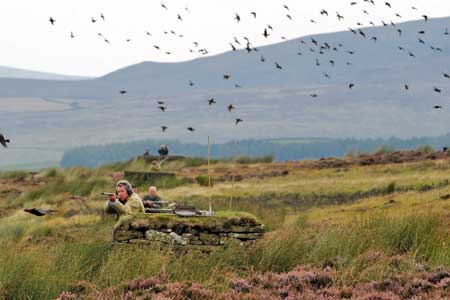
These loaders are among the regular equipment of a hunting day on the Moor. In addition, you need, the obligatory Land Rover to transport the shooters and their entourage to the hunt. Also, dogs, hip flasks to keep warm, picnic baskets and “rugs” for lunch. And shooting is done from a “Butt.” An excavated pit, walled with stones and since they have been in the same place for years, the flight lines of drives, completely overgrown with moss. In the Butt you stand waiting with your loader. An experienced helper who helps you in the heat of battle to take over your empty gun and return a loaded one. thus, you can take in sight both arriving and away game.
Guns
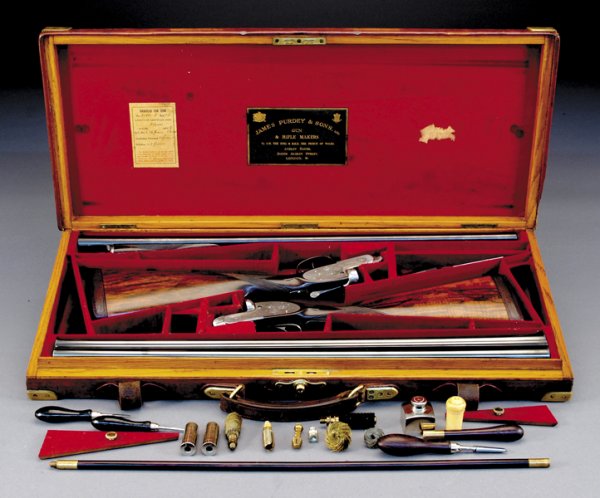
So optimally you need two identical rifles, same type, same barrels, same chokes. And then you end up with the English classics “a pair of” Purdeys or Holland & Holland. For one you quickly pay 100,000 euros. And for the Grouse you need 2. Which as a pair cost just over double, but they are in a nice box together.
Safety
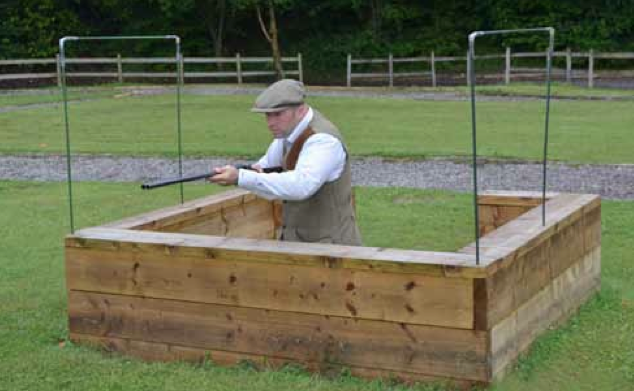
Grouse shooting is special and very exciting. And because of that, safety must be taken care of. Most butts are equipped with safety sticks that prevent you from swinging too far to the left or right. Furthermore, when passing your rifle to the loader, you must always put it on safety, especially when only one cartridge has been fired. Given the intensity of the shooting, hearing protection and safety glasses are a must.
There are even special Grouse Shooting training sessions provided to practice beforehand.
Most dangerous is the seasoned older shooter, who used to be a good rifle but is now on his way back. Especially after lunch. This also applies to our hunting days.
All the Grouse ever bred can never replace one man dead
Records
A first record was even published in The Times of Sept. 5, 1893. On August 31 of the same year, a total of 1324 brace (or 2648 Grouse) was shot on Broomhead Moor with nine rifles. And this even though the first shot did not fall until 10:45.
A second, even more impressive, record was set at Abbeystead in 1915, on opening day Aug. 12. After six drives, 2,929 Grouse had been shot.
But most impressive is Lord Walsingham’s single gun record. On August 28 of the year 1888, he shot 1,070 Grouse at Blubberhouse Moore. He was assisted by 40 trackers and during the day 20 drives were made. Direct support came from 2 Chargers who kept his 4 rifles ready to fire. In the process only 1510 rounds were fired. The more so that on 1 shot 3 birds fell and 3 were hit 2 times on 1 shot.
And it may also cost something
Nothing simple in Grouse country. Purchasing the land, regenerating the moors, the Grouse, the people and equipment for a shooting day. And what does that cost. Well simple between £150 and £200 per brace. Yes you read correctly, a sloppy 200 to 250 euros for 2 birds. Or for a full group of 8 guns, but including accommodation, commission, tips, ammunition, food and drink, you come to a sloppy 65,000 euros for a day of Grouse.
Fieldsports – the hunting magazine
“You see the beaters in the distance and suddenly movement. You react sharply, but too far. Your neighbor, a little lower, tries a shot. Meanwhile, your palms must wipe back from sweat on your tweed vest. Waiting again.
And then suddenly in your direction a “covey” of about 10 Grouse. You raise your black barrel, in one smooth motion, hand under the forewood, your butt in your shoulder, and you aim, … and then there is nothing else “Grouse Shooting.” But this is just the moment. The environment and atmosphere, of course, is much more. A multitude of impressions, smell, color of the moor and the people around it, the Moor people who are happy to be able to bring this forward, the chosen shooters who are happy to be able to experience this.”
– Inspired by several articles from the Shooting Magazine Fieldsports.