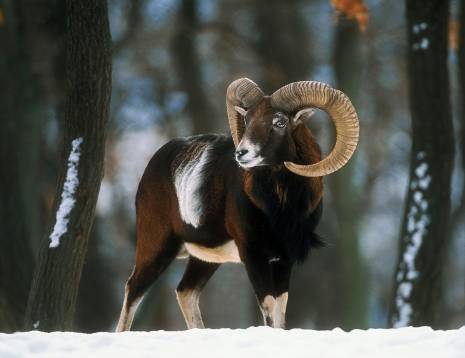


The moufflon is a game species that was imported from the Mediterranean. Many see the mouflon as an enrichment of the wild fauna. Others see it as an exotic species to be eradicated. The mouflon is undoubtedly an interesting game species that has adapted excellently in most of its new habitats and has great hunting value.
As a biotope, the mouflon prefers dry areas with rocky soil and lush shrub vegetation.
The male is a ram, the female is a ewe and the young is called a lamb. The horns are the most typical feature of the species. Although the mouflon is also a ruminant, it does not belong to the cervids (=weedbearers) but to the hornbearers (to which the chamois and ibex also belong).
Horns are permanent skin appendages that grow permanently around a bony spindle at the skull. Thus, most of a horn is hollow and consists of keratin.
In the mouflon ram, horns or snails grow arch-like. This growth is particularly striking during the first three years of life. Then it slows down until the snails appear to form a +/- ninety centimeter long closed circle at about the age of seven. Because horn growth stops during the winter period, a kind of annual rings are formed that accurately indicate age.
The winter dos of mouflons are dark brown, but the underside of the body and the lower half of the runners are white. Most rams then also exhibit a paler saddle patch. This disappears in the redder summer dove.
Mouflons are pronounced diurnal animals and therefore possess a good sense of smell and excellent eyesight. Coupled with their natural caution and the fact that they usually live in groups means that their hunting is not at all easy.
Their food consists mainly of various grasses and leaves, blackberries,…
The rutting season falls between October and December. From the age of one and a half, rams are able to reproduce. Normally they do not participate in oestrus until they are 3 to 4 years old. Ewes usually produce their first lamb (twins are exceptional) when they themselves are two years old. Gestation lasts 5 months so most lambs are laid in March.