


On a successful hunt, it is nice to keep the hunting trophy and possibly hang or display it at home in his trophy room.
Below is a description of the use of hunting memories in the Hunt and below the calculation method
On a successful hunt, it is nice to keep the hunting trophy and possibly hang or display it at home in his trophy room.
Below is a description of the use of hunting memories in the Hunt and below the calculation method

We distinguish here following hunting memories:
The antlers are the trophy at Red and Dam and Reewild.
As we know, antlers are the product of the skeleton,are shed each year and grow back each year. The antlers consist of branches, each (almost) with a separate name, see Red deer. The size of the antlers, the number of scions, does not give the slightest indication about the age, but rather depends on the state of health and habitat of the animal.
Attached is the CIC calculation of the trophy of Red Deer and Roe.
The canines (upper and lower) of the keiler. These continue to grow and so their length does indicate age.
Attached is the CIC calculation of Sus Scrofa‘s trophy.
Snails or horns are the hunting herring in the Moeflon. Horns are permanent skin appendages that grow permanently around a bony spindle at the skull. Thus, most of a horn is hollow and composed of keratin. In the mouflon ram, the horns or snails grow arch-like. This growth is especially noticeable during the first three years of life. Then it slows down until the snails appear to form a +/- ninety centimeter long closed circle at about the age of seven. Because horn growth stops during the winter period, a kind of annual rings are formed that accurately indicate age.
Attached is the CIC calculation of the Moeflon ram’s trophy.
With the duck, the curly feathers of the Woerd are the hunting trophy.
With a woodcock, we have two trophies.
The snipe beard is on the top of the back at the level of the tail insert. The painter’s feather is at the “elbow” of the wings. Given the fineness of this feather, it is used in painting (Fr-La plume du pientre, D-Malerfederchen).
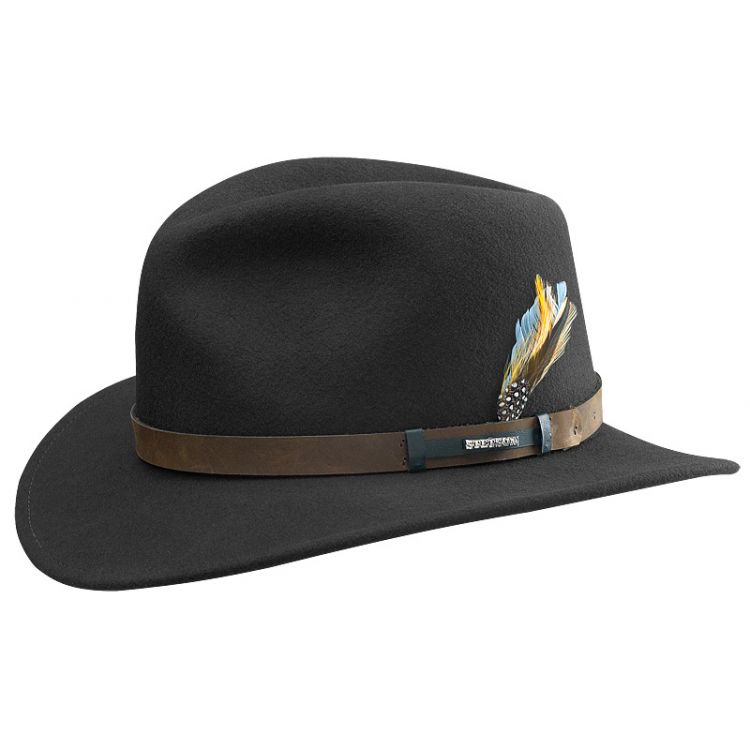
These feathers as well as the Curly Feathers are sometimes worn on the left side of the hat as a Hunting Break. This Jagerbreuk is called “feestbreuk” or “beroepsbreuk” and is worn on the occasion of hunting events but also on the occasion of the funeral of a friend hunter.
There are also a number of, less used, recollections, such as: Grandels of Red Deer, sometimes of the Red Deer, the Hooks at the Sow (Sus Scrofa), the fur of the Ever
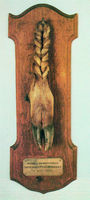
There is also a special hunting trophy at the Chasse a Courre, the Long Hunting Trophy being the coat braided over the forerunner of the Deer or Roe.
In order to compare the size and importance of a trophy, the uniform calculation method was figured out.
Already at the end of the 19th century, with the book “Records of Big Game”, there was a first attempt to determine the value of trophies. Based mainly on the mathematical formulas of the “Boone and Crocket Club” from North America, work continued during various conventions with the “Madrid Formula” as a result. However, it was not until the end of 1977 that a final method of calculation was developed.
The CIC (International Council for Game and Wildlife Conservation – Conseil International de la Chasse et de la Conservation du Gibier), is the international body that controls the equal calculation worldwide.
The calculation relies on a number of indications such as
hereby the CIC calculation method of the most common species:
There is also a medal system for the various trophies:
|
Game/medal |
bronze |
silver |
gold |
| Red deer |
170 |
190 |
210 |
| Wild boar |
110 |
115 |
120 |
| Roe deer |
105 |
115 |
130 |
| Fallow deer |
160 |
170 |
180 |
| Mouflon |
185 |
195 |
205 |
Jachtexamen.be is the online learning environment for hunting, providing optimal exam preparation.