


Biotope
Originally, all pheasants are native to Asia. The pheasant is a resident bird (does not migrate) that is best at home in moist, semi-open landscapes, with adequate cover.
Originally, all pheasants are native to Asia. The pheasant is a resident bird (does not migrate) that is best at home in moist, semi-open landscapes, with adequate cover.
In pheasants, males are conspicuously colored so that hens can easily locate them. The variegated color also draws the attention of many predators to the rooster. Because the hen and the chicks are more simply dressed (danger dress), they escape the attention of predators more easily. The rooster’s variegated colors also excite other roosters into mating fights. Through these fights, the healthy and strong male comes to reproduce and thus passes on his good qualities to the offspring, while the weak and the sick males do not participate in reproduction.
The colors of the rooster are beautiful: on its chest it has shiny reddish-brown plumes, its head and its neck shine greenish-blue up to the white neck ring, if any. Around the eyes there is a large deep red wreath and adults have a pair of short ear tufts. During the reproductive period, the rooster proudly raises its ear tufts and shines at its finest.
The color of the hens is light to dark brown with dark spots. Although the rooster and hen both have a long pointed spear tail, the hen’s tail is shorter. All pheasants have short rounded wings, which allow them to develop fast powerful flight. When in danger they prefer to run away quickly, but in distress they can rise only with difficulty, almost straight up. Once they fly, they achieve a surprising speed, which could reach a hundred kilometers per hour.
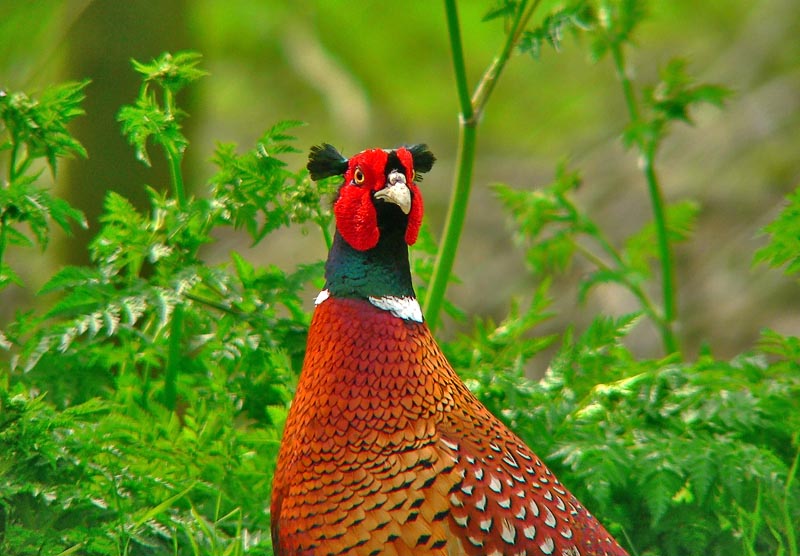
The pheasant lives polygamous. Early in the spring the cocks call. Each cock occupies its own territory: an area of 5 hectares for older cocks, while a young cock is satisfied with half. He announces his presence to competitors and mating hens by regularly crowing, drumming his wings and attacking any intruder with his spurs and beak.
The hens come to join such a beautiful lover full of admiration. Gallantly he regularly courts them, until once they have a nest of eggs. From then on, the rooster will assume his function as an eye-catcher for predators and stay far away from the nest.
The hen makes a simple nest in dense cover on the ground. She lays 6 to 16 eggs of blue-gray to coffee-brown color and incubates for 24 to 26 days. Sometimes you will find eggs by the spot in one nest because pheasants sometimes lay in each other’s nests. Newly hatched pheasants immediately follow the mother (nestlings). A pheasant mother will defend her chicks through thick and thin. If accidentally discovered, she will pretend to be wingless, and in this way she can draw attention away from her chicks by her conspicuous behavior.
Thanks to camouflage, which makes the chicks very difficult to see, they sometimes survive an unpleasant encounter. Still, loss among chicks is very high. Usually the weakest chicks cannot even follow the hen and languish. Pheasant chicks are very sensitive to moisture and various parasites. After three months, pheasants can take care of themselves and the family bond falls away.
Jachtexamen.be is the online learning environment for hunting, providing optimal exam preparation.