


As the English word “Retriever” indicates, a dog well suited to search and retrieve shot game.
Dogs – Retrievers
All about the retrievers.
Retrievers
- Chesapeake bay retriever
- Curly-coated Retriever
- Flatcoated Retriever
- Golden Retriever
- Labrador Retriever
- Nova Scotia Duck Tolling Retriever
Chesapeake bay retriever (FCI 263)
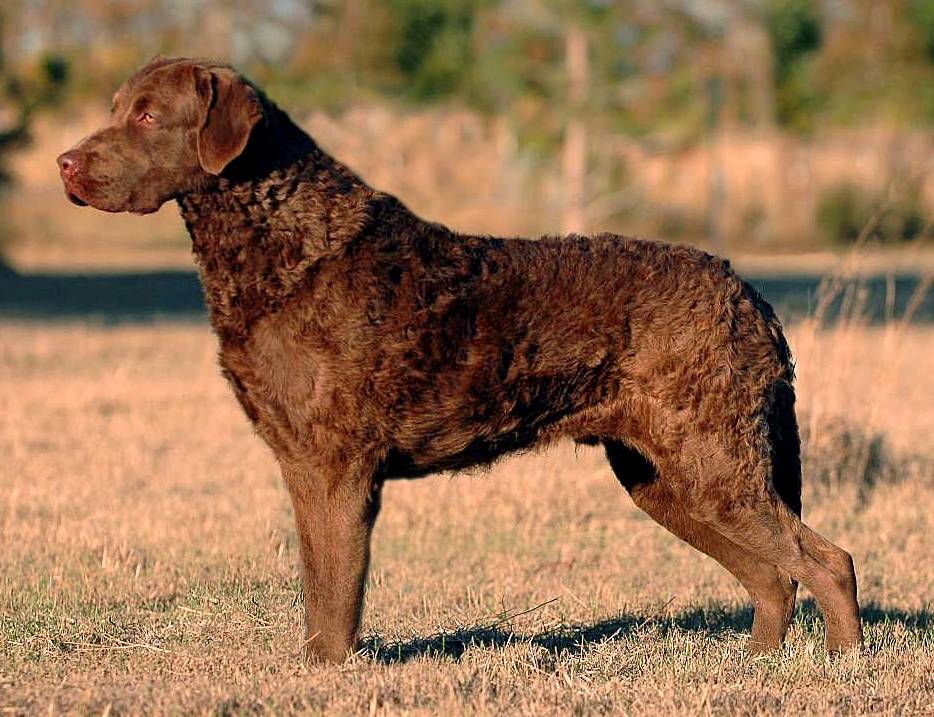
Appearance:
- The body is of medium length, and has a robust appearance. The length of the body is slightly longer than the height at the withers. The chest is strong, deep and wide. The ribs are arched and deep. The back is short and powerful. The topline is straight or slightly ascending, making the withers slightly lower than the hindquarters. The shoulders are well muscled. The forelegs are moderately long and straight. The hind legs should be as powerful as the forelegs. The hind legs must provide the power when swimming and are thus very important for the dog. Medium length and straight with good bone and muscling. The neck is moderately long, and strongly muscled.
- Color: Color ranges from faint brown to dark brown in the shades of dead grass, or from reddish brown to dull straw yellow.
- Head and skull: The skull is broad and round with moderate stop. The muzzle is about the same length as the skull and tapers slightly, but never becomes pointed. Thin lips that do not overhang. The eyes are medium sized, set far apart, bright and have an intelligent expression. The color of the eyes is yellowish or amber. The ears are small, are well placed on top of the head and are carried hanging. The nose is short. A scissor bite is preferred.
- Tail: Medium length and medium weight at the base of the tail. The tail is straight or slightly curved and is never carried over the back.
- Feet: Well arched haze feet, of good size. Well closed toes.
- Hair: Thick and short. Nowhere longer than 4 cm. The undercoat is dense, fine and woolly. The hair on the head and legs is very short and straight. On the shoulders, neck, back and croup the hair tends to wavy. Moderate feathering on the tail and back of the thighs is permissible. The texture of the coat is very important, as the Chesapeake is used for hunting in all weather conditions and the dog must also be able to work in ice and snow. Therefore, the outer coat is somewhat oily, which provides protection against water and helps to dry quickly. The coat should be as water-resistant as a duck’s feathers. The coat should not curl on the body. In summer, this breed sheds tremendously and needs daily brushing.
- Height at Withers: Male: 59 – 67 cm, Female: 54 – 62 cm
Character:
- Hard
- Stubborn
- Battling
- Sharp
- Loving children
- Hard worker
Curly-coated Retriever (FCI 110)
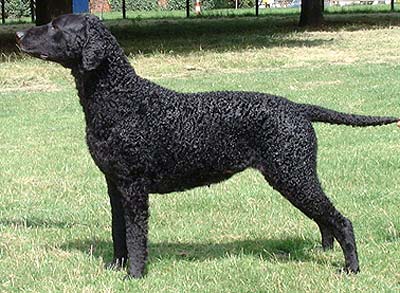
Appearance:
- rectangular, strong and active
- Skull: comparatively long
- Muzzle: powerful and of good length
- Nose: wide nostrils, black in blackish dogs, liver-colored in liver-colored dogs
- Eyes: proportionately large, not bulging, as dark as possible
- Ears: relatively small, set low and worn close to head
- Tail: moderately long, carried straight
- Coat: mass of dense curls, on ears slightly less and on tail decreasing to tip
- Color: black or liver brown
- shoulder height: approx. 66 cm
Flatcoated Retriever (FCI 121)
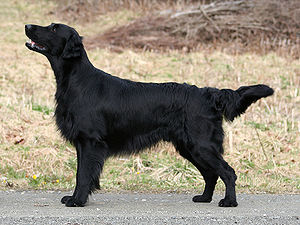
Appearance:
- Build: rectangular, active, strong, not heavy
- Head: comparatively long with planes, moderately broad skull and visible but unmarked stop
- Muzzle: powerful, proportionately long with falcate, straight nasal bridge and parallel with extension of skull
- Nose: large, wide nostrils
- Eyes: dark brown to nut brown, moderately large, not protruding
- Eye opening: oval and horizontally placed
- Ears: worn small and close to head
- back: short and wide
- Loins strong, chest deep
- Tail: carried rteight, comparatively short and not too conspicuously above extension of backline
- Coat: dense, fine and straight
- Color: black or liver brown
- shoulder height: approx. 58cm
- weight: 27 – 31.5 kg
Golden Retriever (FCI 111)
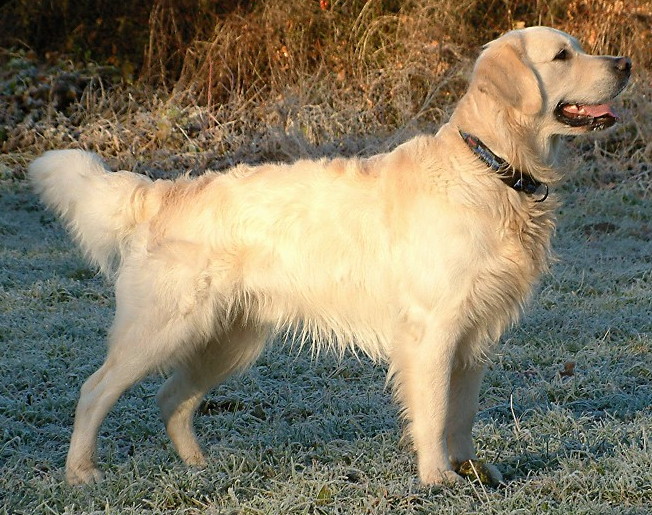
Appearance:
- Build: harmoniously built, strong dog, neither long-legged nor bulky
- skull, broad, stop clearly marked
- Muzzle: powerful, strong jaws
- nose mirror: black
- Tail: reaching to the jump, not carried high, no curl in tip
- Coat: straight or wavy, soft and shiny but at the same time dense
- color: from warm gold to light creamy yellow
- shoulder height: 51 – 61 cm
- weight: 25 – 31.5 kg
Character:
- lively, friendly and good-natured
- suitable as a guide dog for the blind
- childhood friend, sweet, gentle, reliable
- space and exercise needed
- energetic
The dog in the picture is Duke Destiny of a Bed of Roses. His father is Ritsilyn Calaghan former Belgian hunting champion
Labrador Retriever (FCI 122)
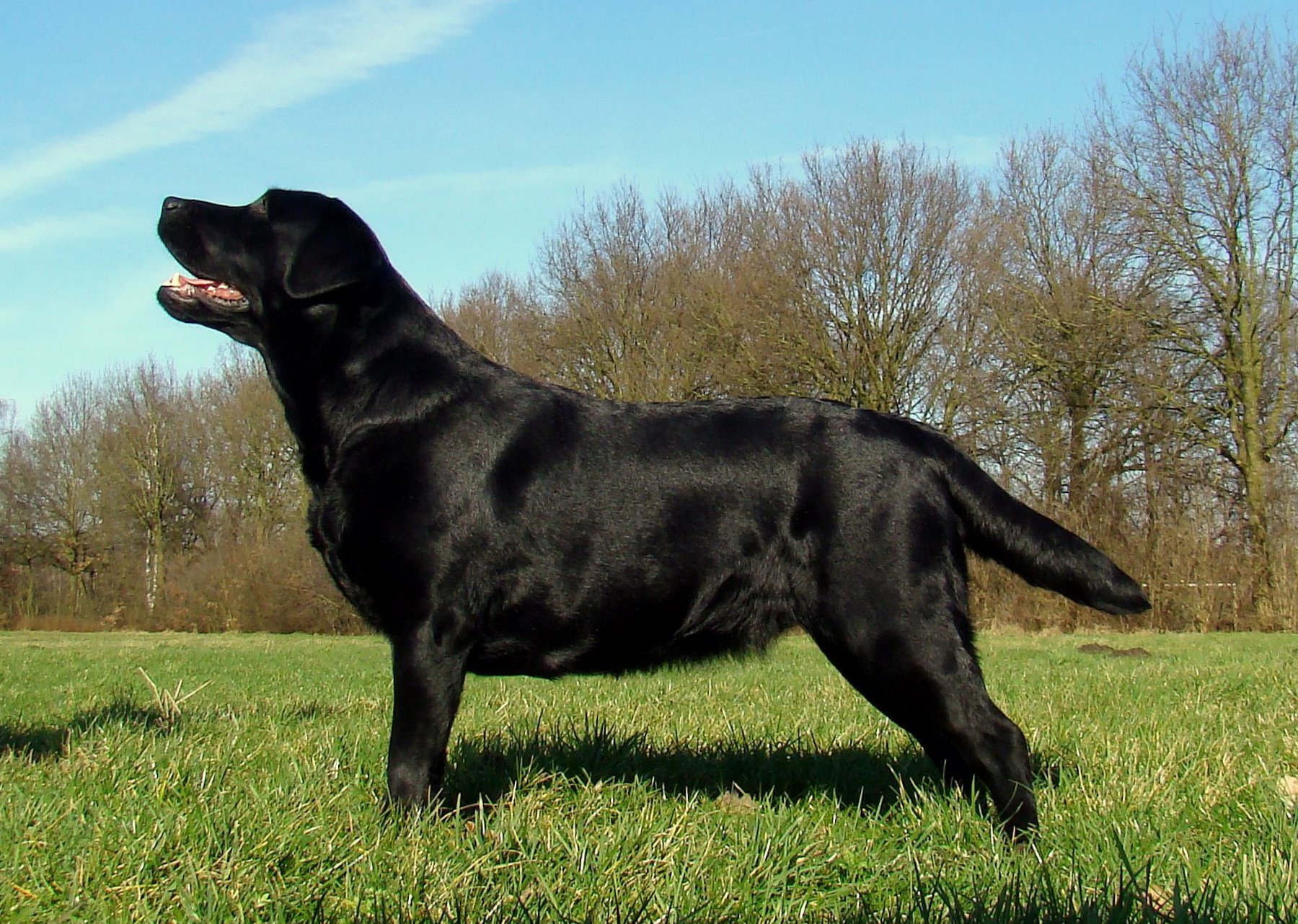
Appearance:
- Build: remarkably strong, well-built, agile
- Head: comparatively broad, muzzle powerful, long and strong jaws
- Eyes: moderately large, dark
- Ears: relatively small, worn close to head
- Tail: moderately long, thick at root
- Coat: short, thick, dense hair
- perfectly round: characteristic of race
- Coat: coarse, hard, very dense, not wavy
- Color: black, liver brown or yellow. White is not allowed
- shoulder height: 54 – 57 cm.
Character:
- very sweet character and child friendly
Nova Scotia Duck Tolling Retriever (FCI 312)
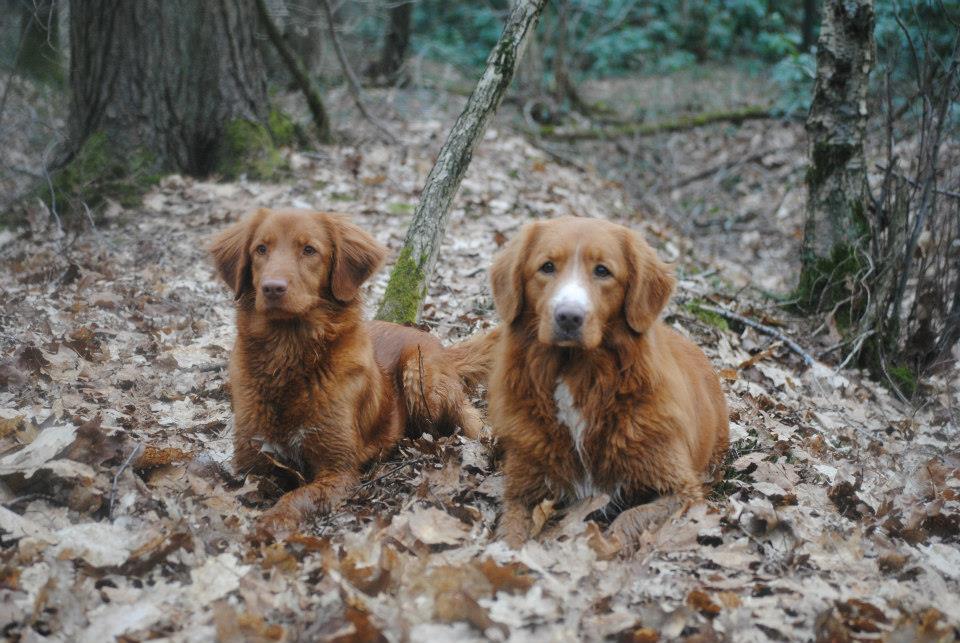
The origin of this retriever can be found in Canada, Nova Scotia, there the dog was used for hunting ducks along the shores of the great lakes, the hunter let his dog play from a hide out along the shores, Tolling, Duck Tolling, until the ducks are within shooting distance, then the Toller is called into the hide out and a stick or stone is thrown into the water so that the ducks fly up and can then be shot, all the while the Toller remains quietly out of sight in the hide out, after the ducks are put down the Toller is brought back to retrieve them , Retrieving.
These are the only retrievers that work both before and after the shot , externally this is a very strong and temperamental powerful dog , the thick coat shades from red to red with white markings on the head , nose , chest tail and feet , with or without a pink or black nose , the male is about 50 cm and weighs about 22 kg , the female about 46 cm and 17 kg.
The Toller is a rarity on the hunting grounds as its resemblance to a fox is striking, but we have taken the initiative with a few people to preserve the original work of the breed.
– Info and publication rights via Jef Savels Varendreef 107 , 8750 Wingene
No permit yet?
Jachtexamen.be is the online learning environment for hunting, providing optimal exam preparation.