

Biotope
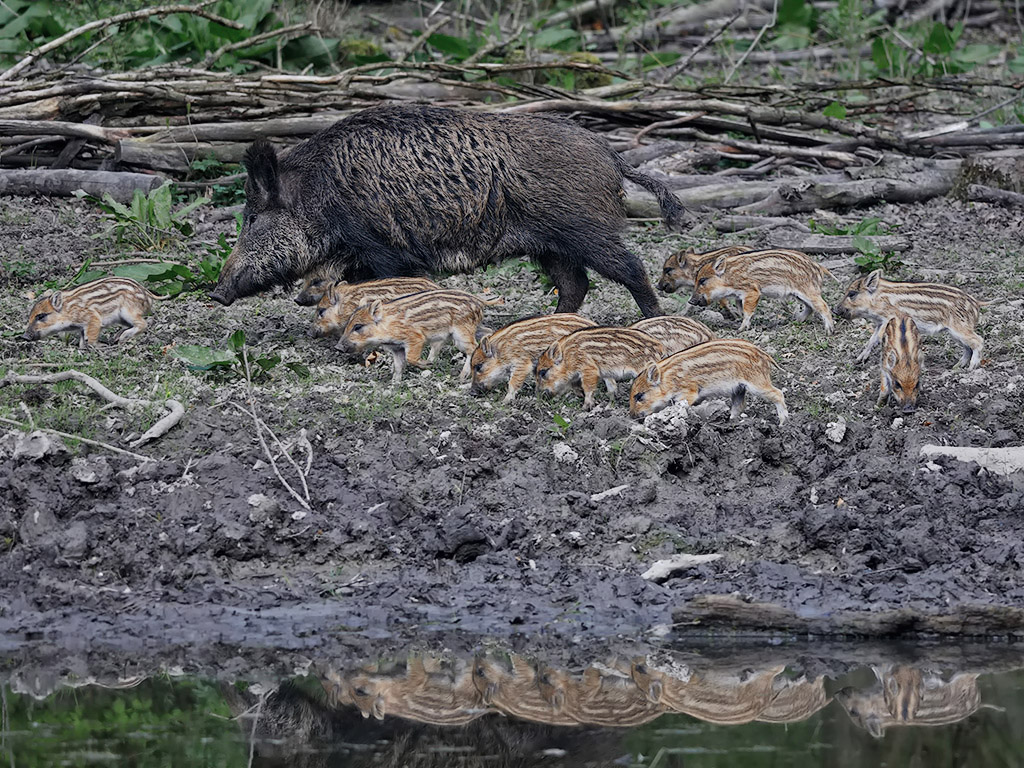
Wild boars are true forest dwellers. They only feel at home in large, quiet forest complexes interspersed with agricultural areas. Such biotopes are found only in the Ardennes and the Veluwe, where their distribution area coincides with that of the red boar.
They are not very local. In one night they sometimes migrate for miles. By the time the first game damage is reported, they have often already settled somewhere else.
They are very fond of using a swampy or muddy spot in the forest to bask. The mud bath is not so much for cooling as it is a way to get rid of troublesome skin parasites. Next to a molting site are usually a few “barn trees” whose bark has been rubbed away to “hog height.
External Characteristics
Upon a chance encounter in the wild, even an ordinary hiker will not mistake the wild boar for another species. In terms of physique, it resembles a tame domestic boar immensely. However, unlike this tame variety, the wild boar is an expression of one and all primal strength and wildness.
It stands high on its legs. Especially the massive forehand is strongly developed. The conical head is equipped with strong jaws and excellent for digging up and breaking the soil in search of all kinds of edibles. The small eyes lie deep within the head. The mobile, erect ears are quite small. In older specimens, especially males, the skin at the level of the shoulders is tough and thick and forms the so-called shield.
The prints of black fowl are unmistakable because almost always the biting toes are printed along, creating a typical trapezoid shape.
The straight tail keeps moving almost constantly. When calmly taking up food it shuttles lustily back and forth. With excitement or alarm it is raised stiffly.