

Biotope
Reewild is not bound to vast woodlands! It feels at home wherever it can find cover, food, rest and safety.
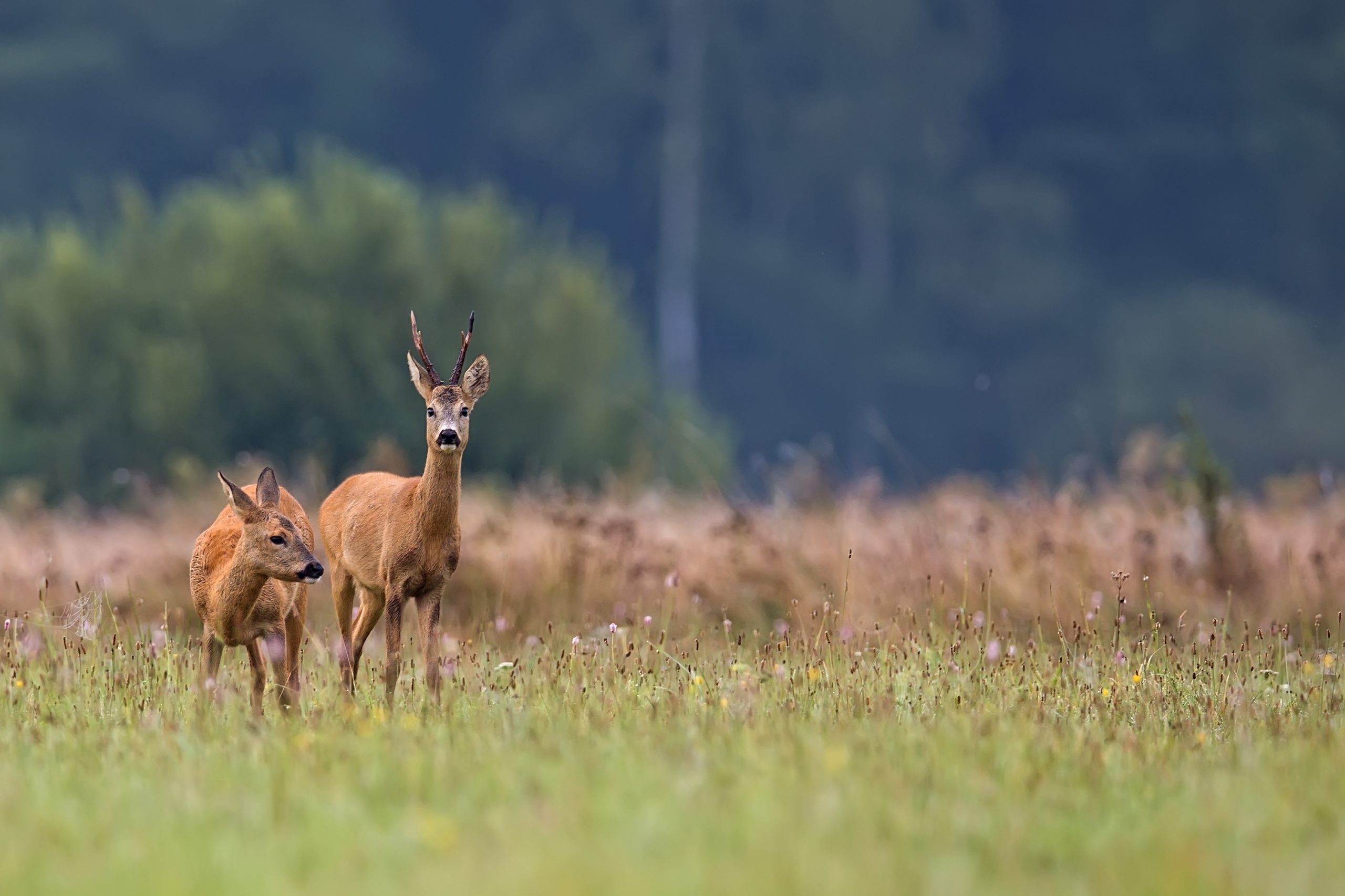
Reewild is a typical inhabitant of the so-called park landscape or forest edge zone. It prefers to settle in areas where dense, impenetrable undergrowth alternates with fields and meadows, interconnected by hedges and overgrown ramparts. Such biotopes offer it the most variety in terms of food. For roe deer are very picky nibblers who, rather than grazing their food in a tender meadow, graze here and there some herbs,
buttons, leaves, etc., they snack on. Acorns, berries, mushrooms, flowers, all kinds of young shoots etc. are also eaten with relish.
Deer will thrive best and will also prefer to settle where they can find all that. We find such ideal deer habitats in southern England, where the climate is mild and the soil very calcareous. It is not for nothing that the very best deer trophies in Europe are obtained precisely there.
External Characteristics
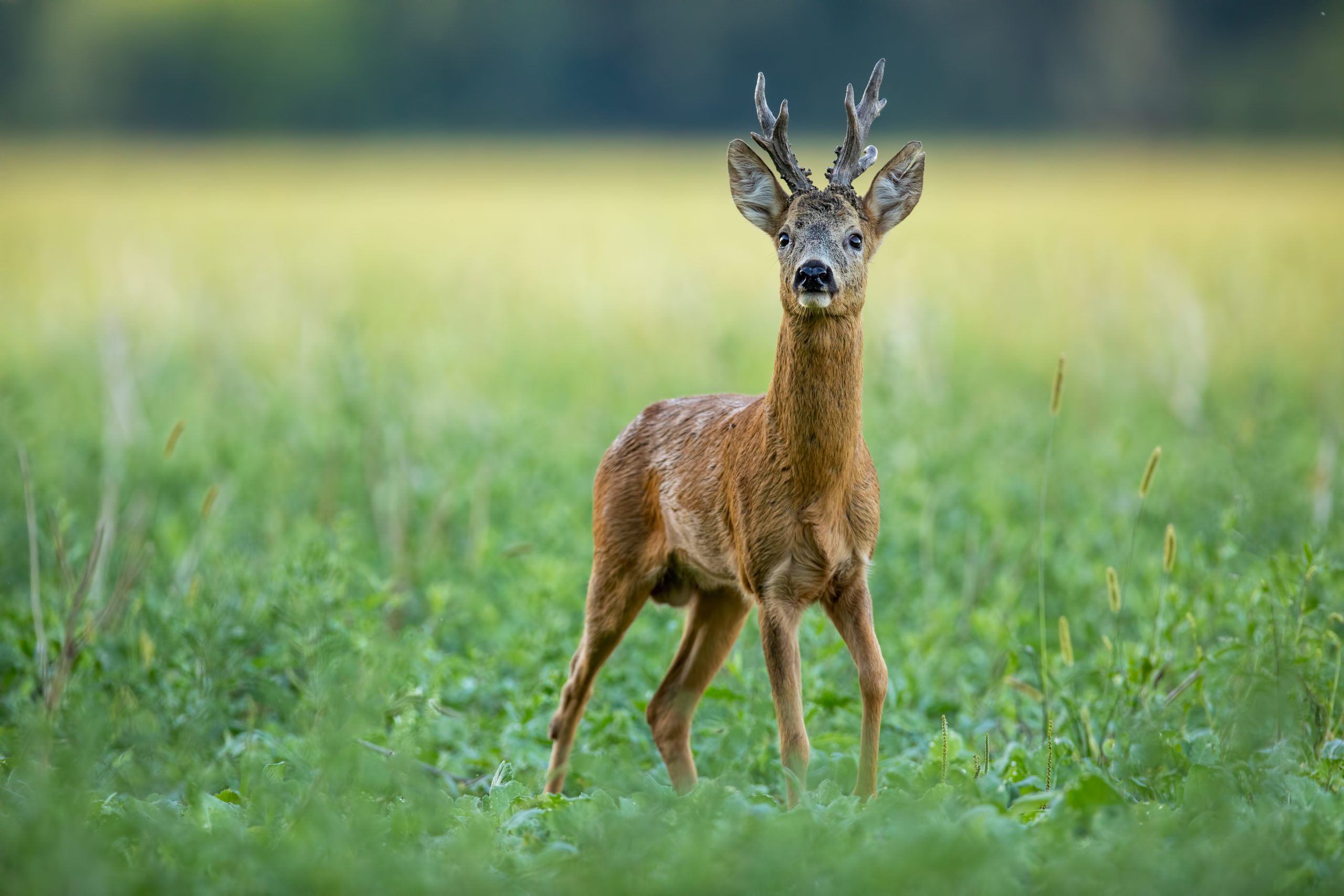
In summer, the coat, called the summer dosh, is a beautiful reddish-brown color. The thicker winter-dos is rather dark gray. The spring shedding (May) is rather irregular : the longer winter hair becomes brittle and breaks off by rubbing and scratching. This happens first at the level of head, neck and shoulders. In this period, deer look really unkempt. In the fall (September), shedding occurs more quickly and inconspicuously. The winter hair grows above the short summer hair in just a few days. The timing of shedding can already be an important tool in correctly addressing fawn!
A general rule states : the younger a doe is, the earlier it sheds.
A yearling buck will already have a full summer dose by early May. An old buck will still have quite a lot of winter hair even in early June. That same yearling will be gray by mid-September while the older one is still completely red. Weak or sick specimens may have trouble with that process and will therefore shed later. The same also applies to feeder goats that sometimes do not start showing their winter dosh until early October. A notable feature in that winter doze is the white spot around the arse region, the mirror. In a roebuck, this is bean- or kidney-shaped. Because a goat wears an additional strand of hair under the white spot, the apron, its mirror is rather heart-shaped. That difference can be important in distinguishing the sexes.
Another sex distinction during winter is the doe’s brush.
In summer, the mirror is much smaller and yellowish. The difference between the sexes has also disappeared. According to biologists, that white mirror has the function of optical signal for conspecifics. In winter, roe deer unite into more or less large groups, called jumps. They behave quite socially. When in danger or agitation, the mirror expands, alerting the others. When fleeing, the mirror also acts as a directional beacon for the fawns.
Social behavior
Knowledge of the social behavior of fawn is of capital importance to a grazing hunter in the proper management of “his” fawn.
Deer are outspoken distance animals and individualists. They experience any close contact with conspecifics as more or less unpleasant. Rather, they will get used to human-induced disturbances.
Deer are fairly site-specific. The life span of a roe deer in a forest biotope is normally no more than 1 to 2 km², the annual range at most half of that.
In spring and summer that area becomes even more limited and roe deer, especially bucks, settle into a territory. Within this, a roe deer prefers to move along fixed trajectories: the bills.
A roe buck does not tolerate any other adult buck in its territory. These are immediately attacked and driven away.
In the class of socially mature bucks, there is a distinct age ranking order. It is usually the oldest (4 to 7 years old) that occupy the best territories. The social ranking is so established that territory fights are quite rare: a younger buck will usually give way to an older one, even if they are matched in strength.
In spring (April/May), a roebuck marks out its territory by sweeping its antlers against trees and bushes. In doing so, it scratches easily visible marks in the ground along a tree trunk with its antlers. At the same time, it spreads supplementary scent flags around its territory via scent glands between the hind hoofs.