


Hunting the wood pigeon requires an attentive, agile and shot-steady hunter. Not only are they very smart and have excellent eyesight, they also fly fast and make the most unexpected movements (especially if they don’t trust the case). In short, hunting the pigeon is a challenge.
Hunting – Pigeon hunting
Everything about hunting pigeons.
Pigeon hunting
The Hunting Field
In the case of control, the location on the hunting field is known. Namely at the place where the damage was reported. Wood pigeons feel most at home in (threshed) corn and (alloyed) grain fields, but they certainly do not refuse a stay among peas or cabbage plants.
In normal hunting, in winter, it is important to know the flight lines, or pull, between foraging and roosting site.
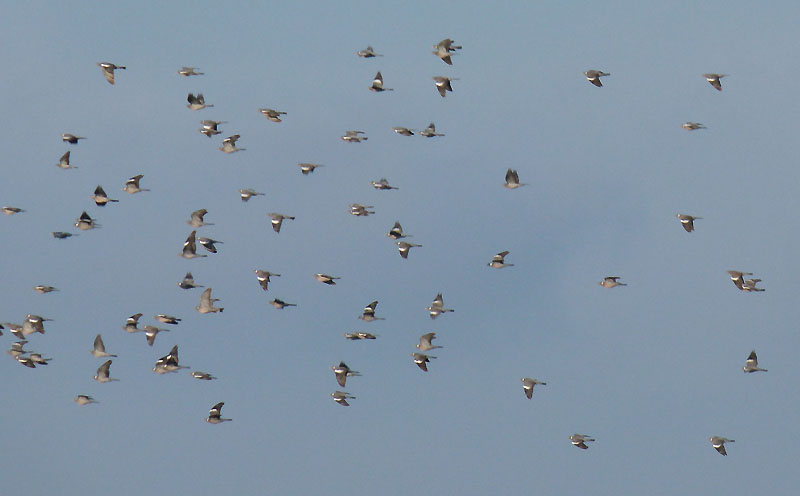
When you arrive at the hunting ground, park the car and start observing what happens. It is of course wonderful to see a few hundred wood pigeons that are eating their crop, but that is no guarantee for a good hunting day. The experienced pigeon hunter stays in the car and watches all movements in the air in and outside the hunting field, good binoculars are important here. Here it is not only determined where the best position in the field is, but where most flights (flight line) are to and from the relevant piece of hunting field. An escape line refers to a road in the air, along which the wood pigeons move to and from the relevant piece of hunting field. So from the place where the wood pigeons have their roosting place and the place in the hunting field where their food is.
If there are already many wood pigeons on the plot in question and there are almost no pigeons flying to and from the hunting field, walk to the part of the field in question and make sure the wood pigeons fly up, then go back to the car and wait for the wood pigeons’ reaction. If nothing comes back within let’s say 20 minutes, it means that the wood pigeons have gone to another plot and after their crop has eaten their crop, they will go to their roosting places (winter, autumn and spring and in summer to their young to feed them).
If possible, shortly before, the day before, explore the hunting field and the flight. But on the hunting day itself, you also have to take into account wind direction, wind speed, rain, …
Timing
In the summer months, the wood pigeons are best hunted half an hour after sunrise. In early spring, autumn and winter, it is better to wait for them at their foraging ground before sunrise. During the short days they mostly forage in the early morning and mid-afternoon until about 1/2 hour before sunset.
The Weather
In a strong wind, the wood pigeons will fly much lower than in no or little wind. Strong winds also ensure that they hear the shots less. When there is almost no wind, they do hear it and the wood pigeons fly a lot higher.
A good suggestion in terms of weather site is yr.no
Camouflage
Good camouflage is also indispensable in pigeon hunting. The wood pigeons are always very alert, at the slightest movement, wrong color or reflection of your glasses or the barrels of your rifle, they already wave off and then do not come under shot.
Camouflage fabric offers a solution here. Gradually, the insight is gaining that camouflage clothing is practical and works very well in pigeon hunting. A camouflage cap and jacket are usually sufficient for a good hut. Make sure that the colors of the clothing do not differ too much from the colors of the camouflage of the hut, because then you immediately stand out when you move.
Try to use natural coverage as much as possible. Such as a ditch, bushes. However, never sit too close to tall trees because then the pigeons, who do not trust it, first fly to those trees and stay out of harm’s way.
Equipment – Decoys
Decoys, whether or not floppy on the ground or floating (fiberglass stick) can only increase the chance of success.
Wood pigeons almost always land against the wind, so you should always take this into account when setting up the decoys and the location of your hut. Especially when the wood pigeons come in, it is important that they do not look into your hut, so put the decoys as such. The decoys should not have a glittering exterior, because the migrating wood pigeons will just fly on
https://huntingeurope.be/product/enforcer-flying-decoys-2-stuks-zak/
The plastic baits should be about 60% with their heads in the wind and downwards. You have to make sure that they stand out enough, (maintenance of white neck spots with matt white paint is important every year) so on alloyed grain on the open areas or with a high mown stubble as high as possible.
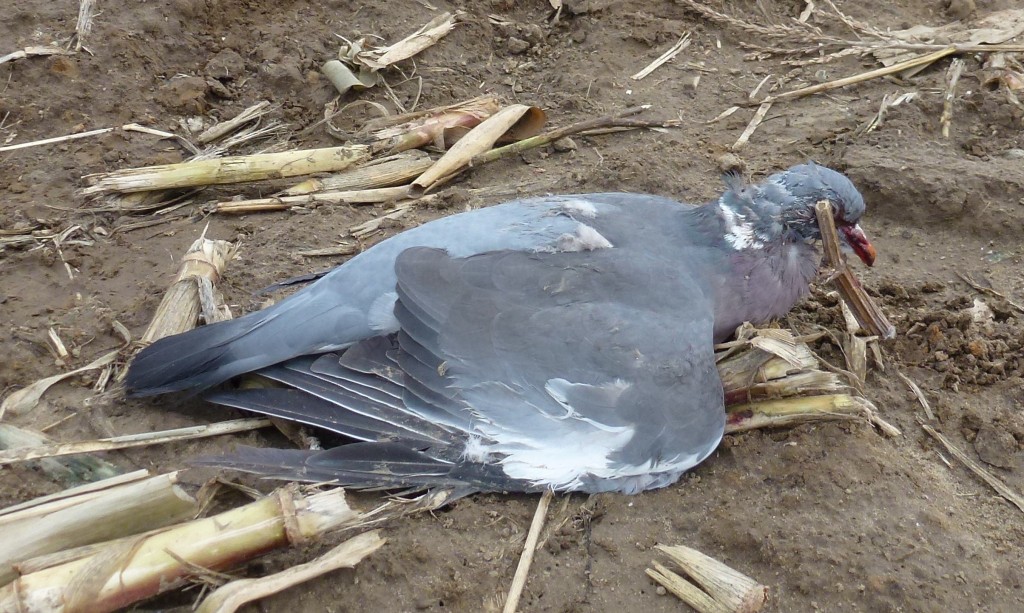
Wood pigeons that have been shot can be placed as a supplement between the plastic decoys, You place them on the field with an iron rod such as (old bicycle spoke) or (fork) under the head or beak. Also make sure to make the white wing band visible. Pigeons placed in the field in this way have a strong attraction to the overflying peers.
It is also useful to keep a number of shot wood pigeons in the freezer as decoys for hunting.
Flight
Flight can be promoted by sitting with several hunters at the same time. The more the merrier, because of the continuous shooting the pigeons are startled and are forced to move and move according to their flight lines.
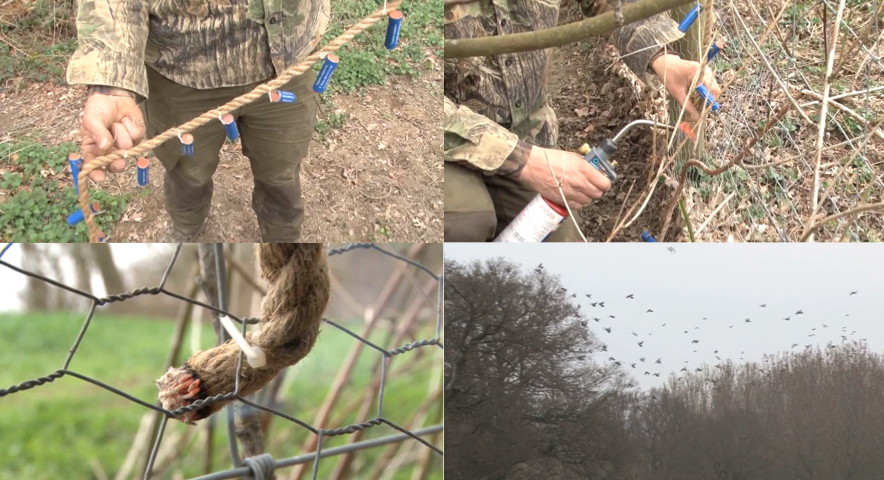
A hunting technique helps by making noise close to their roosting site. And this can be done by means of banging fireworks. Either you buy it prepared (with bangs every 1/2 hour) or you craft it yourself by attaching the fireworks to a piece of thick cotton thread that smolders and ignites a pattern of fireworks each time. Be careful where you hang it, not too close to a public road or walkway, and also not above flammable material (dry leaves) the exploding cartridges can pose a fire hazard.
And then just wait for the pigeons to move.
Species recognition
Make sure that your wood pigeon appeals sufficiently and does not confuse it with other protected pigeon species!
Species recognition is difficult, especially with high-flying pigeons.
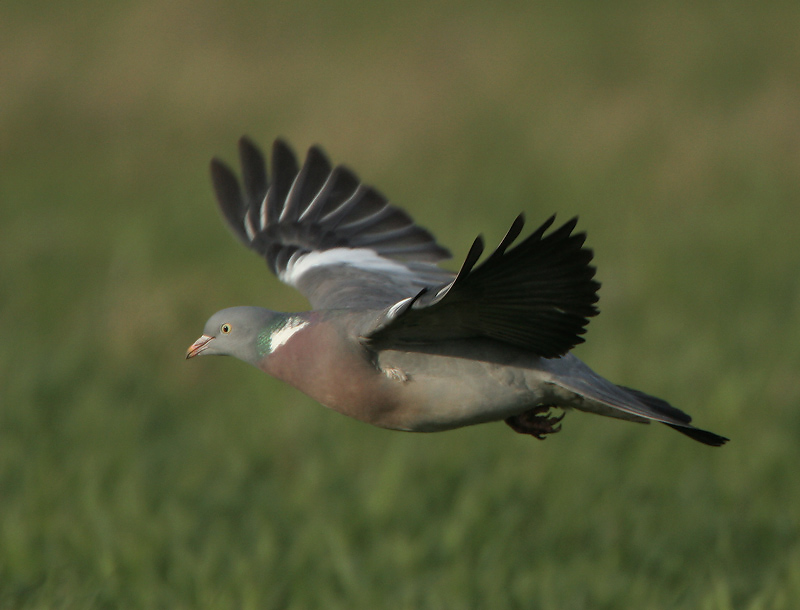
Racing pigeons generally have a tighter straight-line flight and a faster wing beat and they also look a bit more streamlined in flight. But this does not alter the fact that mistakes are easily possible. Sometimes you notice that between a flock of wood pigeons there are a few racing pigeons and then it is damn difficult (especially with backlight if you don’t see the colors well) to make the distinction.
Our suggestion is to wait until you can clearly recognize the white neck ring and the white wing band. On the other hand, the pigeons are also reasonably within reach.
Weapon and ammunition
Calibre 12, 16 or 20, hail size 7, 6, 5 or 4, Steel or Lead. Actually, none of this matters much. Shooting at it is the main thing. (and of course the use of foliage or steel depends on the region).
Dogs
When hunting pigeons on stationed grain and where there is a lot of cover, for example corn, you need a good retriever.
Because a wood pigeon is loose in the feathers, the dog will have to fetch “softly”, otherwise too many loose feathers will remain in the field. These scare off pigeons flying overhead. To limit that risk, it is therefore better to pick up pigeons that have fallen close by hand. The dog only comes into action with pigeons that fall into the cover or sail too far. The dog must learn to ignore plastic decoys and shot pigeons, which are already used as decoys, and not to retrieve them (this is often difficult). To prevent these problems, it is advisable to pick up all dead pigeons in the vicinity of the decoys yourself and remove the loose feathers.
Young or old
Young wood pigeons differ from adult wood pigeons in:
- no metallic green sheen on the neck
- white neck spots are missing (are only there after moulting)
- beak is black to brown (later yellow with pink-red base)
- legs and claw are gray (later blue-red)
- The first hand feathers are brownish-black on the edge and the shoulder cover feathers have a slightly reddish tinted curve.

Game roast care
During hunting, especially in hot weather, make sure that no flies can get to it, covering it with, for example, a jute bag or net that allows the air for cooling to pass through, but not the flies, is important.
After the hunt, the pigeons can be kept cool in the refrigerator. This also promotes feathering. With pigeons, as opposed to Pheasants or Partridges, the feathering is quite easy. You can cut off the wings, the lower leg bones too. After picking, empty through the abdominal cavity. Job done in less than 10 minutes. The so-called dying or “faimenting” is not really necessary here. So whole or in pieces (breast fillets, buttocks) in the freezer.
No permit yet?
Jachtexamen.be is the online learning environment for hunting, providing optimal exam preparation.