


The Driving Dogs bring the game in front of the guns by walking through the revier floating or barking.
Dogs – Floating Dogs
All about the floating dogs.
Floating Dogs
German bracken (FCI 119)
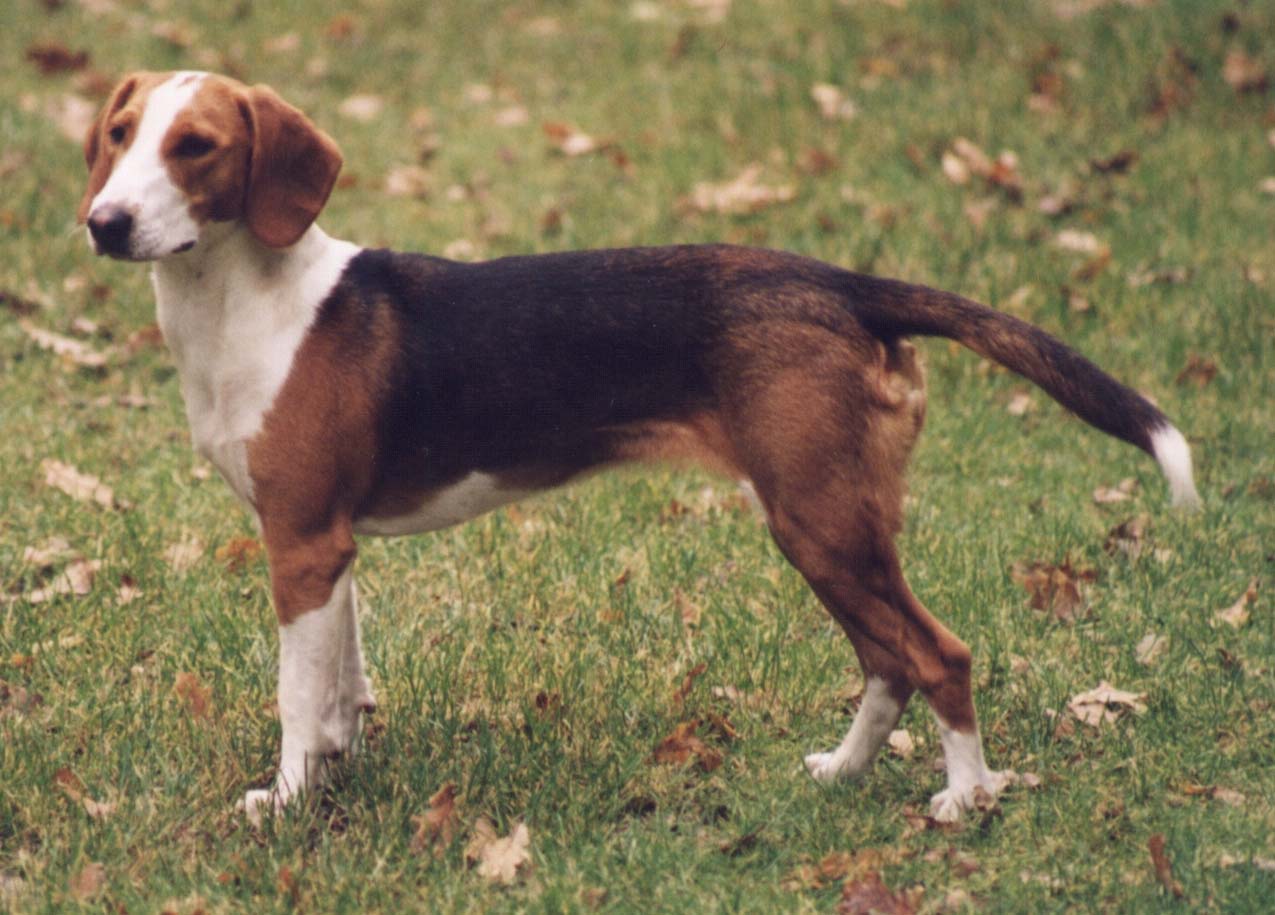
Appearance:
- General: The German Brak is a light, long-legged, elegant but powerfully built hunting dog with noble, proportionately light head. The body is moderately long, with very deep chest reaching below the elbows and slightly arched ribs. The back is slightly arched with slightly sloping croup. Belly is slightly tucked up. Long, thin yet strong legs. Shoulders dry and well connected elbows. Hind legs long and well angulated, thighs broad and full. Moderately long and in proportion to the head strong neck.
- Color: Red to yellow with black saddle or coat and white bracken markings (continuous blaze on head, white muzzle with collar, where a continuous white collar is preferred, white chest, white tail tip and feet).
- Head and skull: The head is light, dry and elongated. The upper skull is slightly domed. Very slight stop. The nasal bridge is very slightly arched. The lips hang over only slightly. The length of the head is about 21 cm, of which the front muzzle occupies 9 cm. The muzzle is only slightly longer than the skull. A slight stripe runs across the nose. The eyes are brown with bright, friendly expression. Rather long, broad and flattened ears. Scissor bite.
- Tail: Long, not particularly strong at the root. Proportionately thick, partly because of the strong hair that acts as protection. The tail is pointed. The tail is carried hanging or in a slight curve upwards.
- Feet: Longer than cat feet with well closed toes.
- Hair: Relatively long, coarse, almost stick hair and very dense. The belly is also densely hairy. On the underside of the tail the hair is usually slightly longer.
- Height at Withers: Male and Female: 40 – 53 cm, a small excess is allowed
Character:
- Lively
- Friendly
- Affectionate
- Excellent hunting dog
- Loving children
- No watchdog
English Cocker Spaniel (FCI 5)
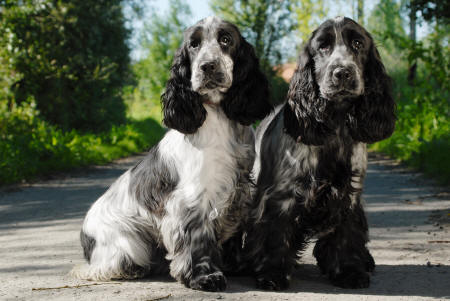
Appearance:
- Head: well-developed, circumcised muzzle, clear stop, skull is finely lined, cheeks are flat and dry
- Eyes: hazel brown, in harmony with color and coat
- Character: intelligent, watchful, mild and cheerful
- Ears: set low and long, not reaching beyond tip of nose, lined with long hair, silky but not in tufts
- Tail: set low, carried no higher than back line, the lower it is carried the better – when dog is at work, with tail continuously moving – docked at 2/5
- Coat: straight, silky, long fur on ears, chest and fringe on back of extremities
- color: many variations:
- monochrome black
- liver brown
- red or gold or also white as ground color with markings in large or small degree in each of the above colors
- in white ground color often arise hairs of the color of the markings, which is called mold: English “roan”
- with the white-and-black gives the impression of blue
- The single-colored out. white spot on breast: undesirable
- shoulder height: approx. 40 cm
Character:
- movable
- vivid
- playful
English Springer Spaniel (FCI 125)
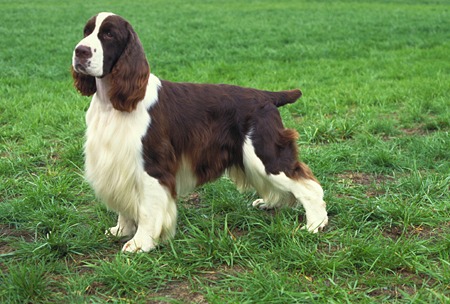
Appearance:
- Build: medium-sized, well-proportioned, of good posture, strongly built for endurance and smooth movement
- Head: moderately long, rather broad, slightly rounded skull, the cheeks are flat, muzzle well chiseled out below the eyes
- Eyes: moderately large, dark hazelnut brown
- Ears: long, rounded and set at eye level, broad but not exaggerated
- Tail: docked, set low, carried no higher than back line, must move lively when dog is at work
- Coat: shiny, fine-textured, longest on neck and underside, on chest, back of forelegs, belly and backside
- Color: all allowed, but white with liver tan, white and black and tricolor are most desired and most common
- shoulder height: approx. 51cm
- weight: approx. 22.5kg
Character:
- intelligent
- barks little
- very highly rated as a hunting dog
Welsh Springer Spaniel (FCI 126)
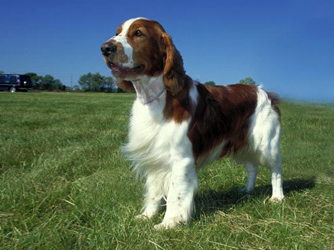
Appearance:
- build: rectangular, strong, compact and symmetrical
- active in action, good movement
- Head: moderately long, well cut under eyes and with clear stop
- Skull: insignificantly arched
- moderately long muzzle, straight nasal bridge and dark or flesh-colored nasal bridge with wide nostrils
- Eyes: dark to nut colored and well closing eyelids
- Ears: comparatively small, tapering towards tip and set rather low. Worn hanging along cheek
- Tail: set low, docked, carried no higher than the continuation of back line
- Coat: dense, straight and silky with long, straight ear fringe and fur on legs
- Color: deep chestnut red and white
- shoulder height: from 46cm to 48cm.
- weight: 16 – 21 kg
Wetterhoun
History
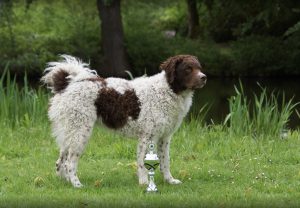
The Wetterhoun (FCI group 8, section 3 Water dogs, FCI number 221) comes from the lake area in Friesland. Originally, the Wetterhoun was mainly used for hunting otter and polecat. Since these are no longer hunted, the Wetterhoun is mainly active on feathered game and hairy game. The Wetterhoun’s sense of smell is renowned, as is its persistence. In addition to hunting, the Wetterhoun was also used as a yard guardian, as a draught dog, and as a mole catcher and pest controller.
Hunting Features
Since upright dogs and retrievers became more popular in the middle of the last century, the Wetterhoun fell into oblivion. Today, the Wetterhoun is again used more as a hunting dog. In a hut or under the blinds on the geese, on the boat on the ducks; the Wetterhoun is at home everywhere, and always calm. A drive hunt for small game such as hare, rabbit, pheasant and partridge also suits a Wetterhoun well, as well as a fox hunt because of its robust appearance and strength. He is much appreciated as a go-getter in the hunt, for those (pre)hunter who knows how to get the Wetterhoun to work with respect and patience. The Wetterhoun is also seen more and more often in sweatwork training. In recent years, five Wetterhouns have obtained a sweatwork qualification.
The Wetterhoun is an all-rounder, working before and after the shot and can be used for tracking. They adapt easily to the terrain. They work under the rifle and thus stay close to their master. The Wetterhoun attends (it briefly indicates contact with game) and then ejects the game. They are also excellent retrievers who are especially good markers. Wetterhouns are well suited for hunting grounds with smaller parcels of land, water, reed beds, bushes and wooded areas. They also do not shy away from heavy cover.
Character and appearance
The Wetterhoun likes to be outside, and likes to be with the boss, and even more likes to be outside working with the boss. At home he is quiet, lying down in the run, and watchful but certainly not noisy. They can easily stay outside and sleep outside at night. There are Wetterhouns known to sleep on top of their kennel instead of inside at -10 degrees Celsius. So the cold hunting season is not a problem for the Wetterhoun.
It is a self-confident balanced dog that is trainable. However, after thorough training, do not expect to have a slave. It is an independent thinking dog that likes to understand the usefulness of your request. The owner must be able to stand this (and otherwise not choose a Wetterhoun). After a consistent and coercive (!) upbringing the dog will gladly work for the boss. A Wetterhoun must enjoy it; variety and challenges are necessary during training. The intelligence of the Wetterhoun is especially evident in practical hunting, where the dog can work well independently.
The characteristic astrakhan coat of a Wetterhoun should be somewhat oily and its grooming is minimal. The coat naturally protects well in rough terrain and weather conditions during work. The Wetterhoun comes in four color varieties: black, brown, black and white, and brown and white.
Prevention and health
The Wetterhoun has a very small population, an estimated 1100 dogs, and is found almost exclusively in the Netherlands. At hunting competitions they show themselves little, because they are real practice dogs. In the Netherlands, the Wetterhoun is actively hunted in various parts of the country. A hunting combination in Flanders has also had a Wetterhoun in its ranks for several years, namely mine.
Despite the small population, the breed is relatively healthy. Occasional hip dysplasia (HD) and elbow dysplasia (ED) occur, although clinical complaints are rare. In addition, heart and eye problems sometimes occur.
Bloodlines / hunting passion
The hunting passion of the Wetterhoun is influenced by the hereditary qualities of its (pre)parents, by stimulation in the litter and by training. I am one of the (very) few breeders who explicitly selects on hunting qualities, so there can be a difference in work ethic and temperament. Outwardly there is no difference to be seen between a hunting dog or a show dog; in hunting passion there are major differences.
Learn more at www.werkendewetterhounen.nl
No permit yet?
Jachtexamen.be is the online learning environment for hunting, providing optimal exam preparation.