External Characteristics
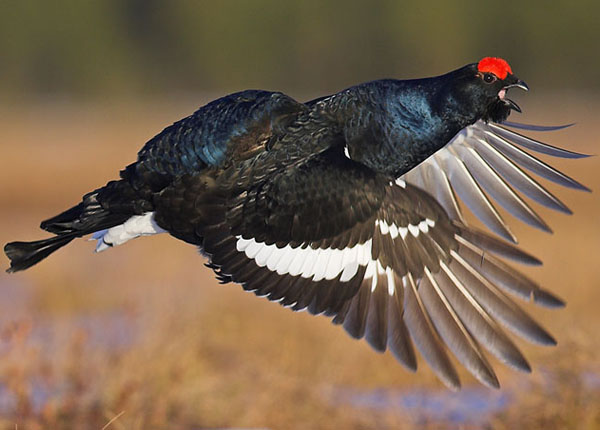
From a distance, the grouse looks and blackish, rather plump bird. Closer up, we see one of the most beautiful birds on the moor. In the sun the steel blue back feathers and the bright white bands over the jet black wingtips shine. the roses above the black-brown soft eyes are crimson. We also note the brown-black bill, the white mirror in the wing and the black-gray hairy walking leg. Typical is the lyre-shaped tail.
The corhen is not so colorfully dressed. She has a warm rust-brown-gray plumage that is black mottled. The beak is more brownish and the red roses above the eye do not swell. The walking leg and legs are thick white-gray hairy.
The young resemble pheasant chicks. Notable is the maroon spot on the head, with a black triangular dot in front. Their downy feathers are striped alternately pale yellow to dark brown and somewhat speckled black on the dorsal side. The underside is yellow-white up to and including the walking leg. The juvenile plumage of both cockerels and hens is uniform.
The grouse is markedly larger than the hen. It measures about 65 centimeters, the hen averaging 50 centimeters? The weight of roosters fluctuates between 1,100 and 1,500 grams, the hen settles for 700 to 1,100 grams.
Propagation
As soon as some sun comes out in late January, early February, we hear the birds bobbing. On the still snowy heath, the grouse ol venture a few dance steps. That early courtship may have something to do with dominance, with the order of precedence the roosters. It is a warning to the young roosters.
Starting in March, there is more prolonged belling and earlier in the morning. Once mid-April, early May, the dance floor is occupied by several roosters at least one hour before sunrise. Only minimal vegetation should be present at the courtship or bollarding site. Walking and flying, they come to the courtship site, where they immediately begin bolting. Three, four, up to 10 and more may occupy the up to 5 acre courtship site. The older cocks in the middle the young ones at the edge. With inflated necks, wings touching the ground and the lyre tail wide open, they dance and gossip their laps with measured strides. From time to time they jump up while emitting their “tchioe” call.
If a hen flies in from somewhere on the moors, there is commotion in the group. some just continue their courtship, others jump in the air screaming to attract the hen.
The nest is made on the ground in a round hole about 5 centimeters deep. This is invested with some moss and dry grass. In it, 6 to 13 ochre-yellow eggs are laid that are set with brownish-red dots. The incubation period lasts 23 to 25 days.