Culinary – Preparation Game

How do you prepare your game for consumption?

Preparation Game

Before preparing game in the kitchen, it must be prepared. In this section some practical tips and attention to the plucking, of feathered game, or skinning, of hair game and also the emptying.

This should certainly not be done immediately after the hunting day. Letting it hang (faizanding) for a few days, head up, in a cool place improves the meat.

Wild Cleaning

Through a valued reader of Hunting, from the Netherlands, we received the attached manuals for the common game species:

Thanks to Paul Bouwmeester for publication rights.

Hairwild Preparation

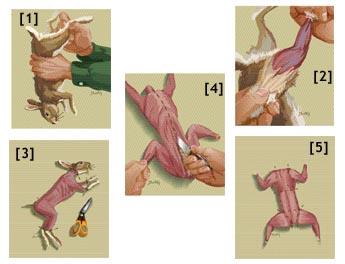
Before we prepare the Hare or Rabbit in the kitchen, they must be skinned and emptied. This should certainly not be done immediately after the hunting day. Letting it hang (faizanding) for a few days, with the head up, in a cool place improves the meat.

It is best to hang the Haarwild by both hind legs upwards. On a pair of nails, about 30 cm apart and in terms of height so that the work can be done at eye level.

Villen

One starts with the hindlings and cuts the skin off the legs. Be careful not to cut the tendons, only the skin. Then cut along the legs to the beginning of the belly. Then pull the skin down. Pay attention to the tail, which should be cut with the skin. Then continue to the head. There the ears may be cut off. Also pay attention to the eyes and mouth. Gently pull and if necessary cut loose. Or, if not wanted for cooking, you can also cut off the entire head.

The front legs may be cut loose and torn through to be removed along with the skin.

Draining

Emptying can be done easily after opening the abdominal cavity. Optionally, you can keep the liver, and heart if necessary to eat or sauce.

After emptying, take care to remove esophagus and trachea if necessary.

Feather game preparation

Before preparing feathered game such as partridge, pigeon or duck in the kitchen, it must be plumbed and emptied. This should certainly not be done immediately after the hunting day. Letting it hang (faizanding) for a few days, head up, in a cool place improves the meat.

There are two methods:

  • Only the breast meat
  • Full

Only the breast meat

If we want to prepare only the breast meat (especially Duck and Pigeon) for a preparation in the kitchen, this is fairly easy.

One should then remove only the breast feathers. Top to the neck, sides to the wings, back to the middle of the belly. Especially with Pigeon, but also Duck certainly remove the hairs by burning them away with a (culinary) gas burner.

The meat is then cut loose along the breastbone to the start of the wings. Especially with Duck the skin is also included given its high culinary value.

Full plumes

In preparation, first remove the wings, in the joint. Then remove the feathers. With Partridge, this only works bit by bit or almost plume by plume. With Duck and Dove, one can really remove it with handfuls of grips at a time.

After pluming, you can still remove the remaining hairs (especially in Pigeon and Duck) by burning them away with a (culinary) gas burner.

When removing the head pay attention to the crop that it does not open. Then one can cut off the tail end (for other there is a culinary not interesting sebaceous gland there).

Emptying can be done easily after opening the abdominal cavity. Optionally, you can keep the liver, and heart if necessary to eat or sauce.

Pheasant Preparation

Before we prepare the pheasant in the kitchen, it must be plucked and emptied. This should certainly not be done immediately after the hunting day. Letting it hang (faizanding) for a few days, head up, in a cool place improves the meat.

In preparation, first remove the wings (at the joint) and pull out the tail feathers. To the head, pay attention to the crop that it does not open when removing the head.

After plucking or skinning, one can cut off the tail end (for other there is a culinary not interesting sebaceous gland there).

Emptying can be done easily after opening the abdominal cavity. Optionally, you can keep the liver, and heart if necessary to eat or sauce.

Foot tendons

Important with pheasant is the proper removal of the tendons in the legs. If one simply cuts off the entire leg, tendons remain in the buttock, which is annoying with this tasty piece of game meat.

One can remove them by making a round incision at the level of the joint and then pulling out the leg, with the tendons.
The tendons are above and below, so the entire joint can be freed along the sides.

Plumes

This is the easiest way, just like Partridge, Duck or Pigeon.

However, while this is very easy with pigeon and duck, plucking a pheasant is usually not so easy. Even if one takes small amounts (especially on the belly, only a few) of feathers together, very often also parts of the skin come off.

After pluming, you can still remove the remaining hairs by burning them away with a (culinary) gas burner.

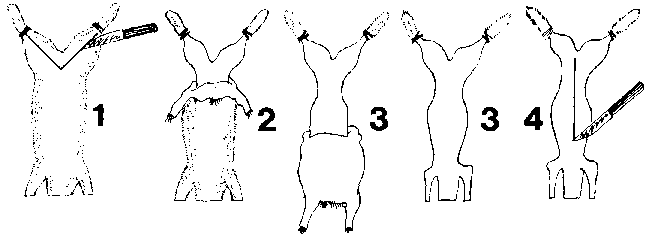
Villen

An alternative then is to completely skin the pheasant. This has culinary, almost, no impact since pheasant has very little fat present under the skin.

The technique is similair to that of a rabbit. One begins at the sternum where the skin is slightly looser on the bone structure, and then one removes the entire skin.

To reduce dehydration, the kitchen can then work with bacon and twine.

Courtesy of Foodtube.com

No permit yet?

Jachtexamen.be is the online learning environment for hunting, providing optimal exam preparation.