Coarse Game – Red deer

All about the red deer.

Red deer

Class: mammals
Order: cloven-hoofed
Suborder: ruminants
Family: cervidae
Species: cervus elaphus

Biotope

As a biotope red deer prefer vast, quiet forests, predominantly with hardwood but also coniferous, preferably interspersed with open flatlands (agricultural areas !). In mountain areas red deer can be found up to the tree line. In Scotland they live in the treeless, heather and shrub-covered Highlands, far from any cover.

External Characteristics

An adult male deer reaches a shoulder height of 130 cm and a body length of 200 cm. Red deer have a clearly visible tail, up to 15 cm long. The body weight of a deer is 120 to 180 kg (alive on foot). During the rut they take practically no food but are enormously active. The weight can drop significantly then.
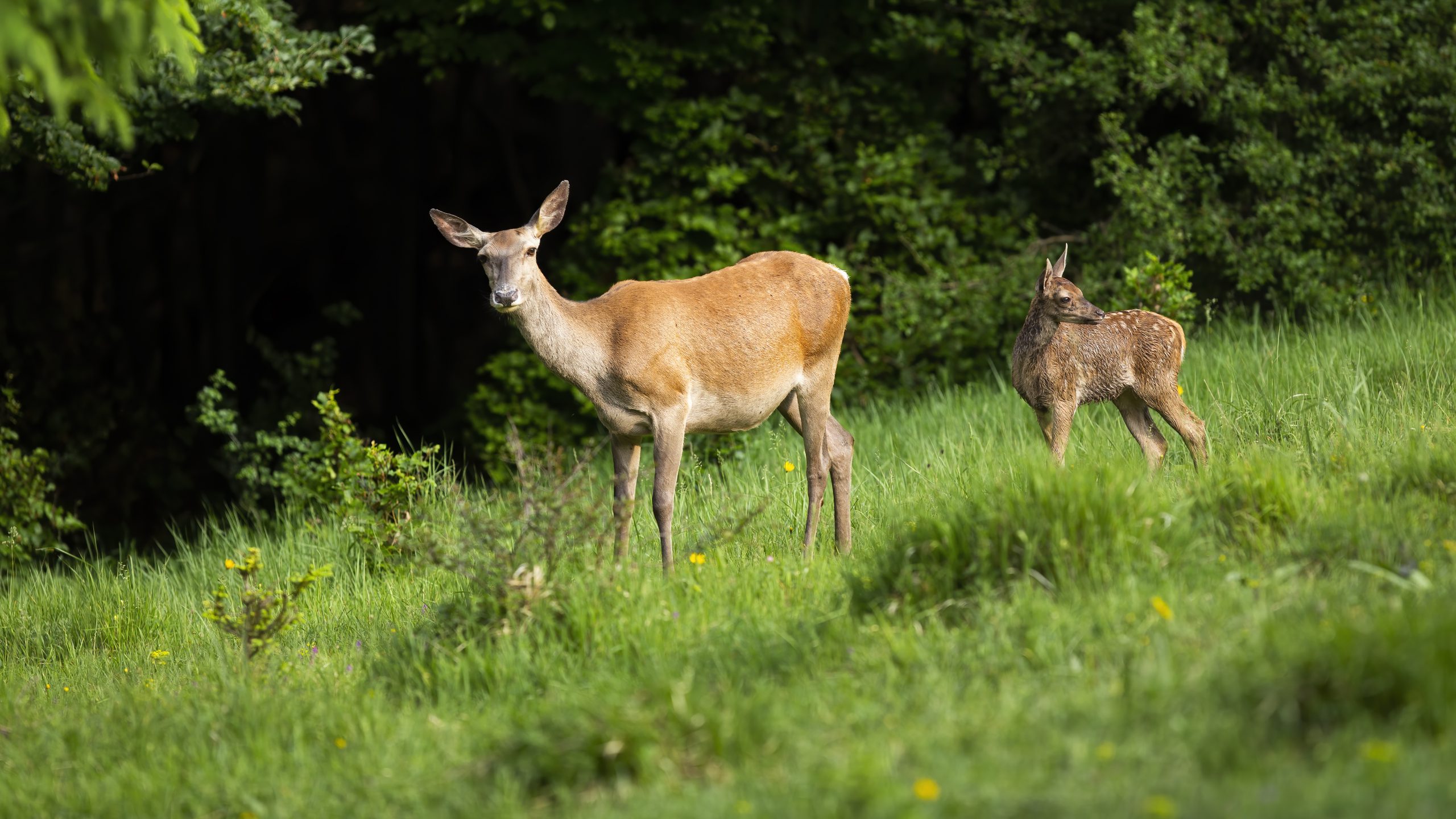
A doe (female red deer) weighs about 70 kg. A narrow-tailed doe (doe in her second year of life, before she has put her first calf) reaches a weight of about 60 kg.
The summer plumage of the red deer is indeed strikingly reddish-brown in color, with a distinctly paler, rust-colored mirror. The denser winter hair is more dark to gray-brown.
The shedding occurs in the months of April and May and again in the months of September and October. Starting at the rutting season, the deer exhibits long, dark hairs at the base of the neck, called the rut collar or rutting mane.

Lifestyle

Red deer live in groups ( packs) separated according to sex. Stags, fawns and young deer (in their second year of life) unite to form a red deer pack. This is led by an experienced lead doe. Adult deer keep together in smaller groups. Very old deer often become loners.
As true cultivators, they remain very shy and very sensitive to disturbance. During the day they usually remain hidden in dense cover. Toward evening, they go out into fields or clearings. An adult animal requires 10 to 12 kg of green fodder daily.
During the summer and the rutting season, red deer like to take a mud bath (kissing).

Propagation

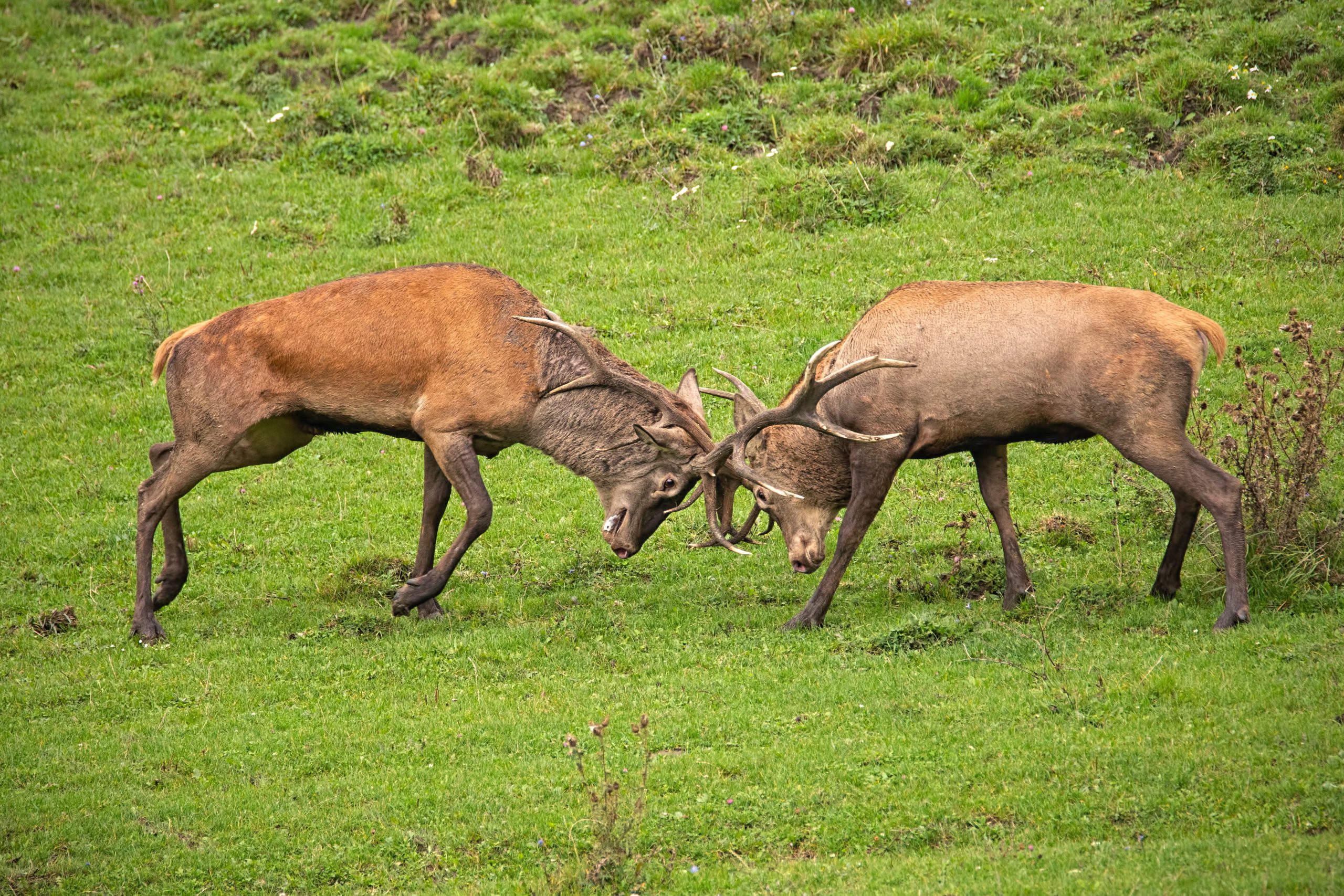
Beginning in September, a gradually increasing restlessness and activity develops among the red deer. The deer, which until then had been hanging out together, leave their “men’s club” and seek rutting sites. Such a rutting site is usually a clearing, clearcut or meadow in an open high-growth forest near the cover where the red deer stay. They are often the same places from year to year. The peak of the rut usually falls in the last week of September. Depending on the wildlife population and sex ratio, a strong deer, known as a place deer, may herd together a rutting pack of several does and strays. Very old, stealthy deer sometimes settle for a single doe. A source pack is stubbornly defended against rival stags.
By defiantly belling, an impressive bellowing, the place deer tries to discourage the others. If it does not succeed, there can be more or less fierce rut fights in which the victor takes over the pack.
Most rutting activity can be observed in the early morning hours. The rut is particularly intense in cold and clear weather.
A rutting deer frequently buzzes in a rutting pit dug by itself with its forerunners, beats its antlers into the ground or vegetation, frequently urinates (hence a foul-smelling, dark oestrus stain on the lower abdomen) and takes almost no food during those few weeks.
After a gestation period of 8 months, a calf is born in May/June. It shows the typical bambi-like spotting pattern on its back and will push itself immobile in the face of danger for the first two weeks. By the end of the summer, the calf spots have disappeared.
The family relationship characteristic of red deer is: doe/calf/small animal or yearling deer. They also move in that order and usually step out of cover that way.

Weatherization

In a male calf, around the tenth month of life, the pinkstocks, the bony outgrowths of the frontal bone, develop. These will later form the basis for the actual antlers. When the calf is about 14 months of age (June), the antlers begin to grow. As with all cervids, this is protected and nourished by the bark skin.
These first bark antlers are usually not swept until September. The blank swept antlers will quickly and dark color under the influence of oxidation.
The first antlers usually consist of two unbranched spears, without roses. Future capital deer very rarely show branching or even indication of crowning already. Good yearling spears should bear spears at least as high as their ears, with blunt ends.
The first head is shed the following spring (May) after which the second antler begins to grow immediately.
The second antler is characterized by the presence of roses and is usually swept as early as August. It may still consist of two long spears (with roses) but usually it is branched into a gaff, six- or eight-thirds antler. Future deer of the second head may even already carry a crown on one or both rods.
The different branches or scions on an antler rod are designated, from bottom to top, as follows. eyed – iced – middle – crown(= 3 scions) or gaff (= 2 scions). The, not always occurring, wolfing is part of the crown.

The number of stags does not give the slightest indication about the age of a deer !!!

A very instructive film around antler mounting in the Red Deer. Includes unique footage of a deer losing a rod, putting on the head, sweeping, …

No permit yet?

Jachtexamen.be is the online learning environment for hunting, providing optimal exam preparation.