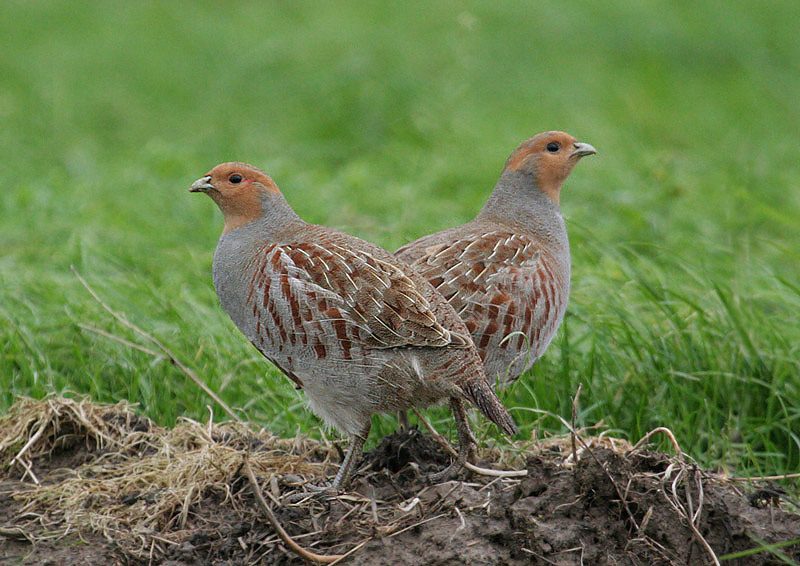
External Characteristics
Partridges are grayish fowl that can be made into a tasty chunk of game roast. It is a small stocky bird with plumage in which gray and brown predominate. The “face” is orange-brown, neck and breast are gray, back and wings are brown and the tail is rust-brown. On the breast is a horseshoe-shaped brown spot, which is generally more obvious in the cockerel, but still does not constitute a reliable sex characteristic. The wing feathers allow a clear distinction between the sexes: the hen has transverse stripes, the rooster does not. In the juvenile plumage, the brown color predominates. Unlike the adults, juveniles have yellow rather than gray legs, pointed rather than rounded outer flight feathers and a dark bill. Cock and hen both average 30 centimeters in length. The rooster is on average slightly lighter than the hen.
Propagation
Partridges are monogamous. This is largely due to the hen’s jealous behavior, which ensures that any competitors who invade the territory are cordially worked out. In spring, the rooster suddenly begins to perform a kind of dance of joy. He then walks in a wide arc around his hen, they both go as if for a courtship flight on the wings, but then the rooster trips around the object of his desire again. Sometimes the rooster even goes for a short circumnavigation on the wings, with one wing almost touching the ground.
When he lands, he trips toward his hen, who sits in a stooped position with the tail slightly raised, and the rooster kicks them. Then there is a brief raising of the feathers, as if to arrange them back into the fold. During courtship both birds make a cooing sound.
Together they look for a nest site preferably in a place with old grass. Almost every day, the hen lays an olive-brown or light gray-green egg in a shallow hole, which is upholstered with some feathers and blades of grass. After 23 to 24 days, the chicks hatch. Newborn partridges are barely four inches tall. Dense and wet vegetation or cover is an almost insurmountable obstacle for such chicks.After a few weeks, the chicks can already move around a bit flying. When they are ten weeks old, partridges are flight-ready.
The laying season reaches its peak around mid-May.