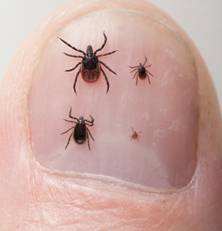
Practical tips to prevent tick bites
- Wear your (work) clothes covering and closing.
- In high-risk areas, wear clothing impregnated with anti-tick agent.
- Check clothing and body both at the end of the day and the next day.
- The tick prefers to be in warm places, such as your head, neck, armpits and arms. Also look at your groin, buttocks and the backs of your knees. Use a mirror to check places that are also hard to see.
- Always record both the date and location of the tick bite.
Treatment tick-resistant clothing
Tests have revealed that for permetrin-treated pants to work properly, they should not be washed with fabric softener. It had long been known that using a hot tumble dryer and an iron that is too hot reduces the effectiveness of permetrin, and that permetrin loses its effect completely when dry-cleaned, but it has now become clear that using fabric softener also reduces the effectiveness of the anti-tick clothing. This is also why Rovince is including a new washing instruction in its new clothing.
Deet on work pants not effective
The “practical trial of tick-resistant clothing” report released by the Forestry Commission in fall 2013 shows that spraying DEET on clothing is not sufficiently effective. The work pants injected with 40% DEET in the trial were not found to have been significantly effective during the wearing days. This could be because spraying with DEET at the beginning of the workday was a precise and time-consuming task, which may not have always been carried out precisely, or that the active ingredient declines over the eight-hour workday.
Source: Tick-resistant workwear, practical trial, October 2013, Mirjam de Groot and Brechtje Bokdam – Report
Lyme disease – symptoms
Lyme disease divided into three stages:
- Early local Lyme disease. This is an early sign of Lyme disease in which a red, progressively increasing ring-shaped skin discoloration develops. This red discoloration usually occurs within two to four weeks (sometimes up to three months) after the tick bite. This red ring, called Erythema migrans (EM) is not always noticed; in addition, a visible, red ring by no means always appears. This red ring disappears on its own, but this does not necessarily mean that the lyme bacteria have disappeared, and they can cause flu symptoms (muscle pain, headache, fever) and joint symptoms within three months after the tick bite.
- Lyme disease spread through the body. If the disease is not detected and treated, later muscle and joint inflammation (swollen, painful joints), severe arm or leg pain, facial paralysis, double vision, tendency to faint, heart disease and skin problems can occur.
- Long-term or chronic Lyme disease. Lyme disease is treatable with antibiotics. The earlier treatment is started, the better the treatment will work. Against Lyme disease, the human body does not build immunity, so after treating an infection, you are at risk of contracting the disease again if you bite a tick.
Tick remover
A tick can be removed very well with the fingers, but many prefer a tick remover. Some swear by the slide, others by the lasso and others by the tweezers. So which one is the best depends very much on one’s preference, dexterity and where the tick is. However, it is wise to use reading glasses or magnifying glasses to see the small nymphs and very small larvae clearly. The most important thing is to grasp the tick close to the skin where the hard mouthparts begin. It is not a problem if a piece of the head remains in the skin. That will come out on its own, just like a splinter. Disinfect the bite wound (after you remove the tick) with 70% alcohol or iodine.
And not only humans but also our faithful friend the dog suffers from these critters.
All care and materials on this site – MedPets
Read more about ticks and Lyme
The Bioscience and Society Foundation (BWM) released a publication on Lyme disease in 2012. The publication runs to 60 pages and covers such topics as: Lyme disease, where and how ticks live, what other diseases can be transmitted by ticks, and treatments and causes of the increase in Lyme disease.
Reporting tick bites
To understand how often and where people are bitten by ticks, it is necessary for people to report tick bites. Report your tick bite on the Tick Radar. That website also has information about ticks, frequently asked questions about Lyme disease and tick news.
The app includes information on how to check for ticks and how to remove a tick. Users can create a tick diary and record a tick bite in it. They can receive a reminder to check the spot where they were bitten. People can also see on their cell phones, via tick radar, how active ticks are. This is especially useful for people outdoors: hikers and visitors to, for example, the forest, heathland, dunes or a park. In addition, an alarm can be set so that you are always aware of the current tick activity.