
Coarse Game – Damhert

All about the fallow deer.

Damhert

Class: mammals
Order: cloven-hoofed
Suborder: ruminants
Family: cervidae
Species: dama dama

Biotope

As a biotope red deer prefer vast, quiet forests, predominantly with hardwood but also coniferous, preferably interspersed with open flatlands (agricultural areas !). In mountain areas red deer can be found up to the tree line. In Scotland they live in the treeless, heather and shrub-covered Highlands, far from any cover.

External Characteristics

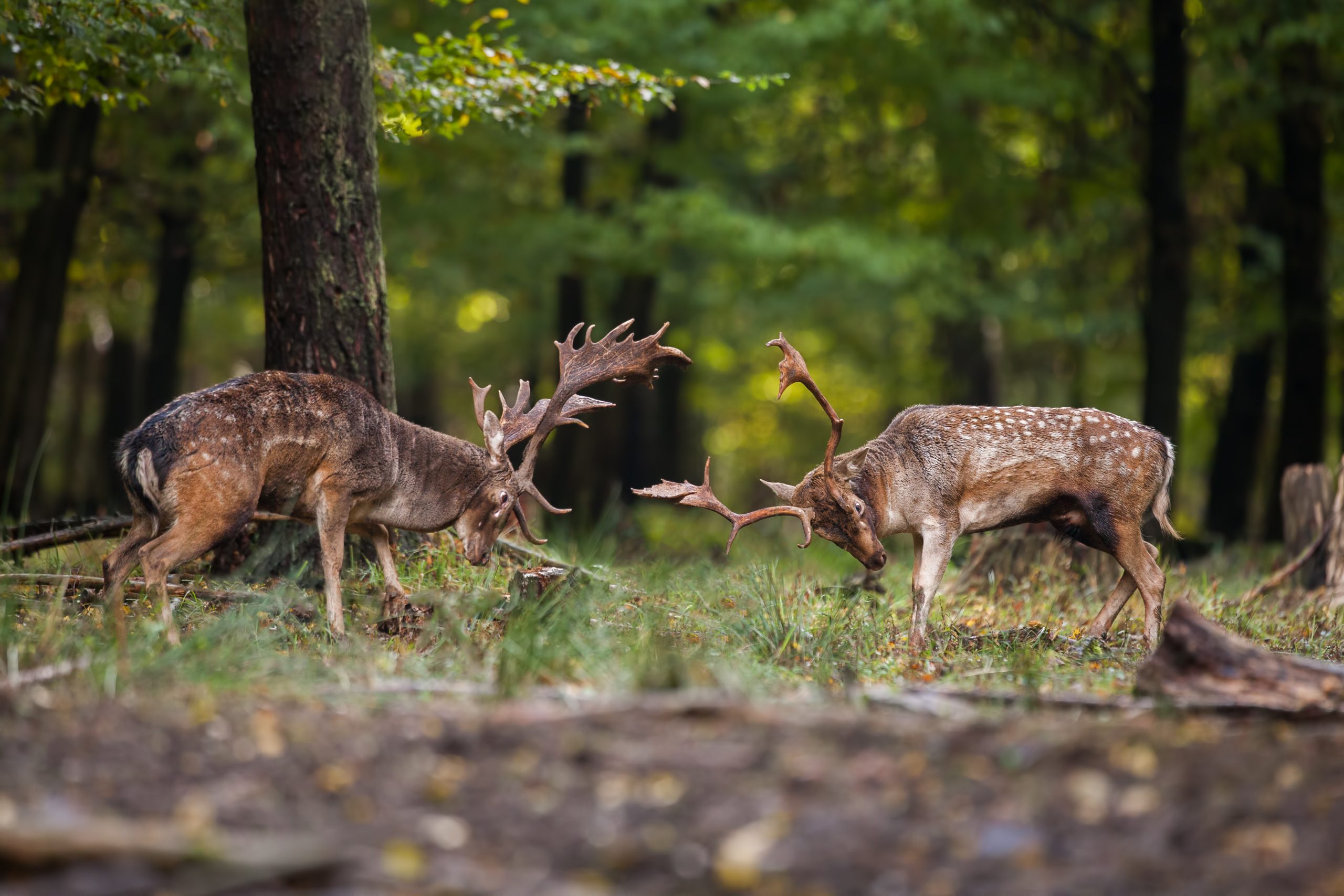
An adult fallow deer weighs about 80 kg. A fallow doe weighs about sixty kg. The original wild color is yellow-brown with white spots on the back. In winter, the color is slightly darker and the spots are less obvious. Nevertheless, several color varieties exist , even in the wild.

Besides the spotting pattern on the back, the rather long tail stands out. The bucks are adorned with hoe-shaped antlers. Another typical characteristic of fallow deer is the way of locomotion. Besides walk – trot and gallop, fallow deer can also jump forward with the 4 runners at the same time (cfr. antelope)

Propagation

The rutting season is also about a month later than for red deer. From mid-October, the older fallow deer take up a rutting position in the forest, where they also behave quite actively during the day and let out their typical, not very melodious and not very impressive oestrus call. After a gestation period of eight months, the fallow doe will give birth to one calf (rarely two).

Weatherization

Antler formation is very similar to that of red deer. Fallow deer in their second year of life bear unbranched spear antlers, about five to fifteen centimeters high. The second head is more or less branched, often (even or odd) eights with sometimes already the beginning of hoe formation, something that is certainly the case from the third head on. The typical antlers, strongest in fallow deer of eight to ten years of age, have on both rods an eye
and middle branch, and above it a broad, laterally flattened hoe with several thorn-shaped scions. A trophy that in terms of beauty and strength (about seventy centimeters in length and 3.5 kilograms of antler weight) must be little inferior to a red deer antler. The shedding, re-growth of the antlers and sweeping are similar to red deer, albeit a month later. Older fallow deer will thus sweep their antlers in August while young skeeters may still be in bark at the end of September.

No permit yet?

Jachtexamen.be is the online learning environment for hunting, providing optimal exam preparation.