


Predators – crowbirds
All about the crow species.
Crows
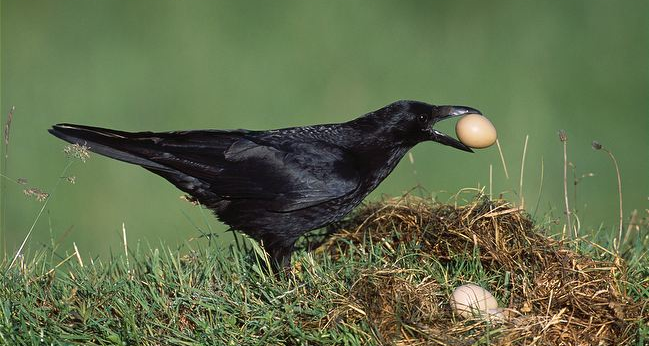
External Characteristics
Black bird measuring about 47 cm. with dark gray bill and legs. In flight, the first 4 hand feathers are quite far apart. The crow makes a scratching, somewhat unpleasant sound.
Propagation
The crow’s nest is smaller than the magpie’s. It usually sits lower in a tree and then against the trunk or a thick branch. After the female incubates the 6 to 8 blue-green speckled eggs for 19 days, the young appear. They remain in the nest for about a month. They remain together as a family for several months.
Biotope and food
Crows have few habitat requirements. They can be found both in forests and in the countryside. Even in villages they appear in recent years. In the vicinity of farms with livestock, concentrations are often greater. There they make use of the silage piles filled with corn. There is little in the way of seeds, fruits, eggs and meat that the crow does not eat. They can be found in fields and pastures looking for insects and maggots. Sometimes do considerable damage in orchards. Skim fields in search of eggs and young of ground-breeding birds. Are also not afraid to eat dead animals. Are the terror of young hares, in whom they first peck out the eyes. In short, especially in the open field, little is safe for them.
Distribution in Flanders
There are probably no places in Flanders where there are no crows to be seen.
A subspecies the hooded crow (Corvus corone corvix), lives mainly in Scotland and Poland. Was often seen here in winter a few decades ago. Now only occasionally.
Magpie (Pica pica)
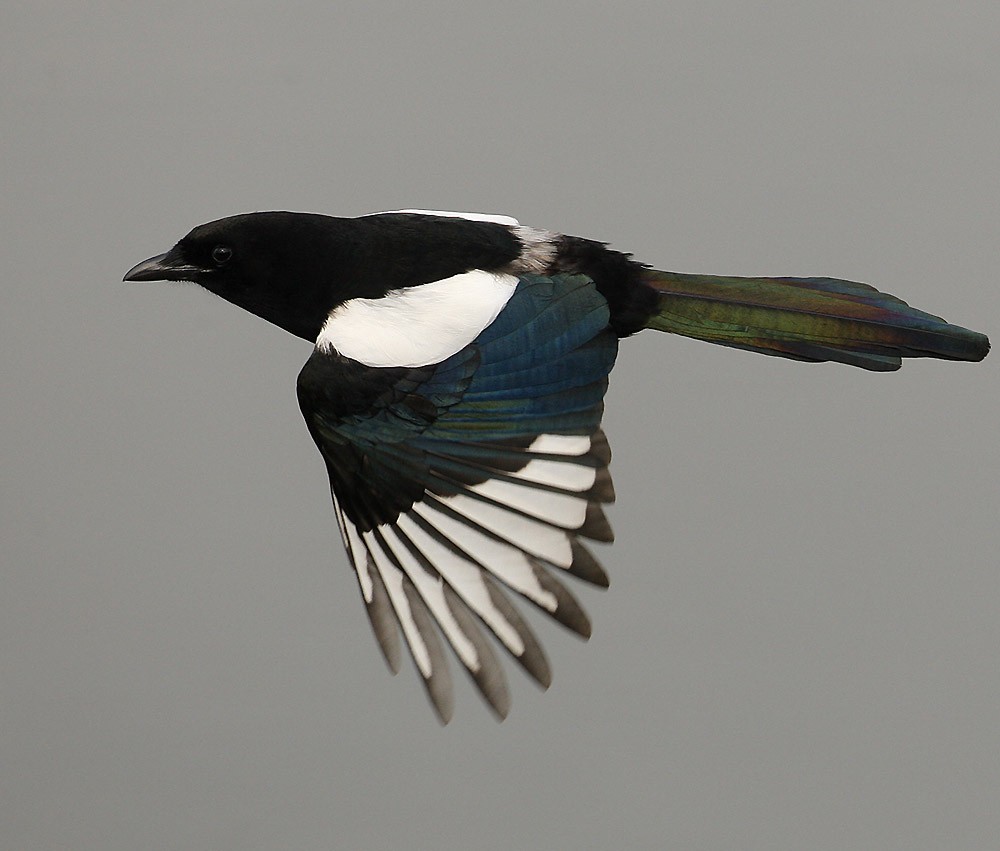
External Characteristics
At first glance, the magpie is a black and white bird. Closer inspection reveals that some black parts such as the tail and wings, have a greenish purple glow. The length of the bird is about 45 cm. Half of that consists of the tail. The beak and legs are gray. Both sexes are similar. Young magpies do not yet have the shiny parts and a much shorter tail. The magpie makes a rather screeching sound. They are known as “clever” birds.
Propagation
The large, dome-shaped nest, equipped with a roof, is often built as early as February. Usually in the top of a tall tree such as a poplar tree. In it, 5 to 8 blue eggs are laid that are incubated by the female for 19 days. The young fly at 4 weeks of age and stay with the parents until September. Magpie live monogamous lives.
Biotope and food
The magpie is not a true forest bird. It prefers semi-open landscape. Is often found near a farm. Especially if there are some higher trees where he can make his nest. In recent decades it is also found everywhere in towns and cities and along roads. This more than likely has to do with food supply. People leave a lot of food behind and drive on the roads killing animals. The opportunist magpie takes advantage of that. In addition to carrion, the magpie eats all kinds of invertebrates, but in the spring especially eggs and young birds. It scours all bushes and hedges and is the terror of small bird species. Later in the year, it also eats fruits.
Predators
It sometimes happens that magpies are caught by the hawk or peregrine falcon. Young magpies that cannot yet fly well sometimes fall victim to cats. Although the magpie often forages along roads, traffic casualties are remarkably low.
Distribution in Flanders
The magpie is quite common throughout Flanders. This only becomes apparent when they start to cluster from September.
Jackdaw (Corvus monedula)
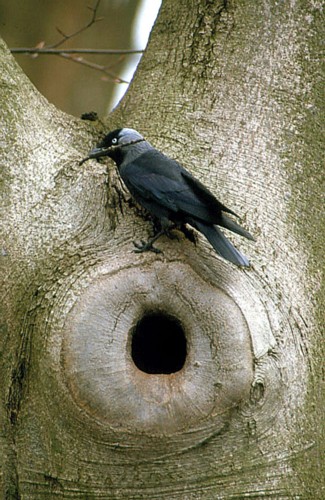
External Characteristics
The jackdaw is a black bird with a gray head and gray legs and beak. The breast and belly are dark gray. At 33 cm. long, it is quite a bit smaller than the other species. As with all crow species, the sexes are the same. In flight, the dark bands under the wings are clearly visible. The sound is a clear “chirp” that can be heard from far away.
Propagation
The jackdaw also prefers to live in colonies. The nests are made in chimneys, hollows in trees, old buildings and church towers. From the latter it owes the name church crow in some regions. The female lays 3 to 7 spotted eggs and incubates them for 18 days. During incubation she is fed by the male. The young jackdaws can fly after a month. Jackdaws are monogamous
Biotope and food
Nowadays, almost every village has a colony of jackdaws. Often the residents are not so happy about this because they cause quite a nuisance. Droppings and especially blocked chimneys. A condition for a colony, however, is that there are enough fields and especially pastures in the vicinity. The pastures not only provide the necessary invertebrates, but usually include corn pits. Like the crow, the jackdaw is not averse to that. Fruit is also on their menu. During the time they have young, jackdaws also search for eggs and young birds. Sometimes jackdaws can be seen on the back of a sheep. Sometimes because they need wool for their nest, sometimes to look for the sheep’s lice.
Predators
Jackdaws not only fall victim to the hawk and peregrine falcon, but also sometimes to the sparrow hawk. Furthermore, they have to fear the cats that sometimes grab young jackdaws. Even the honorable householder who ignites his fireplace can cause them problems. Usually the opposite is the case.
Distribution in Flanders
The population of jackdaws has increased tremendously over the last 30 years and seems to be increasing. There are still few villages in Flanders that do not have a colony of jackdaws. The jackdaw belongs to the protected crow species.
Rook (Corvus frugilegus).
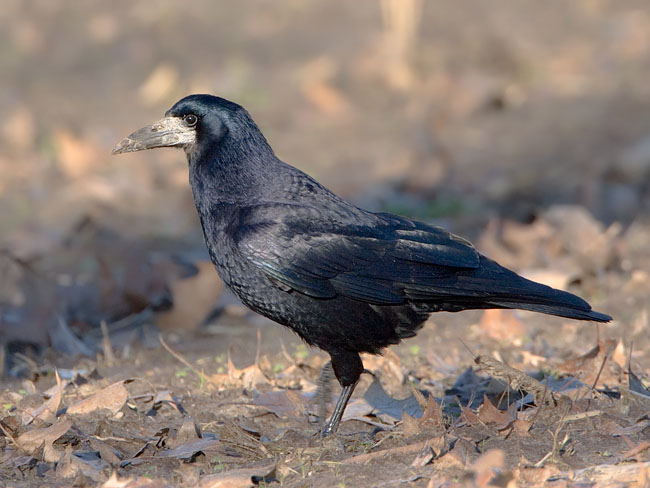
External Characteristics
At 46 cm. long, the rook is slightly smaller than the crow. Has about the same plumage, but a notable difference is the bare patch around the base of the bill and the sheen on the feathers. The sexes are similar. The sound is much higher and clearer than that of the crow. When they are together in their colony, it is a cacophony of sounds. Juveniles closely resemble crows due to the lack of the bare patch near the bill.
Propagation
Because rooks form a colony, they need several trees to make their nests. Nevertheless, 10 nests can sometimes be seen in one tree. The nest resembles that of the crow, but is made in the top of a tree. The nests are built early in the spring. The female broods on the 3 to 5 blue-green eggs with dots, lasting 19 days. The parents carry food for the young in a throat pouch. The young fly out after a month. Rooks live monogamous lives.
Biotope and food
Because rooks need some trees, they are often found in parks. They are true birds of the countryside. They can often be seen foraging by several dozen in meadows or fields. Although they do not despise an egg, they will not really look for it. They like to eat seeds which sometimes causes damage to agricultural crops. Their main diet consists of a variety of insects, worms and snails.
Predators
In some regions, they do occasionally fall prey to the hawk and peregrine falcon. Other than that, they have little to fear. The young rooks are also relatively safe from predators due to their stay in a colony. The greatest danger to the birds is usually agricultural poisons ingested with food. They can also have a hard time in harsh winters.
Distribution in Flanders
The number of rooks in Flanders is quite high. This is not so noticeable because they are concentrated in colonies of several hundred birds. The rook is not a harmful bird and belongs to the protected crow species.
Raven (Corvus corax)
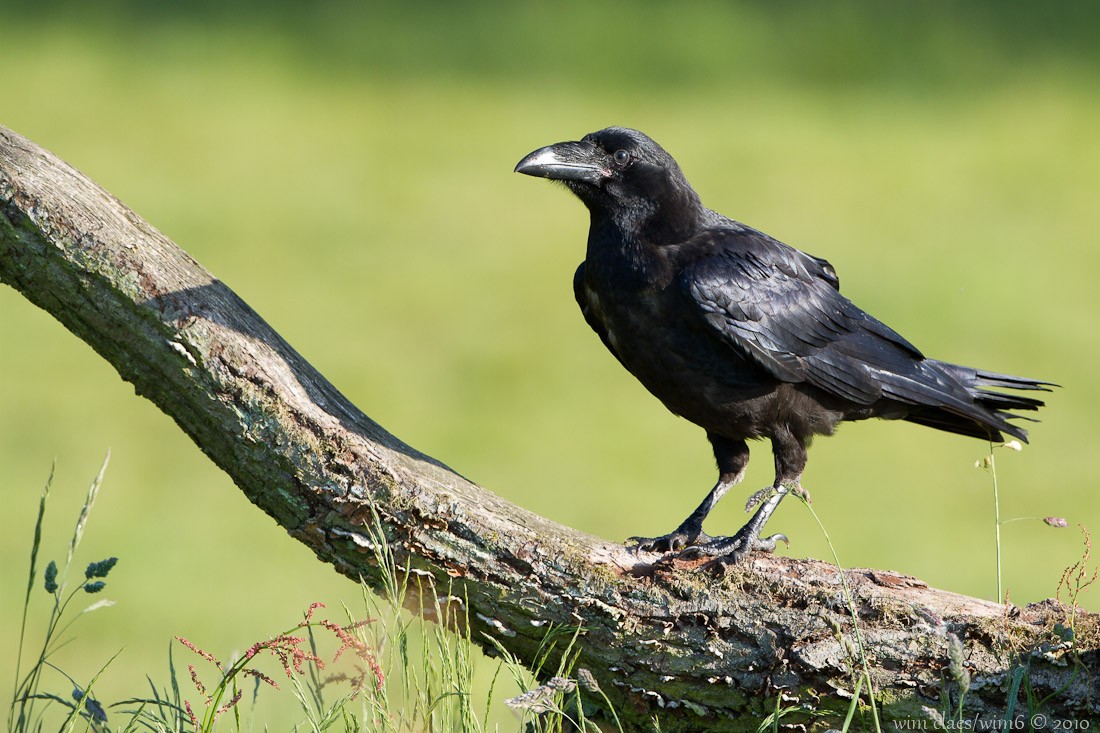
External Characteristics
At about 64 cm. long, the raven is the largest European songbird. It is completely black with a blue to green sheen over its feathers. In the raven, both sexes are equal. It can be distinguished from the black crow by its size, heavy head, sound and slower wing beat interrupted by gliding flights. Although it cannot be heard from its crow-crow sound, it does belong to the order of songbirds.
Propagation
In our regions, the monogamous raven builds its nest is a tree. In other places it is often in rock crevices. As early as March, 4 to 6 greenish-blue eggs with brown spots are laid. Breeding is done by the female who is supplied with food by the male. The young remain in the nest until they are 5 to 6 weeks old. They have a dark brown color.
Biotope and food
The raven is a bird of varied landscapes. Mountains, forests with heaths, or varied agricultural land. It is important that there is little human disturbance. As for food, the raven is far from picky. Bait, insects, amphibians, eggs, birds mammals, seeds and fruits, it can all serve him. With its large strong beak, it is even capable of killing a mammal up to the size of a hare.
Predators
With us, the raven hardly has anything to fear from predators. Therefore, the threat to him comes almost exclusively from humans. Eating poisoned animals and persecution has been its portion for centuries.
Distribution in Flanders
Until the 19th century, the raven was found here in limited numbers. In the first half of the 20th century, it disappeared from Belgium. After its reintroduction a few decades ago, there are again a few dozen breeding pairs. It is not expected that there will ever be large numbers of them. The raven belongs to the protected crow species.
Jay (Garrulus glandarius)
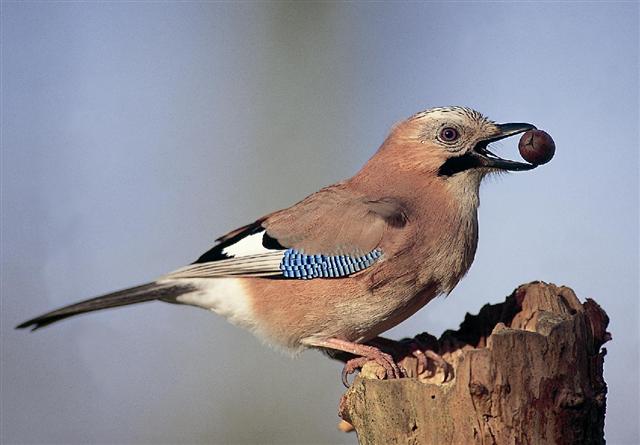
External Characteristics
Perhaps the jay is the most beautiful of the 5 crow species. Its brownish-pink body of 33 cm. is adorned on the shoulder by bright blue feathers. The tail, tip of the wings and a throat stripe are dark brown. The throat, a piece of wing and rump are white. Has another striped crest as its crowning glory. The flight is undulating like that of woodpeckers. As beautiful the bird is, so ugly is its raucous, piercing call. In a forest, it is usually the first to warn with it when danger threatens.
Propagation
The jay makes a rather messy nest in a tree. They hold a kind of courtship flight in the spring. The 5 to 7 eggs are incubated by the female for 14 days. The young, cared for by both parents, are ready to fly after 3 weeks. They remain together as a family until after summer. Jays live monogamous lives.
Biotope and food
About 30 years ago, the jay was still listed in bird guides as a shy forest bird. It still prefers forests, but can now also be found in parks in built-up areas. It does remain a rather shy and especially very observant bird. The jay apparently likes to eat acorns. It even hoards winter supplies of them. Other nuts, seeds and fruits also serve as food. Furthermore, it eats many insects, maggots, worms, etc.. It will not leave out carrion either. In spring it is a formidable predator of eggs and young of small birds.
Predators
Like the jackdaw, the jay is sometimes preyed upon by hawk, peregrine falcon and sparrowhawk. Sometimes eggs or young also fall victim to pine marten or a squirrel.
Distribution in Flanders
Whereas the jay was a rather rare bird half a century ago, it has now become a common sight. There are still few forests and parks in Flanders that do not have one or more flocks of jays. Some years many birds from the north arrive in winter.
No permit yet?
Jachtexamen.be is the online learning environment for hunting, providing optimal exam preparation.