


Predators – Mammals
All about mammalian predators.
Mammals

External features
The polecat has an elongated physique. The rams can weigh up to 1.5 kg, the does usually weigh a little less.
The coat consists of short, yellow under hairs and long, dark brown, shiny cover hairs. The flanks and belly are usually lighter than the back. The head shows the typical white mask. The polecat is a true nocturnal animal. Therefore, we do not see it very often. We often have to content ourselves with what it left behind on its nocturnal tour.
The shedding of the winter coat occurs in the months of May and June. The winter fur is long-haired with a yellowish undercoat on top. The summer fur is much shorter and darker with a rusty brown coat. The white facial spots are most evident in animals with winter fur. A rust brown stripe runs across the midline of the abdomen. Except for the shiny black nose, the chin and muzzle are yellowish white. The yellow runs down the nose in an arc across the eye to a yellow spot behind the eye. In the females, the yellow is paler than in the male, sometimes almost white. The anal glands emit a disgusting urine odor.
Lifestyle
Although the polecat is noticeably larger than the stoat, it is not as harmful. The polecat hunts mostly at night. Sometimes it also hunts for rats and rabbits as early as late afternoon.
We meet the polecat everywhere. The polecat usually lives in burrows that it digs itself. It is a culture follower. It adapts to humans. It also looks for its prey close to people. It lives solitary.
During the winter months, it seeks out stables and barns if it is in the mood for eggs or chicken meat.
Like a cat, the polecat kills even when it is not hungry. Such behavior is purely reflexive: as soon as the cat or polecat sees something move, they must catch it.
Propagation
The polecat mates in March and, after 40 to 45 days, gives birth to 3 to 6 blind young in a warm, dry nest. The young are cared for for 3 months. Then the family separates and each looks for a place to hibernate during August and September.
Ermine (Mustella Erminea).

External features
The black tip on the end of the tail makes it easy for us to distinguish stoats from weasels.
The short, dense hair coat os brown on the upper side during the summer months. The underbelly and the inside of the legs are outlined white. After the November molt, they are completely white except for the black tail tip.
The ram measures about 24 to 30 cm, the doe 20 to 26 cm with and weight of 140 to 350 g and 110 to 240 g, respectively.
In the adult animals, the rams are much larger than the nuts.
Lifestyle
The nature of activities is quite dependent on temperature. In summer they are pronounced diurnal animals, roaming restlessly, especially in warm weather, in search of prey. In winter, they live more withdrawn within a small radius of activity, often in straw. They still occur in sufficient numbers and this is still steadily increasing.
Weasel (Mustella nivalis)
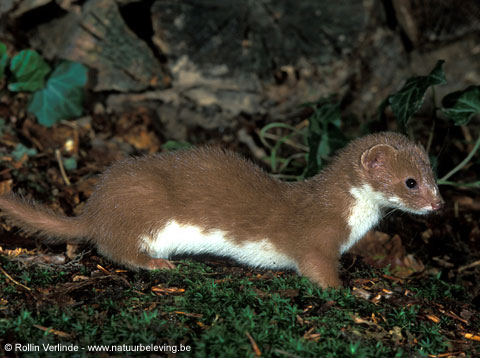
The weasel is the smallest native predatory mammal. Weasels live throughout Europe except Ireland.
External Characteristics
The weasel can be compared to the ermine in shape and size. Only it lacks the black tail tip. Moreover, unlike stoats, weasels remain brown even after autumn moult.
The upper side and tail are brownish red. The belly and the inside of the legs are white. The ram measures about 18 to 23 cm, the nut 16 to 19 cm with a respective weight of 60 to 120 g and 40 to 80 g.
Lifestyle
The weasel does not show itself easily, although it is a diurnal animal. In summer it is particularly active and roams widely. During the winter months he stays more underground in pipes of moles or mice. In snowy weather it almost never comes out so it is with great difficulty that we will notice a weasel print in the snow.
As a typical field animal, the weasel prefers dry areas.
Propagation
The ranching season falls mainly during the months of February and March. After a gestation period of 1 month, 6 to 8 young are given birth.
After 3 months, they are independent.
Tree marten (Martes martes)

External Characteristics
The pine marten closely resembles the stone marten. The overall length of the ram is between 75 and 80 cm. The nut is somewhat smaller. Has about the same brown coloration. The differences are that the chest and belly of the pine marten are more yellow than white. The breast spot is also not as forked but more rounded. Like the stone marten, has a fairly long tail. The sounds the pine marten makes are very different.
Propagation
Like the stone marten, the pine marten has delayed gestation. Mating occurs in the summer, but the fertilized egg does not enter the uterus until January. The 3 to 6 young are usually born in April. The nursery is often a hollow tree or, for example, an old nest of a black woodpecker. The young are born blind and can only see when they are 6 weeks old. At 6 months of age, they are as large as the mother. Yet it takes until the second year after birth for monogamous pine marten to reach sexual maturity.
Biotope and food
As its name implies, the pine marten prefers forests. Although it is capable of living outside of forests as well. Unlike the stone marten, the pine marten avoids the presence of human habitation. The pine marten is an even better climber than the stone marten. It is even capable of successfully chasing a squirrel through the treetops. Still, it seeks most of its food on the ground. That consists of carrion, insects, amphibians, eggs, birds, small mammals up to the size of a rabbit and fruits.
Predators
The pine marten has few natural enemies in our area. Its greatest danger comes from humans. Eating poisoned bait, persecution and traffic are real threats.
Distribution in Flanders
The pine marten occurs in Flanders only to a very limited extent. The main cause is probably the lack of sufficient areas of tranquility.
Stone marten (Martes foina)

External Characteristics
The stone marten (velvet marten) is a brown to grayish-brown animal with a white belly and chest. The light undercoat is completely covered by the brown cover hairs. At up to 75 cm. long and weighing over 2 kg. the ram is a sizable animal. The nut is a lot smaller. The length of the tail is about a third of its total length. Produces a range of grunting, squeaking and hissing sounds.
Propagation
The stone marten is one of the marten species with delayed gestation. Mating is in the summer, but implantation of the embryo occurs only 3 months before birth. Total gestation thus lasts about 38 weeks. The 3 to 7 young remain in the nest for about 2 months. They are only adult after a year and sexually mature in the second year after birth. The stone marten lives monogamously and has its own territory.
Biotope and food
Even more than the polecat, the stone marten is found near human habitation. If it is not too vast and flat, we can find it anywhere. Likes to live in barns, attics or even crawl spaces under the floor. Makes itself quite unloved by its great fondness for eggs. Not only chicken eggs, but for example also the eggs of pigeons. Often even the pigeons do not survive such a visit. Furthermore, he eats birds, small mammals, amphibians and fruits. For some reason, he likes to crawl under the hood of a car and then bite the wiring.
Predators
As an animal that is predominantly nocturnal and due to its hefty size, it has few enemies. Persecution by humans and traffic cause the most casualties.
Distribution in Flanders
The stone marten has been on a tremendous march from the east in recent decades. It is now no longer a rare animal in almost all of Flanders.
No permit yet?
Jachtexamen.be is the online learning environment for hunting, providing optimal exam preparation.