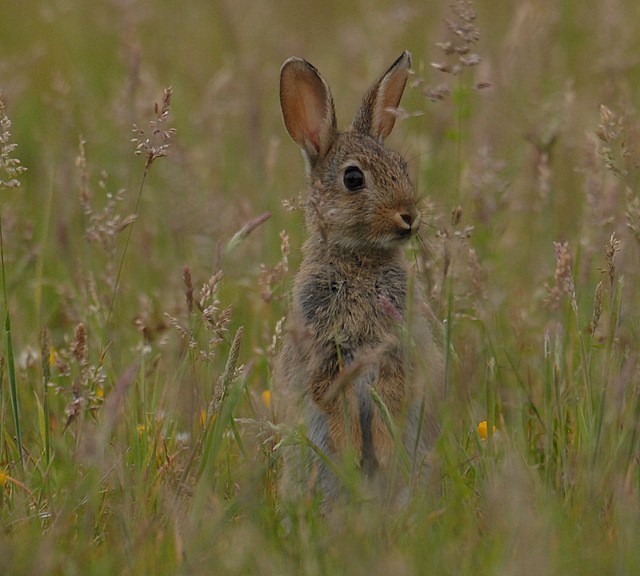
External Characteristics
It is worth paying close attention to the rabbit It has a very small mouth: it never has to open its mouth very far because it gnaws a turnip or carrot in very small bits. To be able to gnaw properly, it has two adaptations: the upper lip is split and can be pushed aside so that the front teeth are free. These front teeth are two chisel-shaped “gnawing teeth” that are always growing back. To wear down those teeth regularly, the rabbit must gnaw constantly. For rabbits, gnawing is a necessity of life, hence the sometimes extensive damage to crops.
Also notable are the large eyes, as a rabbit is a nocturnal animal. There are three eyelids : one more than in ourselves. In addition to the movable upper and lower eyelids, there is a third, transparent eyelid at the inner corner of the eye that can spread sight over the eyeball to protect the eye. The long spoon-shaped auricles are highly mobile to precisely pick up every sound and its direction. A rabbit must always be on guard, as it cannot defend itself against enemies who are after it. Its only salvation is hasty flight. While the auricles try to catch every sound, the eyes scan the whole area. The auricles contain many blood vessels and that is where the rabbit fleas come to suck blood. Also, the ears provide release of excess body heat. Because the eyes are located laterally in the head, the rabbit has a very wide field of vision. Approaching a rabbit unseen is impossible !
The rabbit has an incredibly agile spine. When fleeing, it makes good use of this by striking “hooks. At full speed, the rabbit can change its direction with the pursuer overshooting its prey.
The color of the fur varies according to the region, yet less pronounced than in hares. Usually the back is a variegated mixture of gray, ochre, pinkish and black hairs. The back of the head or bulb is reddish, but the flanks and ears are solid brownish gray. The belly, the inside of the buttocks and the eye outline are white, as is the tail on the underside. The brown whiskers are only weakly developed.The weight of an adult rabbit averages 1375g for a length of 42 cm. Male rabbits are generally larger and heavier than their female counterparts.
Propagation
Although the rabbit can potentially reproduce throughout the year, we note that the reproductive cycle in natural conditions is distinctly seasonal. In our regions, reproduction begins in February and ends in August.
The sacred number “seven” plays an important role in sexual life. An adult nut is particularly sexually attractive every seven days. After first satisfying hunger, mating then takes place at dusk. On average, the gestation period lasts 7 x 4 = 28 days. Within 24 hours of farrowing, the lees are fertilized again. An adult rabbit lees gives five litters a year with 6 to 7 lampreys each time. In total, about twenty of them become adults.
Young females, born from the first pregnancies can give birth to young the same year. In the first place they guarantee reproduction at the end of the season. From the age of six months the females can have young. The males are not mature until nine months.
The young are thrown into a specially dug burrow or roll, the female feeds material into the mouth and mixes chest and belly hair into it. With that mixture she coats the bottom and walls of the nest.
After hatching, as she leaves the nest, the female plugs the exit with soil and leaves her markings, urine and feces there. These repel the other females. The young, born naked and blind, remain in the nest for about 3 weeks.