

Wine & hunting: 2 passions, 1 whole
The gastronomic world is one characterized by a constant evolution of
scents, tastes, textures and techniques in a relentless search for new dimensions
and taste experiences. The origin of products and how they are made
are more important than ever. Under the impetus of the consumer, the producer must
to do their utmost to be in a responsible and preferably as ecological way as possible.
product. It is this awareness that has led me to pursue 2 passions with
together. This article is therefore intended as a guide on how to pair game dishes
with both classic and less ordinary wines. It can therefore be a source of inspiration for
wine lovers, hobby chefs and (semi-)professionals in their search for new,
surprising wines and accompanying dishes.
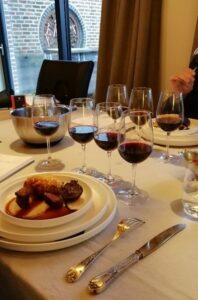
As a hunter, I spend a lot of time in nature and I have the opportunity to provide for a large part of our meat consumption myself. In this way, the circle is completely complete, from game management to preparing the stretched game. As sommelier-conseil at Vino Degusto, the passion for the wine trade is also present. Every year, winegrowers must do their utmost to vinify quality wines. They too are at the mercy of the conditions of nature and how their grapes thrive in them. Coincidentally, these 2 themes can be very highly regarded culinarily. It goes without saying that it is challenging and extremely fascinating to combine game dishes with matching wines, especially when you can bring back beautiful hunting memories during the meal
Looking, analyzing & tasting
The tools that one can always fall back on are mainly to be found in the classic
kitchen and wine world that have earned their stripes for decades. Use and
combinations from specific regions that are bursting with individuality and identity will make it
continue to do so, although it is at least as interesting to shift the focus in time and also
to look beyond horizons. Tasting and analysis are the key concepts to achieve
new insights and to think more out of the box.
This is no different in the combination between game and wine, although one should pay attention to this
that game is still an exception within their diet for many people. It
is mainly consumed in restaurants and during the holidays. Quite rightly, they want to
can therefore fully enjoy a beautiful meal and a good quality to very good
good glass of wine.
Although there are different game species available throughout the year, the most well-known period runs from October to January. This is also the period when you can get many other fantastic products that go very well with meat from wild animals. Think of winter truffle and various wild mushrooms, but also rich root vegetables and vegetables such as chicory, turnips and Brussels sprouts. With a few exceptions, this results in refined and rich dishes that are extremely nutritious. Of course, it is impossible to put forward the right wine for every game species because there are several factors that can influence this. Think of things like:
- The preparation method
- The garnishes used
- The intensity and flavor profile of the sauce
- The intensity of the meat
- The number of courses within your menu
Choosing is certainly not losing
However, it is possible to provide some tools that can help you make a targeted and deliberate choice when you are going to eat dishes with game or prepare them yourself.
We list some of them for you:
1. Make your choice within a higher wine segment than the entry-level wines.
Game dishes are more refined and delicate compared to everyday dishes. Because they are scarcer, they are often also slightly more highly regarded in terms of quality and are sometimes even labelled as a delicacy. A winegrower’s wine assortment is composed in the same way. The higher you go in the range, the more refined and ‘special’ the wines become. Availability also decreases as you move up the pyramid, but of course the quality does increase.
2.Fruity wines with primary aromas go (completely) under
Wines that are mainly aimed at quick consumption will usually have a simple structure. They are mainly aimed at primary fruit aromas that are neither varied nor complex. The tannins are supple, although there is a chance that they can be a bit angular, depending on the quality of the wine. In combination with game dishes, simple wine types usually lack depth and also lack the power to stay upright with game dishes.
3. Be prepared to shop within a higher price range
As mentioned, a meal with game is rather exceptional and often more expensive than common products such as chicken, pork and beef. Following on from point 1, it is of course true that the price also increases as you increase in the quality of the wine. Allow yourself the pleasure of drinking a high-quality wine with a nice meal with game. Therefore, let quality take precedence over quantity.
Do you have no limits or do you really want to show off wines that are top-notch?
Choose some French gems, many game dishes have also been devised within the French classic kitchen. Think of a beautiful Margaux, a perfectly balanced Côte Rotie or aged pinot noir from Burgundy.
In Italy we are talking about Barollo, in an old or new style, Amarone (riserva) or Brunello di Montalcino, although Spain is certainly not inferior to some fantastic houses in Priorat, Rioja or Ribera del Duero.
4. Game prefers red wine most of the time, although white is also possible in some cases.
Let the combination between wine and dish depend in the first place on the color of the meat. Game usually has a red meat structure, although there are exceptions to this. Think of game birds such as pheasant and partridge, but wild rabbit is also white in meat. If you serve vol-au-vent of pheasant or a waterzooi, go for white wines with careful wood aging. A chardonnay lends itself well to this in many cases.
5. Prefer dark fruit aromas to red fruit aromas
Therefore, look for wines from more southern or slightly warmer wine regions. Although there are certainly exceptions to this, these wines will often feel a bit warmer and rounder and have a more supple tannic structure. The whole of wine and dish can thus achieve a beautiful harmony that appeals to a wide audience.
Of course, you can also opt for wines that mainly have aromas of strawberry, cherry or raspberry. In this case, make sure they are a bit more mature and be sure to keep an eye on the acidity balance. It should not be too pronounced and should focus on supporting the fruity accent in the wine.
6.De wine must have a fused tannic structure
Fine dishes usually call for elegant, beautifully concentrated wines. In combination with game, tight, firm tannins are not immediately indicated because the meat does not have a firm chewing structure as is the case with beef, for example. The thread structure is rather fine and melts away quickly during chewing, so that firm tannins will not be broken down sufficiently. This runs the risk that the wine will dominate the dish and create an imbalance.
7.Wood is preferred over stainless steel
Funny, you can say that this makes the game on your plate feel at home again. Wild animals very often live in wooded areas. Of course, this is not the primary approach why we choose wood, but it does form a nice mnemonic. We need wood education for 2 important things. On the one hand, it will ensure that the firm tannins of powerful grape varieties such as Syrah, Agiorgitiko and Malbec become more supple and fused. In addition, wood aging also ensures that the wine will have a nice spiciness. This of course depends on the toasting on the one hand and the age of the barrel on the other. The type of wood and size of the barrel also play a crucial role. The influence of heavily toasted, new barrels will be greater than that of 2nd or 3rd year barrels of a larger volume.
8. Above all, choose something you know how to taste yourself
If you already have extensive knowledge, you can certainly start looking for it yourself. Often you will also learn things during this search that can be useful to you later. If you do not yet have extensive knowledge, be sure to be guided by a professional. Give him as much information as possible about the dish you are going to make, the sauce, how you are going to prepare it, but also who your guests are and above all, how hard you want to spoil them. Together you will undoubtedly achieve a suitable result and the wine is one less worry for a successful evening!
Somm’s suggestions
I would like to give you some suggestions that have been experimentally tested and approved. As you will notice, there are some surprising and less classic combinations. Definitely worth testing or getting inspired.
-
Wood pigeon with bimi & parsley root
|
Balla Geza Feteascá Neagrá Balla Geza Winery |
||||||
| Romania Transylvania (Minis) |
Minis DOC | Granite & Sedimentary Rocks | Several months in large oak barrels | Feteascá Neagrá | 2019 | |
| Visual phase: Intense purple-red wine with purple edges. The wine is clear and brilliant and has no evolution. |
||||||
| Olfactive phase: The first nose is beautiful and full of dominant aromas of black ripe fruits, such as blackberry and blueberries. After rolling, the aromas become more intense and we also notice elegant notes of vanilla and a nice spiciness of bay leaf and thyme. The nose is intense, very pure and correct. |
||||||
| Gustative phase: The attack is very juicy and bursting with fruit. The expression is also continued in the middle mouth and gives a very mouth-filling wine with a beautiful balance between acidity, fruit aromas and beautifully fused tannins. The finish is very long and runs through all olfactory facets. A beautiful wine from Romania. |
||||||
| Wine pairing: A wine with a phenomenal balance that lifts the dish where necessary and at the same time harmonizes beautifully. The juiciness of the wine accompanies the flesh above all and provides a subtle upgrade of the parsley root. The mouth-filling character gives the wine enough power to stand up wonderfully against the sauce where the mushrooms round off the tannins in a fantastic way and the wine gives the mushrooms an extra touch. The assessment was unanimous and extremely positive. |
||||||
-
Pheasant ‘Brabançonne’
|
Ried Steinberg Privat Weingut Josef Fritz |
||||||
| Austria Wagram |
Qualitätswein Ried Steinberger | Loess & sandstone | Several months on oak barriques | Roter Veltliner | 2019 | |
| Visual phase: Moderately intense, golden white wine that is bright and brilliant. The wine shows no evolution. |
||||||
|
Olfactive phase: On the nose, the aromas of gooseberries and a light touch of white pepper immediately emerge. After rolling, a lactic butter note and very subtle honey aromas are distinguished. The nose is varied, intense, pure & correct. He encourages the consumer, as it were, to taste.
|
||||||
| Gustative phase: In the mouth, one gets a true explosion of aromas & texture. The attack is very firm and very mouth-filling. The middle drink is very layered and underpinned with gossamer acidity. The wine is perfectly balanced. This white wine has a long finish with a good ratio of bitter and sweet. The expression of the nose is absolutely confirmed in the mouth. |
||||||
|
Wine pairing: This roter veltliner complements the dish in a very appropriate way. The layering that the wine possesses ensures that the whole is brought together extremely finely. The spice of the pepper and the fine acids match well with the sharp and creamy of the sauce. The finesse of the mid-mouth blends very nicely with the elegance of the pheasant where the aftertaste of the wine creates a playful finish with the chicory. |
||||||
-
Wild duck with pumpkin, figs & hazelnut
|
Costers del Priorat Petit Pissarres Costers Del Priorat |
||||||
| Spain Priorat (Los Solanes) |
DOQ (DOCa) Priorat | Llicorella (red slate & quartz) | Separate vinification in stainless steel barrels with aging in oak barriques & foudres (new & 2nd year) for 6 months | 60% Garnacha 40% Carignan |
2019 | |
|
Visual phase: Intense cherry red color with purple edges. The wine is clear and has no contamination. There is no evolution present.
|
||||||
|
Olfactive phase: The nose is very intense with pronounced aromas of red fruits, especially cherries and light floral notes of violets. In the second nose, soft vanilla notes and cinnamon come to the fore to finish with a nice pepper touch. The nose is varied and pure.
|
||||||
|
Gustative phase: The attack is very powerful and immediately mouth-filling. This attack gradually turns into a structured, but high-quality middle mouth with noticeable tannins and sufficient body. The fruitiness in this wine is mainly reflected in the acidity it has in the middle mouth and is therefore nicely structured. The finish is spicy and very long.
|
||||||
|
Wine pairing: A very nice and pleasant combination with the dish. On the one hand, the acidity ensures the perfect balance, both in the wine and with the dish, and on the other hand, this wine is anything but heavy. The tannin structure is of such quality that it combines very smoothly with all the elements in the plate. The flavors of pumpkin ensure that everything that is rounded off and therefore flawlessly brings the whole close together. The roasted hazelnut provides the nice contrast. |
||||||
-
Venison ‘grand veneur’ with winter vegetables and poached pear
|
Taurasi “Macchia dei Goti” Azienda Agricola Antonio Caggiano |
||||||
| Italy Campania |
DOCG Taurasi | Clay & lime soil | 12 months in barriques, then another 6 months at foudres | Aglianico | 2017 | |
| Visual phase: Very intensely concentrated cherry red color with purple edges. Wine is beautiful and has no noticeable evolution. |
||||||
| Olfactive phase: Wine is a bit closed at first nose and has mainly animal & leather notes. After aeration come aromas of beautiful ripe black fruits, vanilla, cassis and garrigue spices. The nose is intense and has a beautiful complexity that makes you long for more. |
||||||
| Gustative phase: Due to the closed nose, we first let the wine aerate before tasting. The first attack is full of black fruit and very juicy. The fruit is nicely assisted by elegant acidity. The mid-mouth is very aromatic with nicely interwoven tannins that provide a nice texture. The finale is wonderfully spicy and very long with all the aromas once again. A beautiful wine that keeps coming. |
||||||
|
Wine pairing: A wine that does justice to the dish. Juicy red meat with beautifully melted tannins, a nice acidity to break up the sweeter and creamy elements in the dish and a delicious fruit explosion full of elegant power provide a very nice interplay with the Brussels sprouts and the caramelized chicory. A pairing where all flavors retain their individuality and yet flow very nicely into each other. Already top, but within 2 years more than likely phenomenal. |
||||||
-
Wild boar with Jerusalem artichoke, beetroot & orange notes
|
Gaia Estate Red Gaia Estate |
||||||
| Greece Peloponnese |
PDO Nemea | Clay & lime | 12 months in oak barriques | agiorgitiko | 2017 | |
|
Visual phase: Intense ruby red with a slightly watery edge. The wine is clear and has no contamination. There is no evolution.
|
||||||
|
Olfactive phase: The first nose is dominated by black fruits such as blueberries and cassis. After rolling, pleasant aromas of vanilla, but certainly also powerful spicy aromas of bay leaf, pepper and eucalyptus. The nose is very intense, varied and pure.
|
||||||
|
Gustative phase: The first attack is very expressive and mouth-filling. In the middle mouth, the black fruit gives way to a phenomenal spiciness and very nice woody touch. The tannins provide a very pleasant body because they are nicely fused. They are nicely emphasized by the acidity in the wine. The finish is long with a spicy finale where the whole thing is refreshed with a nice menthol touch.
|
||||||
|
Wine pairing: The ripe black fruit that is slightly rounded off by the wood food gives a great interplay with the earthiness of the Jerusalem artichoke and parsley root combined with the deep and sweet of the beetroot. The acidity of the wine provides a nice contrast. The elegant structure of the meat is nicely supported by the spiciness of the wine, which also ensures that the wine effortlessly stands up to the bitterness in the sauce. The blue cheese provides a nice contrast due to its salt content.
|
||||||
-
Civet of hare with foie gras
|
María Victoria Bodegas Verum |
||||||
| Argentina Patagonia |
Alto Valle del Rio Negro DOP | Clay | 18 months in French oak barriques (50% 1st & 50% 2nd year barrels) | Malbec | 2016 | |
| Visual phase: Intense purple-red wine. Wine is clear and brilliant and shows no evolution. |
||||||
| Olfactive phase: The first nose is dominated by blackcurrants, blackberry and cassis. After rolling, the nose becomes a bit more intense, a bit meatier and you get some more spicy accents. The nose is moderately intense, rather simple and not evolved. |
||||||
|
Gustative phase: The attack is smooth and fruity with a certain elegance. The acidity is in the wine in a fine way, so that it is hardly noticed. However, the mid-mouth is nicely balanced with perfectly integrated tannins. The finish is medium length and slightly spicy.
|
||||||
|
Wine pairing: Very nice association with the dish. The tasty, meaty structure of this meaty malbec complements the dish where it needs it, namely suppleness. The acids and power are sufficiently contained in the dish. Both elements are also present in the wine, but in a subtle way that they do not complement the dish, but ensure that the wine can remain upright. The juicy, suppleness makes the meat structure of the hare legs slightly softer, giving you a nice cohesive whole that, very importantly, does not become too heavy. A very nice gastronomic combination. |
||||||
With culinary greetings,
Sander Herbosch
‘Sommelier Conseil at Vino Degusto’