

What to do with the carcasses of animals without (known) owners?
Legal information regarding animal carcasses without (known) owners
Animals living in the wild are legally called ‘res nullius’ animals, which are animals without an owner. The definition of ‘res nullius animals’ is ‘animals that are not owned by a person and that live on sites or places that are not closed off by a continuous construction aimed at making the spread of the animals to surrounding areas and places impossible, regardless of the nature or cover of those places’.
From a legal point of view, the carcasses of these res nullius animals fall outside the jurisdiction of both ANB and OVAM. The legal definition of waste is ‘any substance or object which the holder discards or intends or is required to discard’. Since these are animals without an owner, there is no keeper who could or would want to get rid of them. An exception to this is dead pests that are released during pest control (e.g. in a food company, because that is considered by legislation to be waste, more specifically industrial waste). The holder wants to get rid of it and may therefore dispose of these dead pests as residual waste.
The carcasses of res nullius animals are excluded from the scope of European Regulations 1069/2009 and 142/2011 which contain guidelines for the disposal of waste and carcasses. OVAM and ANB are therefore of the opinion that, only if carcasses/parts of carcasses of res nullius animals are a nuisance to humans and the environment, their removal should be done in analogy with this legislation.
This table res nullius (pdf – 82 KB) contains the recommendations for the removal of carcasses of res nullius animals in order to prevent possible nuisance.
When carcasses are located on private property, the owner of the land is responsible for the disposal of the carcasses. When the carcasses are located on public property, the municipality is responsible for the disposal of the carcasses (cf. the new municipal law art 135).
Attention! If a certain disease in wild animals poses a risk to public health, animal health or nature, the Wild Animal Disease Decree comes into force. Then specific biosecurity measures can be imposed.
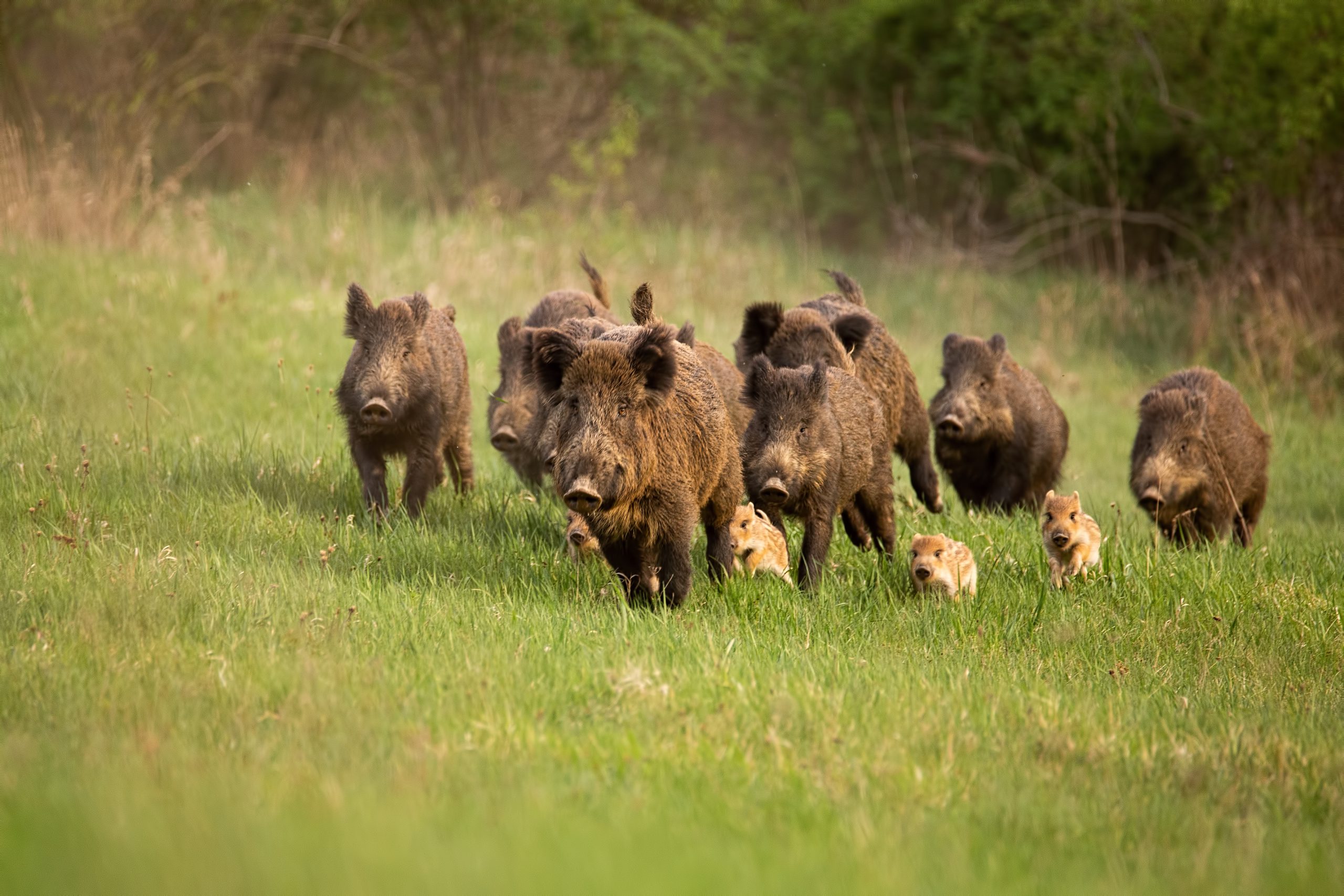
| For example, since the outbreak of African swine fever in wild boars in Wallonia, all wild boars found dead in Flanders are collected for analysis, unless they are a clear victim of hunting activities.
What should you do if you find such a carcass? Always keep your distance and do not touch the carcass! Call the contact point for your province as soon as possible so that the carcass is collected for examination:
The contacted employee of the provincial wildlife rescue centre will ask about your exact location and the situation on site (does the carcass still look intact, or has it already partly decayed, is it in a forest or along the road, is it a small piglet or a larger boar, etc.). The employee will then give further instructions. This person may ask you not to leave until a team arrives on site to collect the carcass for examination. In this way, we try to quickly identify any diseases in wild boars and prevent further spread. |
| In addition, dead birds are also examined for bird flu viruses and other germs.
What should you do if you find such a carcass? Always report abnormal mortality of wild birds in Flanders and Wallonia via the free telephone number of the ‘bird flu call centre’: 0800/99777. If these carcasses meet the set research criteria, they will be collected by ANB for research on germs such as bird flu viruses. |
| Dead amphibians are also examined for germs.
What should you do if you find such a carcass? If you find a dead amphibian in Flanders where the carcass is relatively fresh and intact without a traumatic cause of death (i.e. no amphibians that have been hit by a car, carcasses that have been pecked by animals and no drowned amphibians), it is best to always take it to one of the following Wild Animal Rescue Centres (VOC) so that the cause of death is investigated:
Pack the carcass in a double plastic bag or store it in a plastic box. Always follow the safety protocol to prevent the unwanted spread of the virus. |