


NETD, sNETD and more: Everything you need to know
Estimated reading time: 6.5 min.
Thermal imaging can help you see beyond the invisible, but that doesn’t mean there aren’t any gray areas left. One of the most talked about is NETD and the way it is marketed and measured.
At Pulsar, we used to share the NETD sensor. Other brands often lean towards system NETD. Now we have decided to do both. But what’s the difference? Is one better than the other? And why are we taking this step? Let’s find out.
NETD: What It Is And Why It Matters
NETD is used to measure the thermal sensitivity of a device and stands for noise equivalent temperature difference. Simply put, it represents the smallest temperature difference that a thermal imager can pick up.
In even simpler terms, imagine you have two thermal imaging cameras. One has a high NETD, the other a low one. If you use the first one to look at your hand, you will see it as one hot spot. But if you use the second device, you’ll see the palm and individual fingers and maybe even where the nails are.
NETD is usually measured in mK – millikelvin. It is an industry standard, and for a better understanding of numbers, you should know that one degree Kelvin is equal to one degree Celsius. So, if you have 25 mK, it will be the same as 0.025 C. Keep in mind that the two scales – Kelvin and Celsius – are not equal for measuring temperature. However, since they have the same degree value, the direct comparison works in our case.
NETD is extremely important in situations where the thermal contrast is low, for example in rain or fog. When the weather is dry and clear, it is really difficult to tell which thermal imager has 35 and which – 25 mK NETD.

NETD is extremely important in situations where the thermal contrast is low, for example in rain or fog. In such conditions, different objects in your field of vision are likely to have a similar temperature. The lower the NETD, the better you’ll be able to distinguish between different objects and understand what they are, and see small details – just like in our one-handed example.
Nowadays we often see NETD values of 40, 35, 25 and 18 mK. The lower the value of NETD, the more convincing the advertised thermal imager is. But keep in mind that these differences are especially visible in humid weather conditions or laboratories. In field conditions, when the weather is dry and clear, it is really difficult to tell which thermal imager has 35 and which – 25 mK NETD. In those situations, spatial resolution is much more important. But let’s stick to the sensitivity for now.
Sensor vs. system NETD
With thermal imaging devices, there are usually two types of NETD: sensor and system. At Pulsar, we always share the sensor’s NETD. We get that value from Lynred, the French company that produces our sensors and tests them in laboratories.
Sensor NETD is the minimum temperature difference that the sensor can distinguish at a fixed noise level. It is the basic sensitivity value and does not take into account additional factors, such as image processing algorithms and filters. In other words, it can be further enhanced with the help of software.
As you can probably guess, system (or device, or camera) is NETD sensor plus software algorithms. But is it a bad thing to improve NETD with image processing? Absolutely not – carefully and optimally selected, video processing parameters can reduce noise levels while preserving useful signals and details.

However, it’s not uncommon for manufacturers to overuse these processing algorithms. While they can help to achieve a lower system NETD, they can also reduce fine details, making the image less informative.
Another issue with overusing these algorithms is possible image lag or blurry image when you move the thermal device. As a result, you get a device that performs decently in a static position, but when you need to observe a moving scene, it creates a less-than-perfect image, which can pose a huge problem, especially with thermal imaging rifle scopes. It’s important to remember that no matter how many algorithms you add to your image, you can only improve the value of your system NETD – the NETD of the base sensor will always be the same.
How do you compare NETD?
The trick with NETD – both sensor and system – is that the methodologies for measuring it vary. That said, sensor manufacturers, especially European ones, typically adhere to a number of standards.
The measurement process takes place in laboratories, and there may be slight differences between different laboratories. In Europe, however, the results you’d get in independent testing would likely be very similar to what the manufacturers state.
With the NETD system, the story is different. Although measurement is still done in laboratories (at least in our case), because proprietary algorithms are involved, regulating them is like regulating the Wild West – almost impossible.
At Pulsar, we believe that you should always look at the sensor NETD first, and only then take into account the NETD of the system.
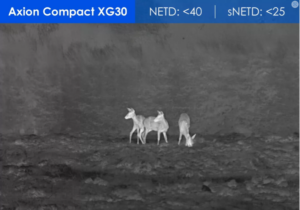
NETD in Pulsar Devices
Until recently, we didn’t share a system NETD – we believed sensor NETD was more objective. But as of right now, if you look at the spec sheet of a Pulsar device, you’ll see two numbers: NETD and sNETD. The first will always be the sensor NETD, which is the number that our manufacturer provides us. The second – system NETD – is calculated after all processing algorithms have kicked in.
The main reason why we decided to introduce this second measure is to make your life a little easier. Because many manufacturers hide their sensor NETD, it is difficult for users to accurately compare the specifications of thermal imaging equipment. With sNETD available on our devices, you can more easily compare them to others, while also keeping the actual NETD value in mind.
NETD on paper and NETD in action
That said, you should remember that these are only paper values. They are calculated in laboratories, not in the field. And because the technology is so advanced, the differences that exist are often small.
Therefore, we always recommend testing the device in actual field conditions before purchasing, if possible.
Then there is one more thing to remember. While NETD is an important value for a thermal imaging camera, there are multiple other factors that come into play when you’re on the hunt.
Optics have a huge impact on image quality. Housing can help dissipate internal heat and therefore affect how the thermal imager will perform over time. Screen quality affects how you see in extreme conditions. The list is endless, so always, always look at the whole picture.


