


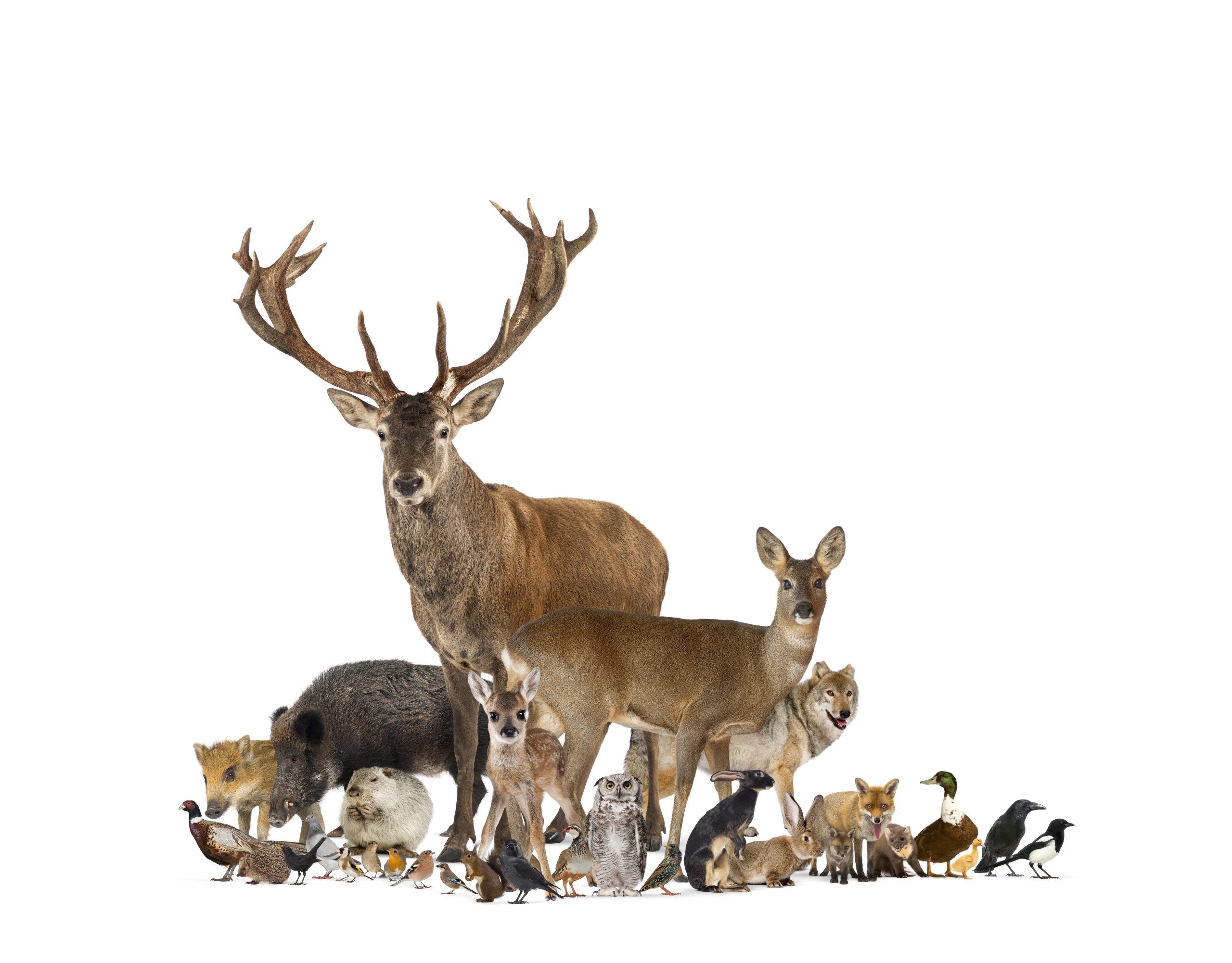
The hunting season for big game is almost over. Thousands of deer and boar had to leave the field. To the eye, their fate seems to be the conclusion of a cold calculation. Yet the hunt leaves no one untouched.
Low hangs the thin fog that shrouds the Veluwe in mist. Yellowish light from the crescent moon shines on the backs of the sheep that are still on their feet at this late hour – their bellies and legs are hidden from view by the patches of mist that cover heath and meadow.
Millions of twinkling stars shine their light in silence. On the border of forest and sand, only falling acorns and a darting rabbit cause some commotion.
Suddenly, a loud bang breaks the silence. The sound chases fiercely over the sandy soils. It reverberates between the trees, makes its way across the heath and then reverberates against the edge of the forest in the misty distances. Wherever it resounds, there is a swell. Nocturnal animals seem to hold their breath for a moment.
The sound from the Sauer must be heard far beyond Staverden. When it has died away many long seconds later, all that remains is some smoke curling up from the barrel.
Further on, motionless, lies a young deer. The graceful silhouette contrasts sharply with the cold forest floor. The hunter next to him goes deep. It is a breathless moment – the synthesis of nature and nature management.
Decimated
The meteorological summer of 2021 is on its way to its peak when Dutch media report that the Gelderland Fauna Management Unit is opening a large hunt on the Veluwe. Experts say that a surplus of boar and red deer threatens to unbalance the domain of big game. To keep nature and biodiversity in balance, a rigorous step is therefore needed: wildlife managers, wildlife management units and hunters must shoot thousands of animals. The boar population is hit hardest: 8800 rooters have to disappear. Of the more than 4600 red deer, 1600 are still allowed to live. The number of fallow deer must also be decimated: of the 1100 animals, there is room for no more than 400.
That sounds like a drastic decision. After all, deer and boar determine the appearance of the Veluwe. In addition, this is not the first time that some of the natural inhabitants of the country’s largest nature reserve have had to leave the field. In recent years, those involved have often set their sights on the animals. But the number of almost 9000 wild boars does not come out of the blue. What does such a decision therefore say about wildlife management in recent years? What considerations and considerations played a role? And which parties are involved?
Life-threatening
A spring evening in April. Dense rows of trees hide the Berkenhorst national hunting centre in Elspeet from view. A little further on, low barriers with urgent warnings keep hikers at a distance. There is a shooting range outside the passable paths. “Life-threatening”.
In the west, the sun retreats behind the horizon. A little further north, a young deer gracefully jumps over a fence. A final breeze touches the young green leaves. Then the silence descends. This is the moment when nightlife awakens.
But tonight the forest is not just for the animals. In small groups, men and women squat in the greenery at pre-arranged locations between the bushes. In the hunting shooting center they just received instructions for the annual game count. Armed with pen, paper and large night vision goggles, they now search for the animals that are on the road at dusk. Each deer produces a peat stripe. The final total of all pairs forms the input for the official fauna management plan. This will be published later this spring and will contain the hunting goals for the coming season.
The count is a snapshot, Erik Koffeman acknowledges. The secretary of the Gelderland Fauna Management Unit is responsible for drawing up the fauna management plan with a small team. The figures collected tonight help him to make a targeted estimate of the number of ungulates walking around in the Veluwe.
According to statistics, based on the carrying capacity of nature and road safety, among other things, about 450 red deer, 900 wild boars or 2250 roe deer are allowed to live on the North Veluwe – roughly the region between Elburg, Apeldoorn and Deventer. If there are more of one species, there is less room for the other animals. But the April 2021 ungulate count shows that there are already about 1500 red deer, to which are added the boars and roe deer. The estimate of this number is rather conservative, which is why Koffeman speaks of a “lower limit” – according to the wildlife manager, it is more likely that there are many more large ungulates to be found.
The Nunspeet-Harderwijk-Uddel triangle also has 1000 more deer than those involved find desirable. How is that possible? Koffeman blames it on years of underestimation. He cites the many trees in the Veluwe as the reason. “It is not an open plain and that makes a correct count very difficult. On an evening like this, you only see part of what is going on.”
If you underestimate the number of animals for a number of years, it will lead to extra animals that you have to “manage” in the following years, Koffeman adds euphemistically.
Nevertheless, roughly including a surplus in the count is not an option, according to the fauna manager. “You don’t want to destroy the population. But you have to cut it, otherwise you will soon fall behind the facts. Then the landscape will be eaten empty and road safety will be endangered.” He refers to the Oostvaardersplassen, where a surplus of game unbalanced nature. “In my view, the situation in the Veluwe is worse than there, but the trees disguise that.”
Nature management requires difficult choices, Koffeman knows from experience. He refers to a study by Wageningen University that states that a healthy population must consist of at least 4000 ungulates. “If we want 1000, we are too low. But a larger population is not feasible on the available surface, because that would put other animal species at risk.” He sees that the number of moles in the Veluwe is decreasing because there is less food left for them. “Boars steal the earthworms from under their noses, while they are an important source of food for moles.”
So, according to the fauna manager, people must intervene. “We have a non-natural system in the Netherlands. Except for the wolf, the large ungulates have no natural enemies here. Hunting replaces the role of those predators.” Human factors do play a role in this, he acknowledges. “Predators are opportunists. They go for the easiest prey, which are the most available. We look at the quality of the animals and whether there is a good population structure. We use human standards.” In practice, this means that not only weak animals are killed, but also young and powerful animals that could easily compete with animal hunters. So a beautiful antler is not a good gun, a beautiful coat an equally uncertain guarantee.
The use of “human standards” has a downside, as the conversations with numerous stakeholders show. There are allegations of tampering with the game figures and examples of wildlife management units imposing additional rules on hunters, making it practically impossible to shoot game.
“The game numbers in the corner between Staverden and the A28 have not been correct for fifteen years,” says big game coordinator Gerrit-Jan Spek, responsible for big game on the Veluwe. The remark fits in with accusations about fauna managers who delay the annual game counts to prevent beautiful red deer from being targeted. Spek: “Apparently there are parties that have no intention of really mapping out how much game there is.”
Mast harvesting
It is bleak on the Stakenberg in Elspeet when Spek tells his story. Rain and wind keep civilians inside. Only occasionally a car passes. An unexpected gust blows red, yellow and brown leaves from the oaks and beeches. Tapping softly, a few acorns land on the moss. There is a smell of fungi in the forest.
The mast harvest is bad this autumn. For years, boars had to deal with millions of kilos of acorns and beechnuts in the autumn, but due to the wet spring of 2021, experts calculate with only a quarter of the harvest from previous years. And according to Spek, that may still be too rosy: many beechnuts that fall also turn out to be immature.
“The Veluwe is out of balance,” the resident of Vaassen observes with regret in his voice. It is simply a fact that the mast harvest is poor. But the fact that there are almost only acorns and beechnuts to be found on the Veluwe is largely due to the grazers. “Red deer, fallow deer, wild boar: they all take their toll.” Spek does not want to lump the animals together, but sees how they all contribute to overgrazing of large parts of the Veluwe.
Nevertheless, Spek does not initially blame the animals for the clear-cutting. “The Veluwe was once a species-rich forest landscape,” says the expert on the local flora and fauna. “But Veluwe residents impoverished their living environment and fought soft deciduous tree species because they could not use them for wood extraction. What still grows in the Veluwe are mainly trees and crops that further acidify the emaciated soil.”
Plants that do help deacidify the soil are at the top of the deer and boar menu. They like to feast on them because they are healthy and easy to digest. But that is disastrous for nature, says Spek.
“Because the animals eat the seedlings, they can no longer grow. Moreover, there are so many deer and boar that they block the return of all kinds of plants and the associated organisms.”
Even in nutrient-rich years, it led to an imbalance between tree fruits on the one hand and grasses, herbs and soil animals on the other. So for several years now, the tourist attractions of the Veluwe have been forced to follow a diet that can best be compared to fast food – with minimal minerals and vitamins and maximum fats. It is tasty for a while, but then it is heavy on the stomach.
The fact that the abundant rainfall in the spring led to a bad mast increases the pressure on nature all the more, Spek notes. “Now that there are no acorns and beechnuts, the animals need even more grasses, herbs and soil life.”
In the past, ground elder, ribwort and blackberries flourished here, on the border of Nunspeet and Ermelo, according to Spek. They were ground up by hungry ungulates, which also reproduced abundantly and thus accelerated the crooked growth. The hazel and linden, important for restoring the soil balance, disappeared.
Spek observes the consequences far beyond the forest. “In large parts of the Veluwe, the blackberry no longer blooms. The bullfinches in my garden show how important flowering and fruit-bearing blackberries are. Even in winter, they still provide food in the form of seeds.” However, the food can no longer be found in the habitat of the boars.
According to the big game coordinator, native species are “eager” to come back. “In places where the deer and boar cannot go now, they flourish again. And that recovery can go wonderfully fast.”
But when native tree species, such as the forest willow and poplar, show themselves again after years of absence, they are especially vulnerable. In the middle of all the conifers, they are a delicacy for red deer. They feast on it en masse and thus prevent the trees from reaching full maturity.
“So we can scratch our heads,” Spek glooms.
Wildlife accidents
Yet at this noon only the animals scratch. On the edge of the main road between Nunspeet and Elspeet, roughly half a kilometre away, a mother boar and her three piglets are looking for food on the roadside. The meager harvest of acorns and beechnuts gives them a growling stomach even before nightfall. The sour aftertaste of the previous night causes internal discomfort. In search of filling and lighting, they therefore move further and further towards civilization to feast on plants and animal proteins.
It is a risk for the animals. In October, Spek, who used to keep track of the number of collisions with wildlife with the local police officer in Elspeet, registered a “historically high peak” in wildlife accidents.
However, damage to the eyes is not the only damage caused by the animals. Deer and boar also like to feed on the crops in the “agricultural enclave”, as the arable farmers around Elspeet are called in technical terms. Figures from Bij12, the implementing organization that, among other things, settles the fauna damage for all provinces in the Netherlands, show that in the Northwest Veluwe, almost 950,000 euros were paid out in the past four years to farmers who reported wildlife damage on their arable land.

That amount does not cover the more than 1 million euros in damage that the farmers claimed in total. The farmers themselves had to help financially. The costs for fencing to keep game off their land – sometimes without significant effect – were also borne by the company.
Big game coordinator Gerrit-Jan Spek can only draw one conclusion. The Veluwe biotope has become so unbalanced that wildlife management – and therefore hunting – is inevitable. Only in this way can nature recover.
That amount does not cover the more than 1 million euros in damage that the farmers claimed in total. The farmers themselves had to help financially. The costs for fencing to keep game off their land – sometimes without significant effect – were also borne by the company.
Big game coordinator Gerrit-Jan Spek can only draw one conclusion. The Veluwe biotope has become so unbalanced that wildlife management – and therefore hunting – is inevitable. Only in this way can nature recover.
Overpopulation
Dozens of kilometers away on the Veluwe, the forester of Staatsbosbeheer cruises in his dark green Volkswagen Amarok over the Veluwe sandy soils. Bart Smit could talk for hours about the Veluwe forests and its inhabitants. About large and small piglet litters. And about grazing pressure monitoring, feeding lines and forestry damage. But at the end of the conversation, some caution creeps into his voice. Because wildlife management may be inevitable, but it remains a sensitive issue.
Nevertheless, Smit does not want to avoid the subject. In the habitat of deer and boar, he sees with his own eyes the consequences of overpopulation.
Smit saw how the abundance of food in good mast years translated into high reproduction rates. Young piglets gained weight so quickly that they reproduced earlier than average. “Sows also sometimes gave birth to as many as eight piglets. Those are big throws. As a result, a population can increase by 300 to 400 percent in a year.”
It used to be quite normal for there to be the occasional poor mast year, Smit muses behind the wheel. “That helped to keep the population small. If there is less to eat, the boars come closer to civilization and are active longer.”
The forester is careful to attribute the good mast to a changing climate, but does detect a tendency. “It is less cold than it used to be and the heat periods last longer. That can play a role.”
The poor harvest of acorns and beechnuts does make hunting a bit easier this year, Smit acknowledges. Part of the boar population dies of certain starvation as a result; Another part is dazed by the lack of nutrition and therefore forms an easier prey.
Red deer are less affected by the skinny mast due to their more varied diet, but that nevertheless offers few guarantees of survival. In his domain, Smit sees how deer calves fall prey to the wolf. The newcomer to the Veluwe ecosystem has been eagerly hunting the young deer in recent years. They fell prey en masse to the predator, which has settled on the Veluwe for about four years. As a result, Smit hardly observes any deer calves anymore.
Nevertheless, the forester is not worried about the future of the fauna. “Game always wants to survive,” says Smit. “It will find a way.”
Naturalist guide
Back to the heart of the Veluwe. Days of rainfall have turned the paths in the Leuvenumse Bos into large mud puddles.
Now that it is dry for a while, dog owners, parents with children and tourists venture into the old deciduous forest just before sunset to enjoy springs and streams. The kingfisher – a permanent resident of this area for years – will not show itself tonight.
A nature guide sees his chance and seizes the first dry summer evening in weeks to tell his story to anyone who wants to hear it. With photos and objects, the guide gives passers-by visual education about the local flora and fauna. Skeletons of deer and roe deer heads protrude from a brown wooden box, some with the antlers still on. “Hunting is deadly” says a sticker in cow letters.
The enthusiasm of the guide is contagious. Passers-by receive a trail map with hoof prints of all wild animals they may encounter. Tough boys without exception choose a card with wolf prints.
A few weeks later, however, nothing is left of the enthusiasm of the guide. When asked about his vision of hunting, a minute-long tirade about hunters and hunting follows.
He spews his bile about the laxity with which landowners would keep track of their property boundaries. Especially in a village like Elspeet, where people are strict in doctrine but have no problem killing animals. “Recently, a fence was destroyed at Laag Kerpel,” fulminates the nature lover. “And what is the result? That extra animals have to be shot again. As long as they don’t have a voice, I’m their voice.” Anonymously, that is.
Fear
In the discussion about hunting that is being conducted in the Netherlands, supporters and opponents seem to have dug themselves in. Phone calls and personal conversations conducted for this article make the mutual fear almost tangible. Hunters and proponents, no matter how pragmatic, only want to have a conversation for background information
or on condition of anonymity. They know the stories of supporters who were made miserable by opponents after a media appearance. Some hunters refer directly to interest groups. Other parties open a conversation with a charm offensive in which the emphasis is on the sustainability and animal-friendliness of contemporary hunting techniques. Repeated attempts to find a hunter who is willing to tell his story openly come to nothing.
Opponents, in turn, speak almost indiscriminately about the rights of animals and detest hunters. “Dutch hunters don’t stand for anything,” fulminates the nature guide from the Leuvenumse Bos. “If they are not afraid to shoot a living creature, why would they spare a human being? And besides, they only dare to have the conversation with their gun in hand.” That his kindred spirits are not devoid of intimidating practices seems fair to him. Hunters must be stopped at all costs. They are the modern-day Nimrods, who ruthlessly destroy the animal kingdom with their violent practices.
Pseudonym
Yet nothing in Freek Jansen’s living room is reminiscent of the great man from Genesis 10. Boar teeth, deer and roe deer skulls and other paraphernalia adorn the living room of the modest hunter. Jansen makes no secret of his hobby, but in recent years he has seen too often how the strong negative sentiment surrounding hunting – with mutual rivalry and opponents who do not hesitate to openly threaten hunters – has caused unrest. The Veluwe hunter is not convinced that his story will change that. And although he does not immediately fear reprisals from animal rights activists, for safety reasons he only tells his story under a pseudonym.
Hunting was instilled in him from an early age, says Jansen. “When my father used to go hunting small game with acquaintances from the neighborhood, I participated as a driver to get the animals moving.” Later he obtained his hunting license himself and got his own hunting ground. On it, he takes care of wildlife management and damage control together with farmers.
The latter in particular is an important part of hunting, says the hunter. When he puts on his hunting suit in the evening and goes to his hunting field with his bullet rifle, he sees with his own eyes how the animals trample crops and eat tops from the growing corn. What is damaged no longer grows and no longer provides the farmer with feed for his own animals. That is why there is a widespread insistence on an effective hunting policy. But indiscriminate shooting is not an option, Jansen emphasizes. “There is a whole organization behind it.”
The hunter explains how regional wildlife management units give substance to the wildlife management plan, which the fauna management unit drew up in the spring. They make a subdivision for each hunting field and set additional restrictions. Only when an animal meets all the conditions, the hunter is allowed to shoot it.
And so it happens more than once that the Veluwe resident returns from his hunting field undone. Because no matter how much red deer there may be, he cannot afford to shoot a doe if the rules dictate that it must be a deer. Or to target a lactating sow. If he does, he can write his hunting license on his stomach.
All these restrictions not only require even more caution from hunters, they also limit the number of animals that can be shot in practice. As a result, many animals remain out of harm’s way every year – fauna management plan or not. They reproduce and, together with their young offspring, reappear in the wildlife figures in the next year, which are therefore again out of line.
All restrictions require thorough preparation from the graying hunter. “You have been making an inventory all year round,” says Jansen. “Where is the game, where do the animals live, where do they come out of cover and where do they enter your field?”
Based on observations, he sets up places where he can cut off hungry deer at dusk.
High seat
That’s why Jansen is hiding himself this evening near a piece of arable land. A gust of wind brings a light forest scent from across the fields.
The hunter vigilantly scans the surroundings. A few evenings he waited in vain for the large grazers, but this evening it is a hit. Shortly after darkness falls, rustling and the crackling of breaking branches betray the approaching arrival of a pack of deer. Moments later, the animals jump out of the cover. Unsuspectingly, they make their way to the farmland. In the high seat – an improvised hunting cabin – the tension rises to a peak.
The hunter carefully observes the pack. Then he aims his rifle. Still, unexpectedly, a shot cuts the silence to shreds. For a moment there is confusion on the land, then the deer continue to eat quietly. A few meters next to them, a dark shadow lies motionless on the ground. The pungent smell of gunpowder vapor slowly drifts away.
“You never shoot in the middle of a pack,” Jansen later teaches. “As a hunter, you try to imitate natural selection. A prey animal always takes an animal from the back of the pack.” That is why he set his sights on a “pointer” jargon for a one-year-old deer calf with incipient antlers. The odd one was still low on the ladder in the hierarchy and stood out because it grazed on the edge of the pack.
That’s why Jansen is hiding himself this evening near a piece of arable land. A gust of wind brings a light forest scent from across the fields.
The hunter vigilantly scans the surroundings. A few evenings he waited in vain for the large grazers, but this evening it is a hit. Shortly after darkness falls, rustling and the crackling of breaking branches betray the approaching arrival of a pack of deer. Moments later, the animals jump out of the cover. Unsuspectingly, they make their way to the farmland. In the high seat – an improvised hunting cabin – the tension rises to a peak.
The hunter carefully observes the pack. Then he aims his rifle. Still, unexpectedly, a shot cuts the silence to shreds. For a moment there is confusion on the land, then the deer continue to eat quietly. A few meters next to them, a dark shadow lies motionless on the ground. The pungent smell of gunpowder vapor slowly drifts away.
“You never shoot in the middle of a pack,” Jansen later teaches. “As a hunter, you try to imitate natural selection. A prey animal always takes an animal from the back of the pack.” That is why he set his sights on a “pointer” jargon for a one-year-old deer calf with incipient antlers. The odd one was still low on the ladder in the hierarchy and stood out because it grazed on the edge of the pack.
Burl
A bright full moon shines on the meadow on the outskirts of Staverden. On the sandy path, which separates nature from civilization, people crowd together. Less than 100 meters away, a group of hinds comes out of the cover. With a graceful leap, the animals take the fence that is supposed to protect the almost ripe corn from hungry intruders.
From far and wide you can hear the mighty burl of rutting deer. In the middle of the night, they defend their habitat and try to impress friend and foe alike. The primal sounds, which seem to come from the depths of their bodies, sometimes last for minutes and roll from left to right through the otherwise silent night. Some tourists traveled hundreds of miles hoping to see for themselves how the mighty deer put their antlers in their necks and let off steam. They are not disappointed.
The bellowing continues for hours. Then deer and hinds go back into the cover. What goes on there can only be guessed. A few more months. Then a new generation will take office.


