

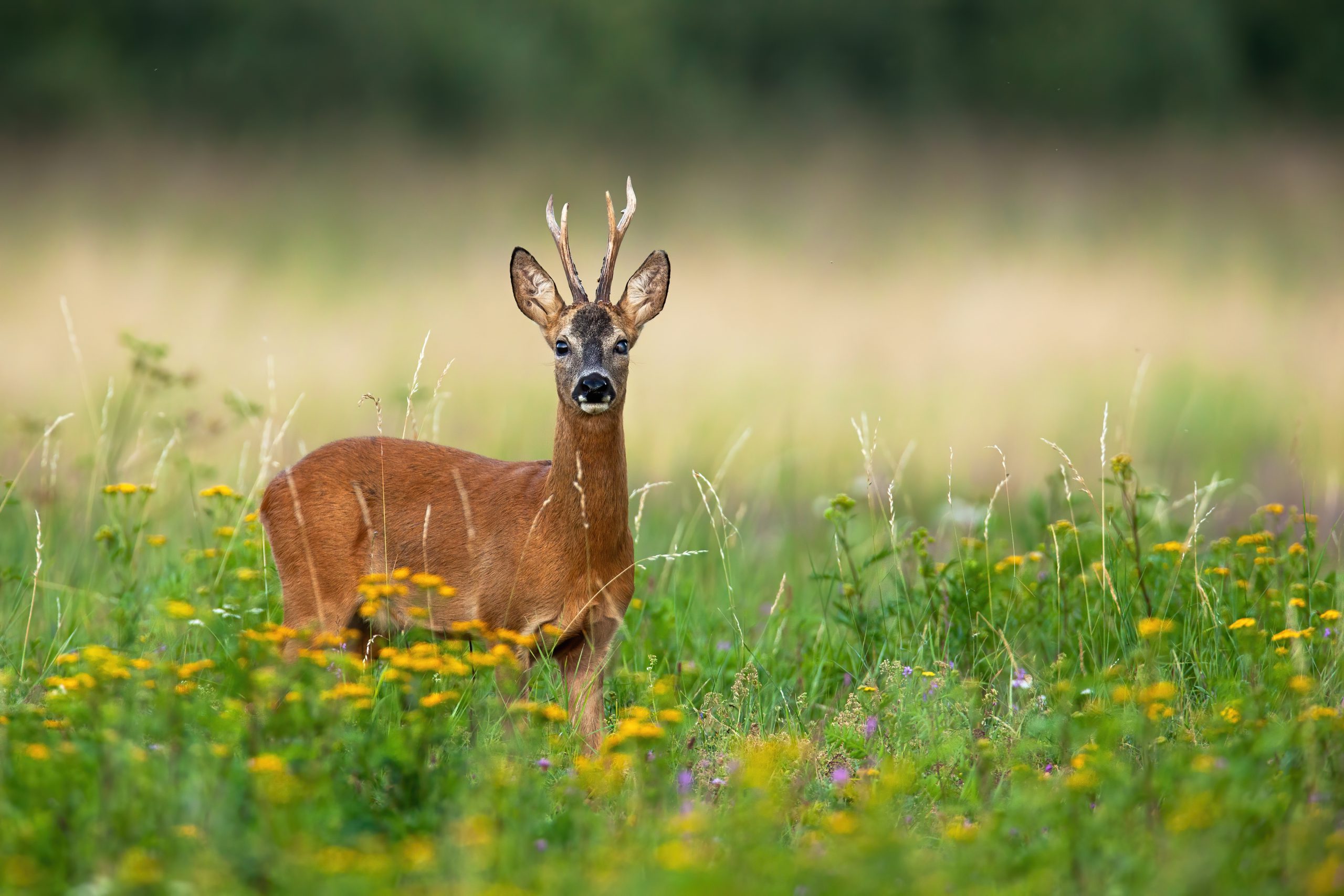
With a leash obligation for dogs from 2023, the Brussels Region wants to boost the languishing roe deer population in the Sonian Forest. To compensate, there would be off-leash zones. Brussels Environment is also carrying out a study to look at further reasons for the decline in the number of roe deer. Phototraps and hormones are used for this.
Since 2008, the number of roe deer in the Sonian Forest has been monitored through a partnership between the three regions. The number of roe deer in the Brussels part of the Sonian Forest is experiencing a gradual decline, which has accelerated since 2020.
While there was still 1.1 roe deer per square kilometre between 2008 and 2013, it was only 0.6 between 2017 and 2020. In 2021, that number dropped to 0.5 per square kilometer. According to the scientists, it is not a decrease in the number of observations, but a real decrease, said Environment Minister Alain Maron (Ecolo) on Wednesday in the Environment Committee, in response to a question from MP and party colleague Ingrid Parmentier. In less than ten years, there are therefore twice as many roe deer in the forest.
20 to 30 attacked roe deer
The main causes of death in the roe deer are stray dogs that attack the animals, and collisions by motorists. It regularly happens that a startled deer (by a dog or something else) walks onto the highway in and around the forest and is hit there. Forest rangers keep track of this as much as possible, but are not always informed. Only in the Brussels part of the forest, reports Brussels Environment, twenty to thirty deer are attacked by dogs every year.
That number has risen sharply in 2020, not only in the Brussels part but in the entire forest, and by extension also in other forests.
Brussels Environment has asked the non-profit organisation Wildlife and Man, which monitors the population, to study the causes of the decline of the roe deer population. Scientists see several possibilities that influence the birth and death rate within the population: the recreational pressure of an increasing number of cyclists and walkers, stray dogs, and possibly also disturbing or attacking wild boars. The wild boars are a fairly recent appearance in the forest.
Phototraps and hormones
To find out the exact reasons for the declining roe deer population, two research methods will be combined. On the one hand, photo traps will be installed in random places. This should make it possible to compare with the roe deer populations in other Belgian forests, such as the Meerdaal forest or the Hoge Kempen National Park.
In addition, doses of glucocorticoids (hormones) will be administered to roe deer “in a non-invasive manner” in order to determine the stress level within the population.
Brussels Environment is also working on a revision of the Forest Code, which should be completed in 2023. The idea is to streamline legislation in the three regions. Dogs would also have to remain on a leash in the Brussels part of the Sonian Forest, “which seems essential to reduce the pressure on the roe deer population,” says Maron.
Off-leash zones
In 2008, the three regions already agreed that they wanted to harmonise forest legislation in the Sonian Forest, which extends over the three regions.
Just as is the case with mushroom picking, the rules currently differ around whether or not to let dogs loose in the forest. In Brussels, a dog owner is allowed to let his pet roam freely in the forest, “as long as it has its animal under control”, in the other regions this is not allowed. This description dates from 1995 and is difficult to evaluate objectively, the minister acknowledged in the same committee in response to a question from MP Els Rochette (One.brussels).
Due to the current context, and at the express request of the foresters in the forest, Brussels is now working on a standardization of the rules. This should make the legislation clearer for visitors to the forest, and at the same time reduce the pressure on fauna and flora.
To compensate, Minister Maron provides clearly demarcated off-leash zones for dogs in or near the Sonian Forest, which must be in place before the general off-leash ban comes into force. A working group coordinated by Brussels Environment will work to weigh up animal welfare, the ecological function of the forest and its social function.