


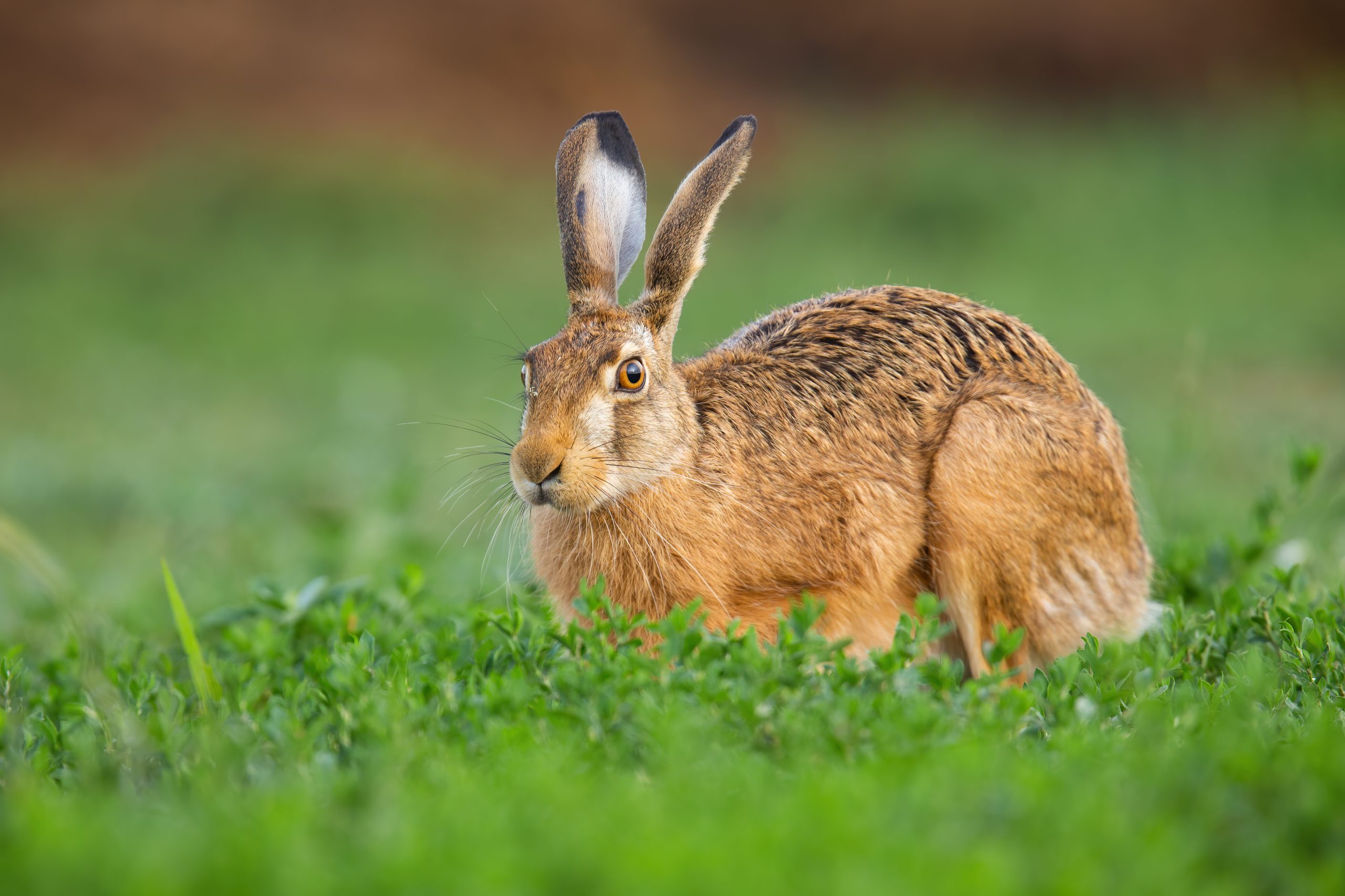
The agricultural sector was again criticized yesterday by the Ministry of Agriculture, Nature and Food Quality because things were said to be going badly for hare and rabbit. If you look deeper, you will see that there is a scientific double standard.
According to Minister Van der Wal of Nitrogen and Nature, things are not going well with hare and rabbits in the Netherlands. She writes: ‘The main causes are habitat loss, reduced habitat quality and the effect of predators. This is partly due to the intensification and increase in scale of agriculture, changes in the landscape and agricultural machinery.’
The minister bases this on a report drawn up by Wageningen Environment and Research on behalf of the ministry, after the Mammal Society placed hare and rabbit on the Red List two years ago. There was something to be said for the rabbit, because it has deteriorated sharply due to illness. This is omitted in the letter to parliament and in the summary of the report, so that the focus is mainly on agriculture. The ministry thus seems to be using the report to reinforce its own policy on the agricultural transition that it considers necessary.
Parrot
Anyone who reads the study concludes that the researchers have not investigated the causes at all. They only cite other research reports on the causes. That is now a tried and tested recipe, which makes you think that there is new evidence but it turns out to be the same every time. In the case of hare, it is striking that three reports report a decline of 61 percent since the 1960s. Nowhere in the Basic Report Red List, where the 61 percent is listed first, is there an analysis on which the 61 percent decrease is based and there is no reference to the data used. Partly because of this, the case of hare and rabbit seems to be deliberately working towards the decision to remove them from the game list. In Limburg, Utrecht and Groningen, hunting for the coming season is already excluded. However, the scientific substantiation is quite shaky.
Data
The biggest omission is that there are no reliable counting data of rabbits and hares. I wrote a column about this earlier when the new Red List was published. My conclusion was that hare only got on the Red List because the base year that was compared with was changed from 1960 to 1950. So not because the hare has been doing worse in recent years.
The Wageningen researchers are now again basing themselves on the same data and results, and then you see that certain data are not included in determining a trend for scientific reasons, while other data that also have all kinds of snags are. Uncertainties that can also explain the outcomes that do not fit into the picture of deterioration are also omitted. A few examples.
Breeding bird counts
To find out how the hare is doing, the researchers rely on data from the Meetneet Urban Species (MUS) and the Breeding Bird Monitoring. Within MUS, breeding birds are counted within the urban environment. If there happens to be a hare walking around there, it can also be imported. Because hares occur outside urban areas, the Breeding Bird Monitoring is a more interesting source, but here too the goal is to count breeding birds and not hares and rabbits. Hares are bycatch and not the purpose of the count. The researchers completely ignore this. Unjustified in my opinion and this is also evident from my non-representative sample within my own working group of partridge counters.
Hares not imported
For three years I have been the teller of partridges for Sovon in the Achterhoek. I asked this morning who imports other species besides partridges. Within half an hour, six counters responded. One entered everything, one only hares because it had never seen a partridge in its counting area and the other four only imported partridges. I think it is the same in many other counting areas. I have been introducing them myself since this spring, because I now know that government policy is based on them. But of course, these data are not very scientific. However, because there is a protocol for these counts, the researchers conclude that the quality of this data is very good and can therefore be included. The CBS then also put a stamp on it and then it is truth.
Fauna management units
Data from the Fauna Management Units, which do include targeted counts of hares and rabbits by hunters, have not been included. According to the researchers, this data is not validated and reliable enough. Inquiries with the Hunters’ Association reveal that hunters throughout the country count several times a year. However, the counting protocols are different for each Fauna Management Unit. As a result, there is no uniformity and CBS cannot put a stamp on it. Instead of researchers looking closely at what you can do with that data, they have now thrown it in the trash. The Mammal Society did the same two years ago.
Habitats directive
According to this selective data selection, the bottom line shows that the hare population is declining by 1.2 percent annually. Because that is more than 1 percent, the researchers conclude that the conservation status is very unfavourable. This is new in this study, because hare and rabbit have not been looked at in this way before. But there is also a caveat to this. This 1 percent rule is derived from the conservation objectives derived from the Habitats Directive, which concerns species that are threatened with extinction. Why the researchers have applied this strict guideline to species that are common is a mystery. Here, too, different choices could lead to different outcomes.
Culling figures
The report states that in addition to counts, culling data were also used, but only up to 2011. The culling figures of the following years are no longer known, although they are known. Again, the explanation for this is lacking and the researchers seem to have only looked at the report of the Mammal Society instead of requesting data themselves. According to the Mammal Society, these culling figures, which have been available since 1960, would show that these figures are sufficiently reliable to be seen as figures about how many hares occurred in that period. However, the research on which this association relies has not been published publicly. So other scientists cannot see how it came about and repeat the research to find out if it is correct. By not including the culling figures from after 2011 and then only basing yourself on bycatch from breeding bird counts, it feeds the idea that unwelcome data is not included.
Counting points halved
A final example is about the reliability of the figures. How many people actually count? Has that increased or decreased and could there also be an explanation for changes? In Limburg, for example, the number of counting points has halved in the past 12 years. And I have not yet mentioned that the behavior of the animals may have changed due to the increased crowds in the rural area, for example due to recreation. Then they are there, but they have become more nocturnal. There is nothing about that in the report either.
All data on the table
Well, to focus on the agricultural sector again as a bogeyman makes me think. The minister would do well to make all data public and ask the researchers to make their own analysis instead of parroting other researchers and a mammalian interest group. In any case, I do not recognize the ‘very unfavourable conservation status’ when I look over the meadows and fields.