

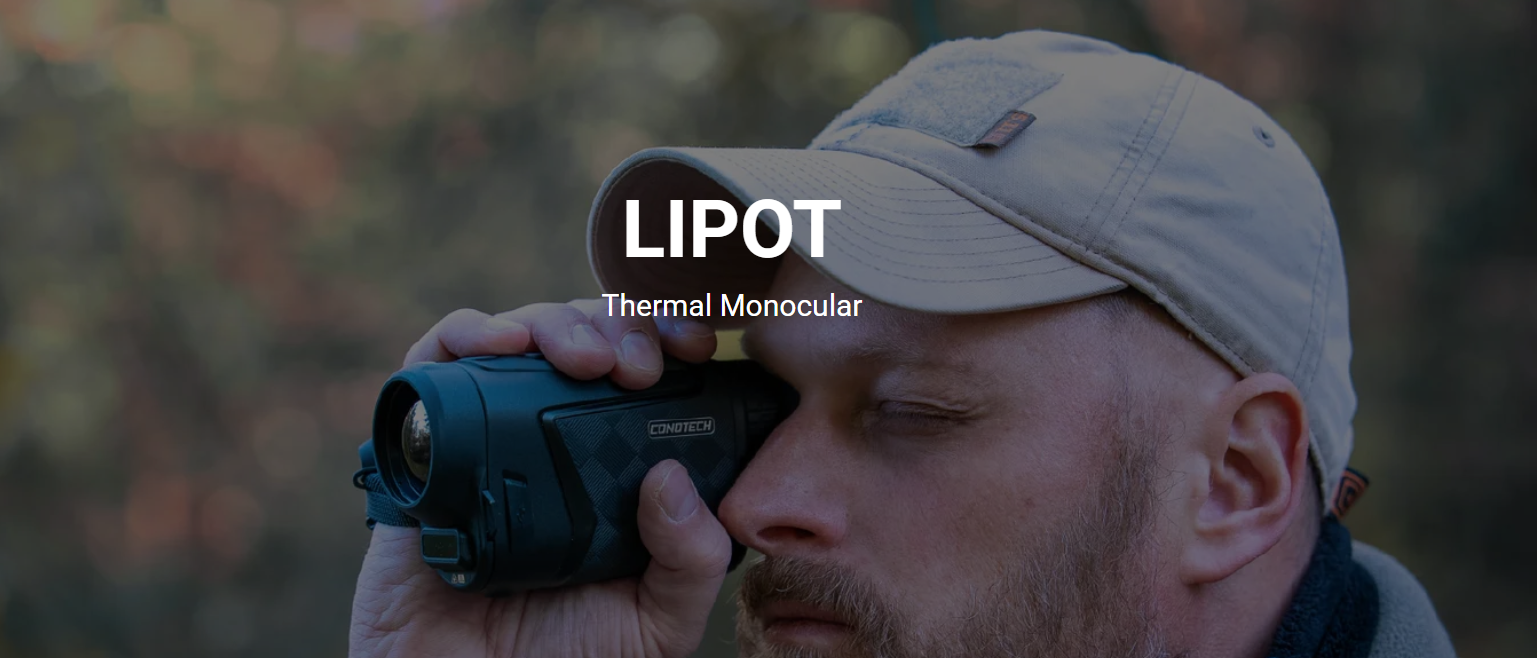
CONOTECH Lipot Series: Thermal Imaging Viewing with AI Autofocus
The thermal imaging market continues to develop rapidly. Higher sensor resolutions, better image processing and more compact devices have become almost standard in the meantime. With the new CONOTECH Lipot series , however, CONOTECH is trying to make a difference in another area: automatic focusing using AI.
For hunters who regularly switch between short and longer distances while observing, this can be a particularly interesting feature.
AI Focus: automatically a sharp thermal image
One of the most important novelties of the Lipot series is the so-called AI Focus technology.
Many classic thermal imaging cameras require the user to manually turn the focus ring when an animal is at a different distance. When searching a field, forest edge or large open plain, this means that you have to refocus regularly.
The Lipot takes a different approach. At the touch of a button, the system analyses the image and automatically focuses the camera. According to CONOTECH, the system adapts to changing distances and conditions.
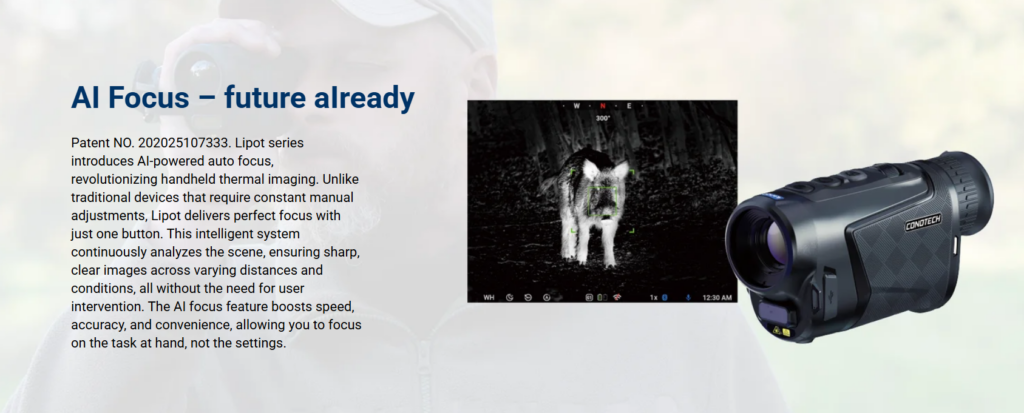 For the hunter, this mainly means: less attention to the settings of the camera and more attention to what is happening in front of you.
Three models: Lipot 325LRF, 335LRF and 635LRF
The Lipot series consists of different versions, so that a suitable version is available for both short observation distances and for use in larger open areas.
The Lipot 325LRF has a 384 × 288 sensor and a 25 mm lens. With a basic magnification of 2.5x and a relatively wide field of view, this is an interesting choice for wooded areas and situations where you regularly observe at shorter distances.
The Lipot 335LRF also combines a 384 × 288 sensor with a 35 mm lens. The basic magnification is 3.5x. As a result, this model is more focused on observation at greater distances.
If you are looking for a higher resolution, you will end up with the Lipot 635LRF. This version has a 640 × 512 thermal sensor, a 35 mm objective and a base magnification of 2x. The larger number of pixels provides more detail and at the same time gives a larger image than the 335LRF.
All models work with a 12 μm detector and an image frequency of 50 Hz.
Highly sensitive thermal sensor
CONOTECH specifies a NETD of less than 15 mK for the Lipot series.
A low NETD value is important when the temperature differences in the landscape are small. Think, for example, of humid evenings, foggy conditions or a forest environment where the background temperature is close to that of the wild.
It is precisely under such conditions that a sensitive sensor must be able to convert small temperature differences into visible details.
Built-in Laser Distance Meter
The designation LRF stands for Laser Range Finder. The Lipot cameras have an integrated laser rangefinder.
This is particularly useful during hunting. With thermal imaging it can sometimes be difficult to estimate distances correctly, especially at night or when you have few landmarks in the landscape.
The rangefinder can both take individual measurements and measure continuously while observing.
Full HD OLED display
The image is displayed via a 0.49-inch OLED display with a resolution of 1920 × 1080 pixels.
A good viewfinder is at least as important as a good sensor. A higher resolution makes it more pleasant to observe for longer periods of time and helps to distinguish small details better.
In addition, CONOTECH uses its proprietary EYEC-II image algorithm, which further processes the thermal image to improve contrast and detail reproduction, among other things.
Less than 300 grams
Another strong point of the Lipot series is its size.
The cameras weigh less than 300 grams, according to CONOTECH. This makes them particularly compact for thermal imaging cameras that have both autofocus and a laser rangefinder on board.
For hunters who already take binoculars, weapons, ammunition and other accessories with them during a bear hunt or long observation evening, any weight saving is welcome.
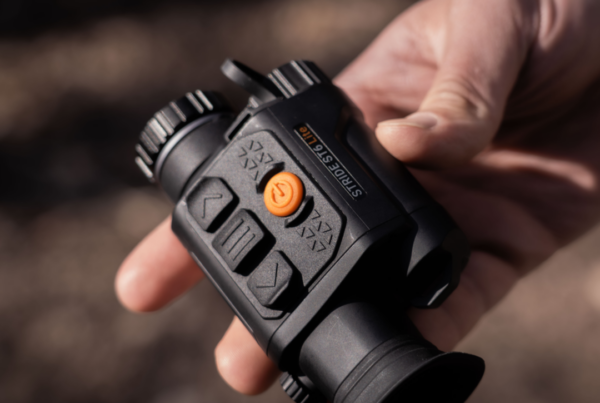
The controls are also designed for one-handed use. In addition to three control buttons, the Lipot has a rotary knob that allows you to quickly navigate through the various settings.
Removable 18650 battery
The Lipot runs on a rechargeable 18650 battery and offers up to about 6 hours of runtime, according to the manufacturer.
The advantage of a replaceable battery is clear: during a long hunting day or observation session, a spare battery can easily be taken with you and exchanged.
Photo, video and WiFi
In addition to observing, the Lipot can also capture images. The camera supports photo and video recording and has WiFi.
Recordings can also be viewed and deleted directly on the device. This is useful when you want to check the recorded image immediately after an observation without first using a smartphone or computer.
Which CONOTECH Lipot suits which hunter?
The choice between the different models depends mainly on the terrain you are hunting.
Lipot 325LRF: interesting for forest, mixed terrain and observations where a wide field of view is important.
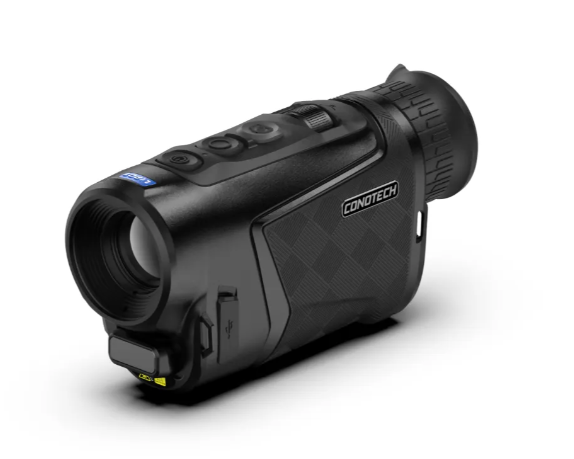
Lipot 335LRF: interesting if you observe more often at a greater distance and want more optical magnification.
Lipot 635LRF: the most interesting choice for those looking for maximum image quality and detail recognition thanks to the 640 × 512 sensor.
Conclusion
With the Lipot series, CONOTECH brings together a number of features that are of interest to hunters: a highly sensitive thermal sensor, integrated laser rangefinder, Full HD OLED display, low weight and above all the new AI autofocus.
The latter is perhaps the most striking part of the series. Instead of constantly focusing manually while observing, the camera takes over much of that work.
This can be an advantage, especially when quickly searching a hunting area. You take the camera out of your jacket pocket, search the terrain and can concentrate on recognizing and assessing the game.
With the 325LRF, 335LRF and 635LRF CONOTECH also offers three variants with which the Lipot series can be used for both forest hunting and observation over larger open plains.