Weapons – Pellet Guns

All about pellet guns.

Pellet guns

Bullet Calibers

The Calibers are not only useful to know which ammunition fits which rifle, but also provide an overview of the history of the development of the current Hunting Weapons.

Parts Bullet

The most important thing is the diameter of the ball, which makes up the caliber. This is expressed in mm or in inches. With this last designation, (almost) always in decimals. And since these are usually American calibers, the designation with a . (dot) (our “,” for decimals). Hence the name .22 or .300, pronounced point 22 or point 300.

A second indication is the length of the case (in mm) as with 8×57, diameter of the ball 8 mm and length of the case 57 mm, length usually preceded by the x (times). Name is then 8 times 57.

300 Win Mag

Especially the bullets of American manufacture have a name with only the bullet diameter (in inches) followed by some indication, which has little to do with the caliber. This indication varies from the powder charge over the year of first use to a completely arbitrary addition such as JRS or NATO.

Below are some striking examples of remarkable calibers. Certain calibers are included here either because they are frequently used or because the history is very intriguing within Hunting.

Below are some striking examples of remarkable calibers. Certain calibers are included here either because they are frequently used or because the history is very intriguing within Hunting.

.22 250

The point 22-250 is now a bullet that is used to shoot smaller game (predators, such as foxes) at long range. The bullet is a rather light caliber, but the shell (and therefore the powder charge) is quite heavy

.22 250

The 22-250 is based on the 250-3000 Savage whose neck was reduced to a .22. The 3000 savage comes from the former manufacturer Savage Arms and the fact that the original 1915 bullet reached a speed of 3000 ft/s (910 m/s), with a bullet of 87 grain (5.6 g). The naming of the .250 comes from a reduced and shortened .30-06 shell.

For the sake of completeness, Savage produced the first hammerless rifle with his “Model 1895”.

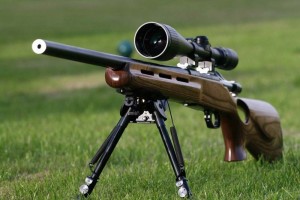
The complete equipment of the .22 250 is not complete with a “large” scope to shoot up to 300 meters. A target of 8x32x56 (such as the 8x32x56 swat mildot parallax from Accushot) with a magnification of up to 32x and an objective lens of 56mm is not a luxury but a necessity. Also notice the stabilizing feet in the front for better marksmanship.

30-06

The 30-06 is actually a latecomer. A few years earlier (France in 1898, Germany 1905) a pointed arch was designed for better air resistance. It was not until 1906 (hence the 06) that this bullet was standardized in the American army. The first digit “30” refers to the diameter of the ball, 30 hundredths of an inch or 7.62 mm.

Its popularity in the hunting world is mainly due to a few characteristics. The bullet size ranges from 7.1 g to 14.3 g (100 to 220 grains). But especially the recoil energy that is 27.3 (with a 10 g bullet from a 4 kg heavy rifle) remains just around 27 Joule. And this 27 Joule recoil energy is considered as a limit acceptable by most shooters.

Round & Pointed ball design (early 20th century)

While we’re talking about recoil, a word about Mag-Na-Port. This technique provides reduced recoil and the ability to reload faster for the next shot. This is due to the installation of trapezoidal and oval openings at the end of the barrel (Mag-Na-Port) or a series of round holes (Man-Na-Brake). This technique ensures the optimal removal of the gases propelled by the ball before they leave the barrel head-on.

Mag-Na-Brake

30-06 (France)

The 30-06 has been allowed for hunting in France again since the law of 06 March 2012. Please note that the implementation will enter into force on 07 September 2013 at the latest (Article 33). “In concrete terms” this means, in accordance with French law, that the 30-06 and other military calibers are released for hunting AT THE LATEST on 07 September 2013. Unlike in Belgium, it is customary in France to promulgate a law with a limit on the implementation date which means that – implementing decrees or not – the law enters into force on the expiry date provided for by the “Assemblée Nationale et Sénat” and promulgated by the “Président de la République”, as is the case in the present case. So not yet before this hunting season, but absolute certainty after September 07, 2013.

Consult also the attached 30-06 document in this regard.

30-30

This caliber has a ball diameter of 30 hundredths of an inch or 7.62 mm. The second 30 indicates the powder charge, namely 30 grains (100 grains is 6.48 grams). The 30-30 was, and still is, popular for shooting Deer at close range. This has a lot to do with the fact that deer are quite common in dense forests where shooting can only be done at short distances anyway. For larger big game species (Black or Red deer) this calibre unfortunately does not have enough energy (2,200J at 100 meters), at best 1,850J with factory ammunition.

8×57 yrs & 8×57 yrs

This is a special one. The numbers and letter have the following meanings:

  • 8: Ball diameter, 8 mm;
  • 57: length of the sleeve, 57 mm;
  • j: formerly used by the Infantry “J”;
  • r: Rim sleeve (for chicken barrel rifle);
  • S: “S” type cartridge – calibre 8 which has a larger diameter than the regular 8×57 yrs

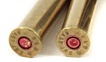
The 8×57 yrs have a ribbed ring just above the case as identification, and a black one (German manufacture) or it has a red percussion cap (Czech manufacture).

8×57 JRS Rib

8×57 JRS Percussion Cap

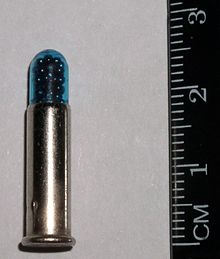
.22 Ratshot

As a special caliber among the Shotguns we have the Smoothbore Bullet, a bullet that is fired in a Shotgun. And, there is a counterpart, so a hail load that is shot with a bullet, the .22 Ratshot.

The Hail bullet is fired with a rifle, but can also be fired with a pistol or revolver. The use is limited to the extermination of vermin such as rats, snakes or other harmful rodents or birds. The advantage is the light charge that does not make holes everywhere in walls and wall plates.

Since this is usually fired from a .22 Longrifle with rim fire, this type is not allowed in Belgium.

.22 Ratshot

.300 Win Mag

The well-known .300 is called in full .300 Winchester Magnum or abbreviated .300 Win Mag. And as the name indicates a product of Winchester the rifle and ammunition manufacturer, launched in 1963.

The basis was the .375 H&H Magnum hull, from 1925, which was blown out and shortened and whose neck was reduced to a .300.

This also created the “problem” of the .300, namely a neck that was shorter than the diameter of the bullet (.264 versus .300).

But despite this technical “shortage”, the .300 was still a success. Not only hunters, but also sports shooters, soldiers and police services. The latter especially for Long Range and sniper assignments.
The competition in this caliber is the more powerful .300 Weatherby Magnum and the newer .300 Remington Ultra Magnum. However, the original .300 has won several 1,000 m competitions since its introduction.
The only downside is the recoil. With an energy that is about 40% greater than the 30-06. This brings this caliber to the upper limit of what is permissible (with prolonged use). But with modern running with reduced recoil (Mag-na-port) and energy absorption in the stock and absorbent pump shoe.

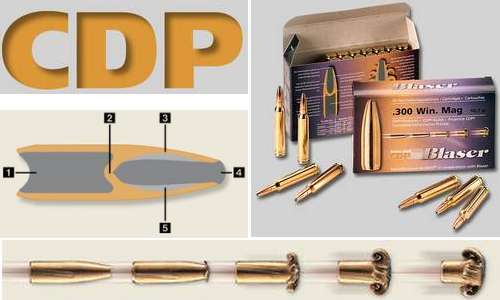
In terms of bullet, there is recently the new CDP with Controlled Deformation Process. This causes a mushroom formation or deformation depending on the “body” that is hit. Or smaller with Roe Deer, larger with Deer and Sus Scrofa.

.338 Win Mag – .300 Win Mag – .375 H&H Mag

.300 Win Mag – detail

.300 CDP

.950

This is indeed an American Caliber, in inches – or 2.4 cm.
It is therefore only approved in America as a Hunting Caliber “Sporting Use Exception”. The question still remains what you want to shoot with this?

It is unique in every way, only 3 barrels have been made and the ammunition is also not commonly available at the gun shop.

  • The bullet weighs 3,600 “grain” (about a 1/4 kg), compared to 150 grain for a normal .300 Win Mag;
  • The load is 240 grains of powder, compared to 80 grains for the .300;
  • Cost per bullet is about 40 euros;
  • The full rifle weighs about 50 kg;
  • The recoil is about 270 Joule, compared to 27 at the reference, our .300;
No permit yet?

Jachtexamen.be is the online learning environment for hunting, providing optimal exam preparation.